Acetaminophen and Liver Disease: How to Dose Safely to Prevent Hepatotoxicity
Acetaminophen Daily Dose Tracker
Medications Taken (Last 24 Hours)
You are currently within the safe dosing limits for your profile.
It sounds crazy, but one of the most common medicines in your kitchen cabinet is also the leading cause of acute liver failure in the United States. Whether you call it Tylenol, paracetamol, or simply "the stuff for a headache," Acetaminophen is a powerful tool when used correctly, but it has a dangerously narrow window between a dose that helps and a dose that harms. If you already have liver issues or enjoy a few drinks a week, that window shrinks even further.
Key Takeaways for Safe Use
- The absolute maximum dose for a healthy adult is 4,000 mg in 24 hours.
- If you drink alcohol or have liver disease, your safe limit may drop to 2,000 mg.
- Many cold and flu meds contain "hidden" acetaminophen, leading to accidental overdose.
- Severe liver damage can occur if glutathione stores are depleted by too much medication.
- Acetylcysteine is the critical antidote if an overdose is suspected.
Why Acetaminophen Hits the Liver So Hard
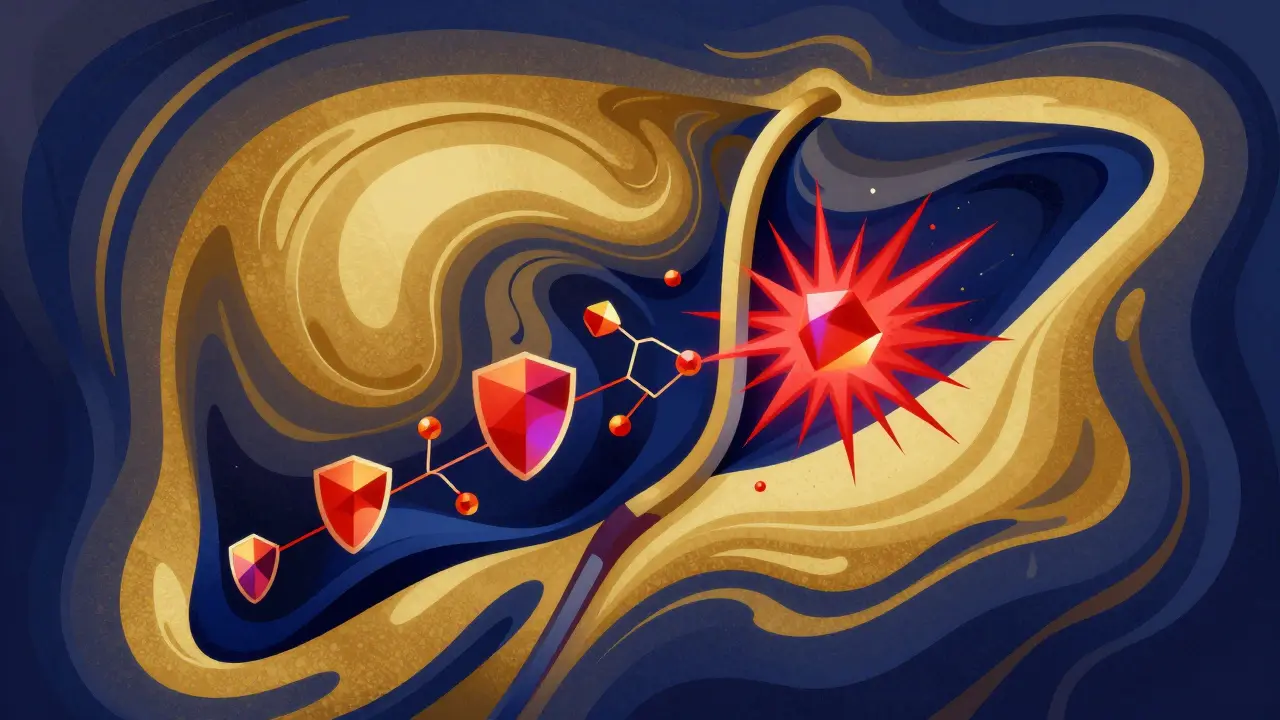
To understand why this drug can be toxic, we have to look at how your body processes it. Normally, your liver breaks down acetaminophen using two safe pathways called sulfation and glucuronidation. But when you take too much, these pathways get overwhelmed. Your body then switches to a backup system involving Cytochrome P450 enzymes.
The problem is that this backup system creates a toxic byproduct called NAPQI (N-acetyl-p-benzoquinone imine). Your liver has a natural defense against NAPQI-a substance called Glutathione-which neutralizes the toxin. However, once about 70% of your glutathione stores are gone, the NAPQI starts attacking and killing liver cells, leading to Hepatotoxicity (liver damage).
The "Hidden" Overdose Trap
Most people don't intentionally take 12 grams of acetaminophen to hurt themselves. Instead, they fall into the "combination trap." Acetaminophen is an ingredient in over 600 different medications. You might take two extra-strength Tylenol pills (1,000 mg total) for a fever, then take a dose of Nyquil or Sudafed for a cough, and a dose of Percocet for back pain. Suddenly, you've crossed the 4,000 mg threshold without even realizing it.
This is especially dangerous during cold and flu season. Because these drugs are marketed for different symptoms, users often forget they all contain the same active ingredient. On prescription labels, always look for the abbreviation "APAP," which is shorthand for acetaminophen.
Safe Dosing Guidelines
Sticking to the numbers is the only way to ensure you aren't accidentally poisoning your liver. For most healthy adults, the standard dose is 325 to 1,000 mg every 4 to 6 hours. However, not all "maximums" are the same. For instance, some manufacturers of Extra Strength products suggest a lower limit of 3,000 mg per day to provide an extra safety buffer.
| User Profile | Max Single Dose | Max 24-Hour Limit | Risk Level |
|---|---|---|---|
| Healthy Adult | 1,000 mg | 4,000 mg | Low |
| Regular Alcohol User | 500-650 mg | 2,000 mg | High |
| Patient with Liver Disease | 500 mg | 2,000 mg | Very High |
| Child (Weight-Based) | 15 mg/kg | 80 mg/kg | Moderate |
When Liver Disease Changes the Rules
If you have Hepatitis or chronic liver scarring, your liver's ability to produce glutathione is already compromised. This means you don't need a massive overdose to trigger toxicity; even standard doses can sometimes be too much. For these individuals, the 4,000 mg limit isn't just "conservative"-it's dangerous.
Alcohol creates a double whammy. Chronic drinking induces the P450 enzymes (making more of the toxic NAPQI) while simultaneously draining your glutathione stores. If you've had several drinks, your liver is essentially defenseless against the toxic byproduct of acetaminophen.
Spotting and Treating Toxicity
Acetaminophen overdose is sneaky because you might feel fine for the first 24 hours. By the time jaundice (yellowing of the skin) or liver failure symptoms appear, the damage is already severe. Doctors use the Rumack-Matthew nomogram, a specialized graph that plots the concentration of the drug in the blood against the time since ingestion to determine if treatment is needed.
The gold-standard treatment is Acetylcysteine (NAC). Think of NAC as a glutathione refill. It provides the liver with the tools it needs to neutralize NAPQI. To be most effective, NAC should be administered within 8 to 10 hours of ingestion. If a person has taken more than 10 grams or 200 mg/kg, doctors won't even wait for the blood test results-they'll start the NAC immediately to save the liver.
Practical Tips for Every Home
Preventing liver failure starts with how you manage your medicine cabinet. First, stop using household spoons for children's liquid medicine; they are wildly inaccurate. Always use the dose syringe that comes with the product. Second, create a "master list" of every med you take in a day and highlight the ones containing acetaminophen.
If you are managing chronic pain, be wary of "supratherapeutic dosing." This happens when you slowly increase your dose over weeks because your pain isn't improving. This repeated stress on the liver can cause toxicity even without a single massive overdose.
Can I take acetaminophen if I have a liver condition?
Yes, but only under strict medical supervision. Many doctors allow a reduced dose (often no more than 2,000 mg per day), but you must verify the exact limit with your specialist because your specific stage of liver disease changes your risk.
Is it safe to take Tylenol with a glass of wine?
It is generally advised to avoid alcohol completely when taking acetaminophen. Alcohol stresses the liver and depletes glutathione, making you much more susceptible to hepatotoxicity even at lower doses.
What are the signs of an acetaminophen overdose?
Early signs include nausea, vomiting, and loss of appetite. As liver damage progresses, you may notice pain in the upper right abdomen, yellowing of the eyes and skin (jaundice), and confusion. Because early symptoms are vague, immediate medical attention is required if you suspect an overdose.
How do I find acetaminophen in other medicines?
Check the "Active Ingredients" section of the Drug Facts label. Look for "Acetaminophen" or the abbreviation "APAP." Common culprits include multi-symptom cold medicines, prescription opioids like Vicodin or Percocet, and some menstrual cramp medications.
Is NAC safe for pregnant women?
Yes, both oral and intravenous formulations of Acetylcysteine (NAC) are considered appropriate and safe for treating acetaminophen toxicity in pregnant patients.
Doug DeMarco
April 10, 2026 AT 18:46This is such a great reminder for everyone! I've seen so many people just pop pills without reading the back of the box. Always double check those labels, folks! 😊
Rakesh Tiwari
April 11, 2026 AT 13:51Oh wow, imagine being so incompetent that you can't read a simple label on a bottle. Truly a testament to the peak of human intelligence we've reached.
Simon Jenkins
April 12, 2026 AT 08:00The sheer audacity of the pharmaceutical industry to mask these ingredients in a labyrinth of "multi-symptom" marketing is nothing short of a tragedy! I mean, really, it's an absolute travesty that the average consumer is left to navigate this chemical minefield without a proper guide. It's simply ghastly! It's an affront to basic safety! I am practically shaking with indignation at the thought of the potential for such systemic negligence! The chaos is palpable!
Sarina Montano
April 13, 2026 AT 05:40The NAPQI pathway is a fascinating bit of biochemistry. It's wild how such a common molecule can flip from a benign analgesic to a cellular wrecking ball just because your glutathione levels dip. I've always found the way NAC acts as a precursor to replenish that supply to be one of the more elegant interventions in emergency medicine. It's like a molecular rescue mission for your hepatocytes!
Peter Meyerssen
April 13, 2026 AT 11:54The systemic homeostasis of the liver is truly a precarious balance 🌀 It's all about the metabolic flux and the cytochrome P450 induction paradigms. Basically, your liver is just a bio-reactor that can crash if you don't manage the inputs. Totally ontological, right? 💅
emmanuel okafor
April 14, 2026 AT 11:42life is fragile and we must be careful with what we put in our bodies
Franklin Anthony
April 15, 2026 AT 14:45funny how the govt pushes these over the counter meds while keeping the real cure secrets friendly just watch out for those hidden ingredients man they want us sick
Victor Parker
April 16, 2026 AT 07:18Big Pharma is just laughing at us 🙄 they make the pills and then sell the antidote. It's all a game to keep us dependent on the system! Wake up people! 🤡
Camille Sebello
April 17, 2026 AT 17:45My cousin did this!! He took too much!! Ended up in ER!! Be careful!!!
danny Gaming
April 18, 2026 AT 04:46idk why ppl care so much just read the box its not that hard lol america is so soft
Emily Wheeler
April 18, 2026 AT 15:45I think it's really important that we look at this from a holistic perspective where we acknowledge that while the medical guidelines are essential, we also need to support each other in creating safer environments for our families because it's so easy to make a mistake when you're exhausted and sick and just trying to get through the night with a feverish child, and maybe if we all shared more tips on how to organize our medicine cabinets we could actually lower these statistics together in a way that feels supportive and not just scary.
Ryan Hogg
April 19, 2026 AT 09:33I can't believe I'm reading this right now. My liver is already trashed from a bad breakup and now I'm terrified I've been taking too many Tylenols for the stress headaches. I feel like I'm spiraling and honestly I don't even know if I can handle another health scare today. It's just too much. Everything is just too much.