Alcoholic Liver Disease: Understanding the Stages from Fatty Liver to Cirrhosis
Most people don’t realize their drinking is slowly destroying their liver until it’s too late. By the time symptoms like yellow skin, swollen belly, or confusion show up, the damage is often advanced. Alcoholic liver disease doesn’t happen overnight. It creeps in quietly, stage by stage, and for many, it’s reversible-if they act early.
Stage 1: Fatty Liver (Hepatic Steatosis)
This is the first and most common stage. If you drink more than 4 units of alcohol a day-about 3 to 4 pints of beer or 3 small glasses of wine-you’re at risk. Around 90% of heavy drinkers develop fatty liver, sometimes in as little as 3 to 5 days. The liver gets overwhelmed and starts storing fat instead of processing it.
Here’s the good news: this stage has no symptoms in 95% of cases. No pain. No fatigue. No jaundice. You might feel fine. But blood tests can show elevated liver enzymes, especially AST and ALT, with AST usually higher than ALT. That’s a red flag.
What makes this stage different from the others? It’s fully reversible. Stop drinking for 4 to 6 weeks, and your liver can clear out the fat. One 2017 study found 85% of people who quit alcohol completely saw their fatty liver vanish. No medication needed. Just time and abstinence. The liver is an amazing organ-it regenerates. But only if you stop feeding it poison.
Stage 2: Alcoholic Hepatitis (Alcohol-Associated Hepatitis)
If you keep drinking after fatty liver, the next step is inflammation. This is alcoholic hepatitis, now called alcohol-associated hepatitis (AH) to reduce stigma. About 30-35% of people with fatty liver who keep drinking will develop this. It usually takes 5 to 10 years of heavy drinking, but sometimes it hits fast after a binge-like drinking 100 grams of alcohol (about 8 shots) in one day.
Symptoms start showing now. Jaundice (yellow eyes and skin) happens in 85% of moderate to severe cases. You might feel nauseous, lose your appetite, have fever, or feel achy. Your belly could swell from fluid buildup (ascites). In severe cases, you might get confused or drowsy-signs of hepatic encephalopathy, when toxins build up because the liver can’t filter them.
Doctors use the Maddrey Discriminant Function (mDF) score to measure severity. A score above 32 means you’re in danger. About 30-40% of people with severe AH die within a month if they don’t stop drinking and get treatment. Steroids like prednisolone can help, but only about 40% respond. The real treatment? Quitting alcohol. Immediately. If you stop, even severe cases can improve. If you don’t, you’re heading straight to cirrhosis.
Here’s something most don’t know: half the people with severe AH have never been told they have liver problems before. The disease hides until it’s loud.
Stage 3: Cirrhosis (Advanced Scarring)
Cirrhosis is when your liver turns to scar tissue. About 10-20% of long-term heavy drinkers reach this point. At this stage, more than 75% of healthy liver cells are replaced by fibrous scars. The organ can’t function properly. It’s no longer just inflamed-it’s broken.
People often think cirrhosis means the end. It doesn’t. But it’s not curable. The scarring is permanent. Still, stopping alcohol completely changes everything. In 50-60% of cases where cirrhosis is still compensated (meaning no major complications yet), abstinence can stop the damage and even improve survival. Without quitting, median survival drops to 1.8 years. With abstinence, it jumps to 12+ years.
Now the complications hit hard. Fluid builds up in the belly (ascites). Veins in the esophagus swell and can burst (variceal bleeding)-this kills 30% of cirrhotic patients over their lifetime. Kidney failure, brain fog, confusion, and even coma can follow. Liver cancer risk rises too-3-5% per year if you have cirrhosis.
Doctors use tools like FibroScan now instead of biopsies to check scarring. It’s faster, safer, and just as accurate. Treatments focus on managing symptoms: beta-blockers like propranolol cut bleeding risk by 45%. Lactulose helps with brain fog. But none of these fix the root cause.
The only cure left? A liver transplant. But most centers require 6 months of verified sobriety before even putting you on the list. That’s not punishment-it’s survival. Studies show 70-75% of transplant patients live at least 5 years after surgery.
Why Some People Progress Faster Than Others
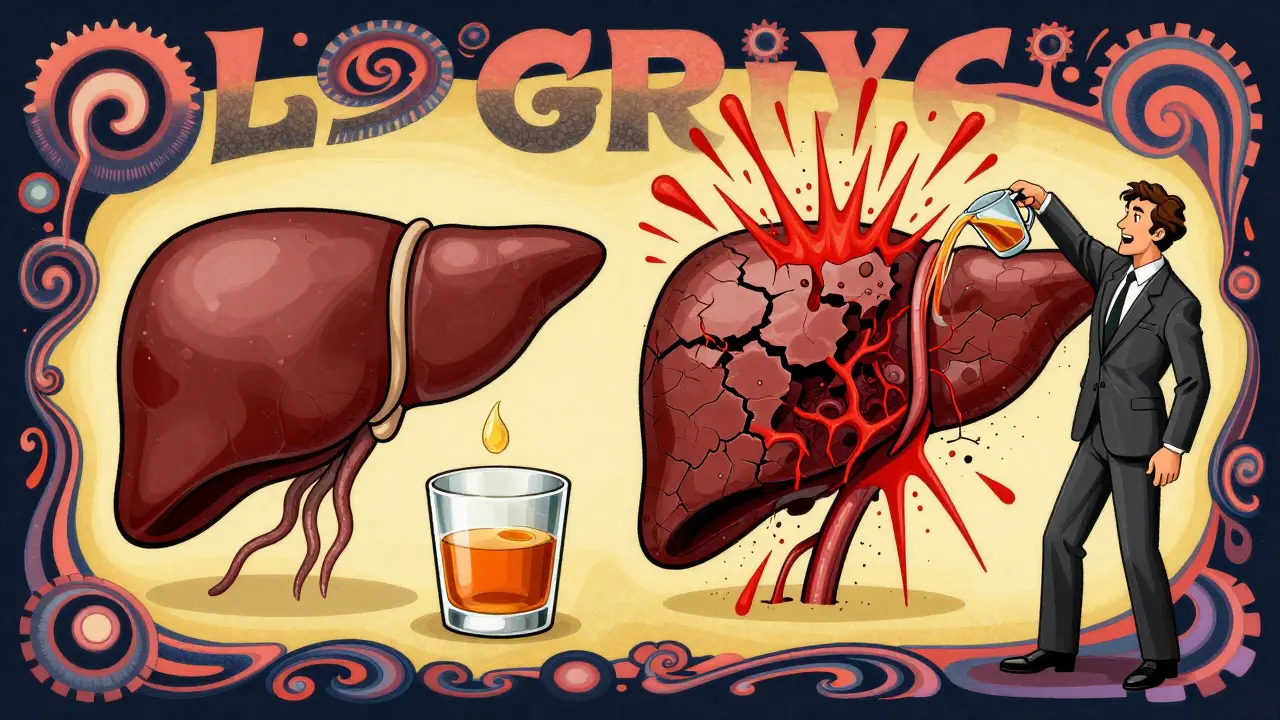
Not everyone who drinks heavily gets cirrhosis. Why? Genetics, sex, and other health issues play a big role.
Women are more vulnerable. They develop liver damage after consuming less alcohol than men-sometimes half as much. That’s because their bodies process alcohol differently. Hormones and body fat make them absorb more alcohol into the bloodstream.
Genes matter too. If you carry certain variants like PNPLA3 or TM6SF2, your liver is more likely to scar. If you also have diabetes, high cholesterol, or obesity (metabolic syndrome), your risk doubles. Even moderate drinking speeds up liver damage if you already have fatty liver from sugar or carbs.
And then there’s viral hepatitis. If you have hepatitis B or C and drink, your liver gets hit from both sides. The damage multiplies.
One study found that people with fatty liver who drank 20-40 grams of alcohol daily (about 2 drinks) saw fibrosis progress 3 times faster than those who didn’t drink. Alcohol doesn’t just add damage-it accelerates everything.
Diagnosis: How Doctors Catch It Early
Most people aren’t diagnosed until they’re in the hospital with jaundice or bleeding. That’s too late. Early detection saves lives.
Doctors start with blood tests. Elevated AST and ALT, especially with AST more than twice ALT, is a classic sign. Gamma-GT and bilirubin levels also rise. But normal blood tests don’t mean a healthy liver. You can have advanced scarring and still have normal enzymes.
Ultrasound and FibroScan are now the go-to tools. FibroScan measures liver stiffness-harder liver = more scarring. It’s accurate 85-90% of the time for detecting moderate to severe fibrosis. No needles. No hospital stay. Just a quick scan.
Doctors also use scoring systems like the Glasgow Alcoholic Hepatitis Score (GAHS) or Lille Model to predict survival. A GAHS score above 9 means more than 50% chance of dying within 6 months without intervention.
The real challenge? Getting people tested before they’re sick. Only 1 in 3 heavy drinkers ever get screened. And many doctors don’t ask about alcohol use-because they’re afraid of offending patients.
What Works: Treatment and Recovery
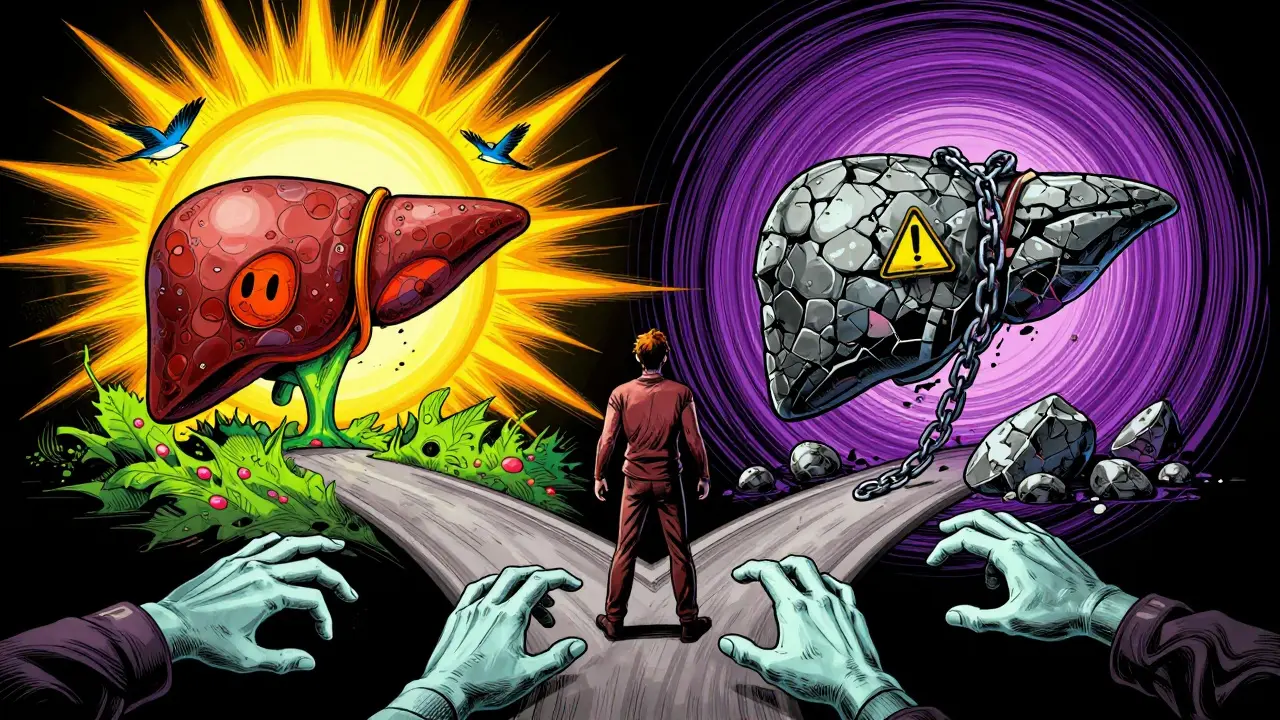
There’s no magic pill. But there are proven paths to recovery.
Stage 1 (Fatty Liver): Quit drinking. That’s it. No drugs. No diet pills. Just stop. Most people see their liver enzymes return to normal in 6 weeks.
Stage 2 (Hepatitis): Stop drinking immediately. Add steroids if your mDF score is above 32. But steroids only help if you stop drinking. If you keep drinking, they won’t save you.
Stage 3 (Cirrhosis): Abstinence is non-negotiable. Manage complications with medication. Avoid NSAIDs like ibuprofen-they hurt the liver. Get vaccinated for hepatitis A and B. Screen for liver cancer every 6 months with ultrasound and AFP blood tests.
Emerging treatments show promise. Fecal microbiota transplants (FMT) from healthy donors improved survival in 40% of severe AH patients in a 2022 study. New drugs like emricasan are being tested to reduce inflammation without steroids.
But the most powerful treatment? Support. People who get help from addiction specialists alongside liver doctors are twice as likely to stay sober. One 2023 study showed 65% abstinence at 1 year with combined care-compared to 35% with liver care alone.
What Doesn’t Work: Denial and Delay
Many patients say, “I only drink on weekends.” Or, “I’m not an alcoholic.” But alcohol-associated liver disease doesn’t care about labels. It cares about total dose over time.
One Reddit user wrote: “My doctor told me I had fatty liver at 38. I thought, ‘I’ll cut back.’ I didn’t quit. Three years later, I was in the hospital with cirrhosis.”
Another said: “I had three hospitalizations for alcoholic hepatitis. Each time, I swore I’d stop. Each time, I started again. By year four, I was told I needed a transplant-but I wasn’t eligible because I hadn’t quit long enough.”
Stigma kills. Many patients report being judged by doctors, family, even friends. That shame makes them hide their drinking. And silence kills faster than alcohol.
Here’s the truth: you don’t have to be an ‘alcoholic’ to have ALD. You just have to drink too much, too often. And you don’t have to hit rock bottom to save your liver. You just have to stop.
What You Can Do Today
Don’t wait for symptoms. If you drink regularly, get checked.
- Ask your doctor for a FibroScan or liver ultrasound.
- Request blood tests: AST, ALT, GGT, bilirubin.
- If you drink more than 14 units a week (UK guideline), consider cutting back or quitting.
- If you’ve been diagnosed with fatty liver, treat it like a warning siren-not a suggestion.
- Reach out for support. Groups like Alcoholics Anonymous, or even online forums, can help you stay sober.
Your liver doesn’t scream. It whispers. And if you ignore the whisper, it eventually stops talking altogether.
Can you reverse alcoholic liver disease?
Yes-but only if you stop drinking and act early. Fatty liver reverses in 4-6 weeks with complete abstinence. Alcoholic hepatitis can improve if caught early and treated with steroids and sobriety. Cirrhosis can’t be undone, but stopping alcohol can stabilize it and extend life by decades.
How much alcohol causes liver damage?
As little as 3-4 units a day (about 2-3 pints of beer or 2 small glasses of wine) can cause fatty liver in as little as a week. Heavy drinking-more than 60-80 grams daily (5-6 drinks)-over 5-10 years raises the risk of cirrhosis. Women are at higher risk at lower doses due to differences in metabolism.
Does quitting alcohol help if you already have cirrhosis?
Absolutely. Even with cirrhosis, stopping alcohol improves survival dramatically. People who quit have a 70-90% chance of surviving 5 years if their cirrhosis is still compensated. Those who keep drinking survive less than 2 years on average. Abstinence is the most effective treatment at any stage.
Can you drink moderately after recovering from fatty liver?
No. Once your liver has been damaged by alcohol, even small amounts can restart the damage. Studies show that returning to moderate drinking after fatty liver leads to faster progression to hepatitis and cirrhosis. Complete abstinence is the only safe choice.
Are there any medications to cure alcoholic liver disease?
No cure exists, but treatments help manage stages. Steroids like prednisolone are used for severe alcoholic hepatitis. Beta-blockers prevent bleeding in cirrhosis. Lactulose helps with brain fog. New drugs and microbiome therapies are in trials, but none replace the need to stop drinking.
Ashley Porter
January 24, 2026 AT 20:35AST > ALT is such a classic red flag it’s almost poetic. I’ve seen it in ERs - patients walking in like nothing’s wrong, labs screaming otherwise. Liver’s a silent assassin until it’s not.
Also, FibroScan is a game-changer. No more invasive biopsies for screening. Why aren’t primary docs pushing this harder?
Peter Sharplin
January 25, 2026 AT 21:22Just want to emphasize something the post barely touches: the psychological barrier to quitting isn’t about willpower - it’s about neuroadaptation. Chronic alcohol use rewires reward pathways. That’s why ‘just cut back’ is a myth for most.
Combining behavioral therapy with medical management (naltrexone, acamprosate) increases abstinence rates by 2x. But access? Almost nonexistent outside urban centers. This isn’t a moral failure - it’s a public health crisis.
Also, if you’re reading this and you’re 35+ and drink more than 10 units/week? Get a FibroScan. Seriously. It takes 5 minutes. Your future self will thank you.
Faisal Mohamed
January 27, 2026 AT 09:42🍷 The liver doesn’t judge - it metabolizes. It’s the body’s silent alchemist, turning poison into… nothing, mostly. We treat alcohol like a social lubricant, not a hepatotoxin.
But here’s the existential twist: if your liver dies quietly, did you even live?
🫠 We build empires on denial. ‘I’m not an alcoholic’ - until your AST hits 300 and your belly looks like a water balloon.
Abstinence isn’t punishment. It’s reclamation. You’re not giving up booze - you’re reclaiming your biology.
✌️
eric fert
January 28, 2026 AT 01:22Let’s be real - this whole post is just fearmongering wrapped in medical jargon. You know what else causes fatty liver? Sugar. Soda. Trans fats. But nobody’s screaming about that. Why? Because Big Pharma doesn’t make pills for ‘stop drinking soda.’
And let’s talk about the ‘6 months sobriety’ rule for transplants. That’s not medicine - that’s moral policing. My uncle had cirrhosis from hepatitis C, never drank a drop. He died waiting. Meanwhile, some guy who binged for 15 years gets a liver after 6 months of ‘rehab.’
It’s not about alcohol. It’s about who society decides is ‘worthy’ of saving.
And don’t get me started on ‘women metabolize differently.’ That’s just gendered pseudoscience dressed up as biology. Same enzyme pathways. Same liver. Same damn organ.
Stop shaming. Start fixing the system.
Curtis Younker
January 29, 2026 AT 14:28Y’all need to hear this: your liver doesn’t care if you’re ‘social drinking’ or ‘weekend warrior.’ It only cares about total dose.
I was 32, drank 2 beers after work, 3 on weekends - thought I was fine. Got diagnosed with fatty liver. My doctor said, ‘You’re 5 years from cirrhosis.’ I cried in the parking lot.
Quit cold turkey. No AA. No apps. Just deleted every beer app, gave away my glasses, told friends I was done.
6 months later, my AST/ALT normalized. 18 months? I feel like I’m 22 again. Energy. Sleep. Focus. All back.
It’s not about being an ‘alcoholic.’ It’s about being alive. You don’t need to hit rock bottom to start climbing. You just need to decide you’re worth saving.
One day at a time. You got this.
Shawn Raja
January 30, 2026 AT 23:16So let me get this straight - if I drink 3 glasses of wine every night, I’m a monster… but if I eat a whole pizza with extra cheese every night, I’m just ‘enjoying life’?
Meanwhile, the USDA says ‘moderate drinking’ is fine, but the liver community says ‘any amount = death.’
Who do we believe? The government? Or the doctors who get paid to scare people into abstinence?
And why is it that every time someone mentions alcohol, it’s treated like heroin? I’ve never seen a post titled ‘Obesity: From Sugar to Organ Failure’ with this level of moral panic.
It’s not about health. It’s about control.
Also - I’ve been drinking for 20 years. My liver enzymes are fine. So maybe the real problem is the fear industry.
Ryan W
January 31, 2026 AT 14:49Ugh. Another ‘quit drinking or die’ lecture. Newsflash: I’m American. I work hard. I deserve to unwind.
And if you think this is just about alcohol, you’re blind. It’s about the government telling you how to live. They want you addicted to therapy, rehab, and guilt.
My grandfather drank a fifth of bourbon every night. Lived to 92. Clean liver. No cirrhosis.
Genetics. It’s always genetics. Stop blaming the drink. Start blaming the weak.
Also - why is everyone obsessed with FibroScan? In America, we have real diagnostics. MRIs. CTs. Not some fancy European gadget.
And women are more vulnerable? That’s just a stereotype. I’ve seen men drop dead from alcohol at 40. Women? They’re tougher. Always have been.
Dan Nichols
January 31, 2026 AT 21:39Stop drinking? Easy to say. Try doing it when your job is 12-hour shifts and your marriage is crumbling and the only thing that quiets your brain is whiskey
Doctors don’t get it. They say ‘just quit’ like it’s turning off a faucet. But the craving isn’t in your mouth - it’s in your bones
And don’t even get me started on the 6-month sobriety rule. That’s not medicine. That’s a loyalty test. You have to prove you’re worthy of a second chance
Meanwhile, the guy who OD’d on fentanyl gets a liver transplant after 30 days. Why? Because he’s a victim. I’m just a drunk
And yeah I know I’m not supposed to say this on here but I’m tired of being called a monster for wanting to feel normal
Renia Pyles
January 31, 2026 AT 22:27Let’s talk about the elephant in the room: alcohol isn’t the problem. It’s the trauma.
Every single person with ALD I’ve ever met was running from something. Abuse. Loss. Anxiety. Depression.
They don’t drink because they’re weak - they drink because they’re hurting.
And the medical system? It punishes them for it. ‘You need 6 months sobriety?’ What kind of cruel joke is that? You’re telling someone who’s drowning to learn to swim before you throw them a rope?
Stop judging. Start healing.
And if you think this is just about ‘willpower,’ you’ve never been addicted. You’ve never felt your body scream for something that’s killing you.
It’s not a choice. It’s a cry for help.
Rakesh Kakkad
February 1, 2026 AT 05:45As a medical professional from India, I must emphasize that the concept of "moderate drinking" is dangerously misleading in our population. Genetic polymorphisms such as ALDH2 deficiency are prevalent in South Asians, leading to rapid accumulation of acetaldehyde even with minimal intake.
Moreover, the conflation of "social drinking" with "safe drinking" is a public health disaster. Our data shows that liver cirrhosis mortality in urban India has increased by 140% since 2010, despite low reported alcohol consumption.
It is not about quantity. It is about cumulative exposure and metabolic vulnerability.
Screening must be integrated into routine checkups. Not only for drinkers, but for those with metabolic syndrome. The liver does not lie.
Suresh Kumar Govindan
February 1, 2026 AT 06:40Conspiracy: Alcohol industry funds liver research. They suppress data on low-dose harm. The "safe limit" of 14 units/week? A marketing tool. Not science.
Real data? Even 1 drink/day increases cirrhosis risk by 20%.
WHO says no safe level. But you won’t hear that from your doctor. Because he drinks too.
And the transplant rules? Designed to filter out the "undesirables." The poor. The addicted. The marginalized.
It’s not medicine. It’s eugenics with a stethoscope.
Uche Okoro
February 2, 2026 AT 19:08Let’s not romanticize the liver’s regenerative capacity - it’s not a superhero. It’s a bioengineered stress-response machine with finite tolerance. The 85% recovery rate in fatty liver? That’s under controlled conditions, with compliance, with follow-up - not in the real world where 70% of patients relapse within 6 months.
And yes, AST > ALT is diagnostic, but only if you’re testing. Most people don’t get tested until they’re jaundiced - because primary care physicians are trained to avoid the ‘alcohol conversation.’
It’s not about denial. It’s about systemic avoidance. We’ve normalized the slow death of the liver because we don’t know how to talk about addiction without moralizing it.
Abstinence isn’t the cure - it’s the only starting point. The rest is just damage control.