Antidepressants and Alcohol: The Dangerous Combination Effects You Need to Know
Antidepressant & Alcohol Interaction Checker
Select the class of antidepressant you are taking to see the specific interaction risks with alcohol:
Key Takeaway:
Imagine you’ve finally found an antidepressant that lifts the fog. Your mood is stable, your energy is returning, and for the first time in months, life feels manageable. Then comes a social event-a birthday dinner or a casual Friday night with friends. Someone pours a glass of wine. You take a sip. Within twenty minutes, you feel dizzy, nauseous, and strangely detached. Or worse, you hear voices that aren’t there. This isn’t just a bad hangover; it’s a chemical collision that can be fatal.
Mixing antidepressants and alcohol is one of the most common yet dangerous medication errors people make today. While many patients assume a single drink won’t hurt, the reality is far more complex. According to data from the National Institute on Alcohol Abuse and Alcoholism (NIAAA), approximately 20% of individuals with major depressive disorder also struggle with alcohol use disorder. This overlap creates a high-risk population where the stakes are incredibly high. A 2022 meta-review highlighted that combining these substances significantly increases mortality risks, with nearly 80% of antidepressant-related deaths being suicides. Understanding exactly how these drugs interact isn't just medical trivia-it's a matter of survival.
Why the Brain Can't Handle Both
To understand why this combination is so volatile, we have to look at what each substance does to your brain. Antidepressants work by altering neurotransmitter levels-chemical messengers like serotonin, norepinephrine, and dopamine-to stabilize mood. Alcohol, on the other hand, is a central nervous system depressant. It slows down brain activity and interferes with those delicate neurochemical processes.
When you introduce alcohol while taking antidepressants, you aren't just adding two effects together; you're creating a chaotic feedback loop. The liver, which metabolizes both substances, gets overwhelmed. For example, Selective Serotonin Reuptake Inhibitors (SSRIs) affect the enzymes responsible for breaking down alcohol. This means alcohol stays in your system longer and hits harder. Clinical observations from the Priory Group in 2023 noted that users of SSRIs can get drunk 30-50% faster than usual. You might take one beer and feel like you've had four. This rapid intoxication leads to impaired motor control, severe drowsiness, and increased accident risk.
The Risk Spectrum: Not All Antidepressants Are Equal
Not all antidepressants react to alcohol in the same way. The danger level depends heavily on the class of medication you are prescribed. Knowing which category your drug falls into helps you gauge the immediate physical threat.
| Medication Class | Common Examples | Primary Danger | Severity Level |
|---|---|---|---|
| MAOIs | Phenelzine (Nardil), Tranylcypromine (Parnate) | Hypertensive Crisis (Blood Pressure Spike) | Critical / Life-Threatening |
| Atypical Antidepressants | Bupropion (Wellbutrin) | Psychosis, Hallucinations, Seizures | High / Emergency Risk |
| Tricyclic Antidepressants (TCAs) | Amitriptyline, Nortriptyline | Respiratory Depression, Extreme Sedation | High / Dangerous |
| SSRIs | Fluoxetine (Prozac), Sertraline (Zoloft), Escitalopram (Lexapro) | Rapid Intoxication, Worsened Depression | Moderate to High |
MAOIs: The Hypertensive Time Bomb
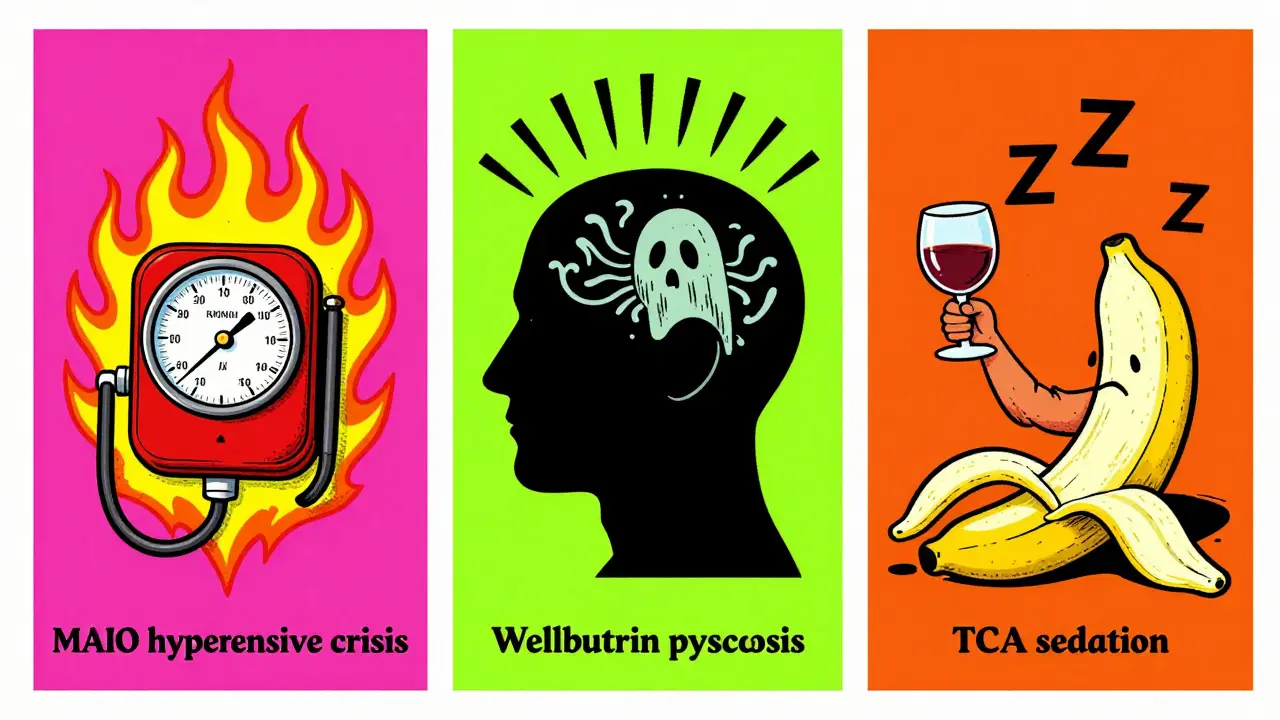
Monoamine Oxidase Inhibitors (MAOIs) represent the most immediate physical danger. These older drugs inhibit the enzyme that breaks down tyramine, a substance found in aged foods and alcoholic beverages like beer and red wine. When you consume alcohol with MAOIs, tyramine builds up rapidly, causing blood pressure to skyrocket. American Addiction Centers reports documented cases of blood pressure spikes exceeding 220/120 mmHg. This can lead to a hypertensive crisis, stroke, or heart attack within 30 minutes of consumption. If you are on Nardil or Parnate, even a small amount of wine is strictly off-limits.
Wellbutrin: The Psychosis Trigger
Bupropion (Wellbutrin) works differently than SSRIs, affecting dopamine and norepinephrine. Its interaction with alcohol is uniquely terrifying because it can trigger psychosis-like symptoms. FHE Health’s 2022 clinical data indicates that 12% of documented cases involving bupropion and alcohol required hospitalization due to auditory hallucinations and delusions. Dr. David Baron, Chief Medical Officer at FHE Health, warns that this combination can lead to a serious mental condition requiring immediate intervention. Users report hearing voices telling them to harm themselves, a symptom that emerges suddenly after just one or two drinks.
SSRIs and TCAs: The Silent Saboteurs
Selective Serotonin Reuptake Inhibitors (SSRIs) like Zoloft and Lexapro are the most commonly prescribed antidepressants. While they don't typically cause immediate strokes like MAOIs, their interaction with alcohol undermines the very purpose of the treatment. Alcohol is a depressant; antidepressants aim to elevate mood. Mixing them cancels out the therapeutic benefits. Research from Alcohol Help shows that even one standard drink per day decreases antidepressant effectiveness by 35-50% in 78% of patients. Furthermore, Tricyclic Antidepressants (TCAs) amplify sedation. Studies show a 3.2 times higher incidence of falls and accidents when TCAs are mixed with alcohol compared to alcohol alone.
The Mental Health Trap: Why Drinking Makes Depression Worse
Beyond the physical side effects, the psychological impact is devastating. Many people turn to alcohol to self-medicate residual anxiety or insomnia caused by depression. However, this creates a vicious cycle. Dr. Sarah L. Johnson, a neuropharmacologist at Columbia University, published findings in the *Journal of Psychopharmacology* (2022) demonstrating that low levels of alcohol consumption reduce antidepressant effectiveness by 40% and increase impulsivity by 27%.
The real-world evidence supports this. A survey by the Depression and Bipolar Support Alliance involving 4,312 respondents found that 67% who combined antidepressants and alcohol reported worsened depression symptoms within 48 hours. Another 29% reported increased anxiety. On Reddit’s r/mentalhealth subreddit, users frequently share stories of extreme emotional crashes. One user described how one beer led to "extreme dizziness and nausea that lasted 12 hours," while another detailed uncontrollable emotional outbursts. The medication stops working, the depression returns with a vengeance, and the patient often drinks more to cope, leading to deeper despair.
What Doctors Actually Say: The Nuance of Moderation
If you ask ten doctors about mixing antidepressants and alcohol, you might get slightly different answers, but the consensus leans heavily toward caution. The National Alliance on Mental Illness (NAMI) notes that some physicians may allow patients taking SSRIs to have one drink per day-such as a five-ounce glass of wine or a 12-ounce beer-but only if consumed with food and under strict monitoring.
However, this "moderation" advice is controversial. Dr. Mark R. Gold of American Addiction Centers warns that drinking can potentiate suicide risk, citing data showing a 2.7 times higher suicide risk in patients who combine these substances. Conversely, Dr. Michael Thase, a psychiatry professor at the Perelman School of Medicine, suggests in his 2023 textbook that occasional, moderate alcohol consumption may be acceptable for stable patients on SSRIs after 8-12 weeks of successful treatment. The key here is "stable." If you are in the initial 4-8 weeks of treatment, abstinence is non-negotiable. This is when the medication is establishing its baseline in your brain, and any interference can derail progress.
Practical Steps for Patients
Navigating social situations while on antidepressants requires a clear strategy. Here is how to protect your health without isolating yourself:
- Avoid Alcohol During Initial Treatment: The first 4-8 weeks are critical. Do not drink during this period. Your body is adjusting to the medication, and interactions are unpredictable.
- Know Your Medication Class: If you are on MAOIs or Wellbutrin, avoid alcohol entirely. If you are on an SSRI, consult your doctor before considering any consumption.
- Define "One Drink": Standard guidelines define one drink as 5 ounces of wine, 12 ounces of beer, or 1.5 ounces of spirits. Pouring a large glass of wine counts as multiple drinks and significantly increases risk.
- Eat Before You Drink: If your doctor approves minimal consumption, always eat a substantial meal first. Food slows alcohol absorption, reducing the peak concentration in your bloodstream.
- Monitor Your Mood: Keep a journal. If you notice increased anxiety, sadness, or irritability after drinking, stop immediately. Your body is telling you the combination is harmful.
Emerging Science: Genetic Factors and Future Guidelines
Science is moving toward personalized medicine. In March 2023, the FDA approved pharmacogenetic tests like GeneSight Psychotropic, which analyze enzyme variants (CYP2D6 and CYP2C19) to predict individual susceptibility to drug interactions. Columbia University research revealed that individuals with the ADH1B*2 genetic variant experience 2.3 times greater impairment when combining SSRIs and alcohol. This means that for some people, even a tiny sip could be dangerous due to their genetics.
Furthermore, the American Psychiatric Association updated its 2023 practice guidelines to acknowledge that for stable patients on SSRIs for 12+ weeks with no history of alcohol use disorder, limited alcohol consumption (≤1 standard drink once weekly) may be considered. This shift reflects a move away from absolute prohibition toward informed, monitored decision-making. However, this applies only to a small subset of patients. For the majority, especially those with co-occurring alcohol use disorders, the risk remains too high.
Can I drink one beer while taking Zoloft?
While some doctors may permit one standard drink (12 oz beer) for stable patients on SSRIs like Zoloft after several months of treatment, it is not universally safe. Alcohol can make you intoxicated faster and may worsen depression symptoms. Always consult your prescribing physician before consuming any alcohol, and never drink during the first 4-8 weeks of treatment.
What happens if I mix Wellbutrin and alcohol?
Mixing Wellbutrin (bupropion) and alcohol is highly risky. It can lower the seizure threshold and trigger psychosis-like symptoms, including auditory hallucinations and delusions. Clinical data shows that a significant percentage of such cases require emergency hospitalization. Most experts recommend complete avoidance of alcohol while on Wellbutrin.
Does alcohol make antidepressants less effective?
Yes. Research indicates that even moderate alcohol consumption can decrease antidepressant effectiveness by 35-50%. Alcohol acts as a depressant, counteracting the mood-elevating effects of the medication. It also increases impulsivity and can lead to relapse into depressive episodes.
Are MAOIs and alcohol deadly?
Yes, the combination can be life-threatening. MAOIs interact with tyramine found in alcohol (especially beer and wine) to cause hypertensive crises, where blood pressure spikes dangerously high (e.g., >220/120 mmHg). This can lead to stroke or heart attack within minutes. Complete abstinence is required for patients on MAOIs.
How long should I wait before drinking after starting antidepressants?
Most healthcare providers recommend avoiding alcohol completely during the initial 4-8 weeks of treatment. This is the period when the medication is establishing its therapeutic effect in your brain. After this stabilization period, discuss with your doctor whether limited consumption is safe for your specific case.