Eustachian Tube Dysfunction: How to Relieve Ear Pressure and Restore Hearing

Ever feel like your ears are stuffed with cotton, especially after a cold or during a flight? You’re not alone. Millions of people deal with Eustachian tube dysfunction - a condition that doesn’t make headlines but ruins daily life. It’s not an infection. It’s not swimmer’s ear. It’s your Eustachian tube, a tiny tunnel connecting your middle ear to the back of your nose, getting stuck. And when it does, pressure builds up, your hearing muffles, and that popping sound you hear when you swallow? It stops happening. The result? Discomfort, frustration, and sometimes real hearing loss.
What Exactly Is the Eustachian Tube?
The Eustachian tube is about as long as your pinky finger. It’s narrow, angled, and mostly closed - only opening briefly when you swallow, yawn, or chew. Its job? Keep the air pressure in your middle ear equal to the outside world. Think of it like the vent on a pressure cooker. If it doesn’t open, pressure builds. In your ear, that means your eardrum gets pulled inward. That’s what causes the fullness, the muffled sounds, and the ringing.
This tube was first mapped in the 1500s by Bartolomeo Eustachi, an Italian anatomist. Today, we know it’s especially prone to trouble in kids under seven because their tubes are shorter and more horizontal - making it easier for fluid and mucus to get trapped. But adults aren’t safe either. Allergies, sinus infections, and even flying can jam it shut.
How Do You Know It’s ETD and Not Something Else?
Not every ear feeling is Eustachian tube dysfunction. Here’s how to tell:
- ETD: Pressure that comes and goes, especially when you change altitude (flying, driving up hills, elevators). Muffled hearing in one or both ears. Popping or clicking when you swallow - or no popping at all. Mild ear pain that comes and goes.
- Acute ear infection: Constant, sharp pain. Fever. Fluid draining from the ear. This is an infection, not just pressure.
- Swimmer’s ear: Pain when you tug on your earlobe. Itching. Swelling in the outer ear canal.
- Barotrauma: Sudden, intense pain during a rapid pressure change - like scuba diving or a fast airplane descent. Often causes eardrum damage.
Here’s the key: ETD rarely causes constant, severe pain. If your ear hurts all day, every day, and doesn’t improve with swallowing or yawning, see a doctor. It could be something else - like a tumor in the nasopharynx, though that’s extremely rare (less than 0.5% of cases).
Why Does It Happen?
Most of the time, ETD starts with a cold or allergy. When your nasal passages swell, the opening of the Eustachian tube gets blocked. Mucus builds up. The air trapped inside your middle ear gets absorbed by the lining - creating negative pressure. Your eardrum gets sucked inward. That’s when hearing drops by 15 to 40 decibels - enough to make conversations fuzzy.
Here’s what triggers it most, based on clinical data:
- Upper respiratory infections (68%)
- Nasal allergies (22%)
- Sinus infections (10%)
People who fly often - pilots, flight attendants, frequent travelers - report flare-ups 95% of the time during altitude changes. Seasonal trends show 65% of cases happen between October and March, when colds and flu are rampant.
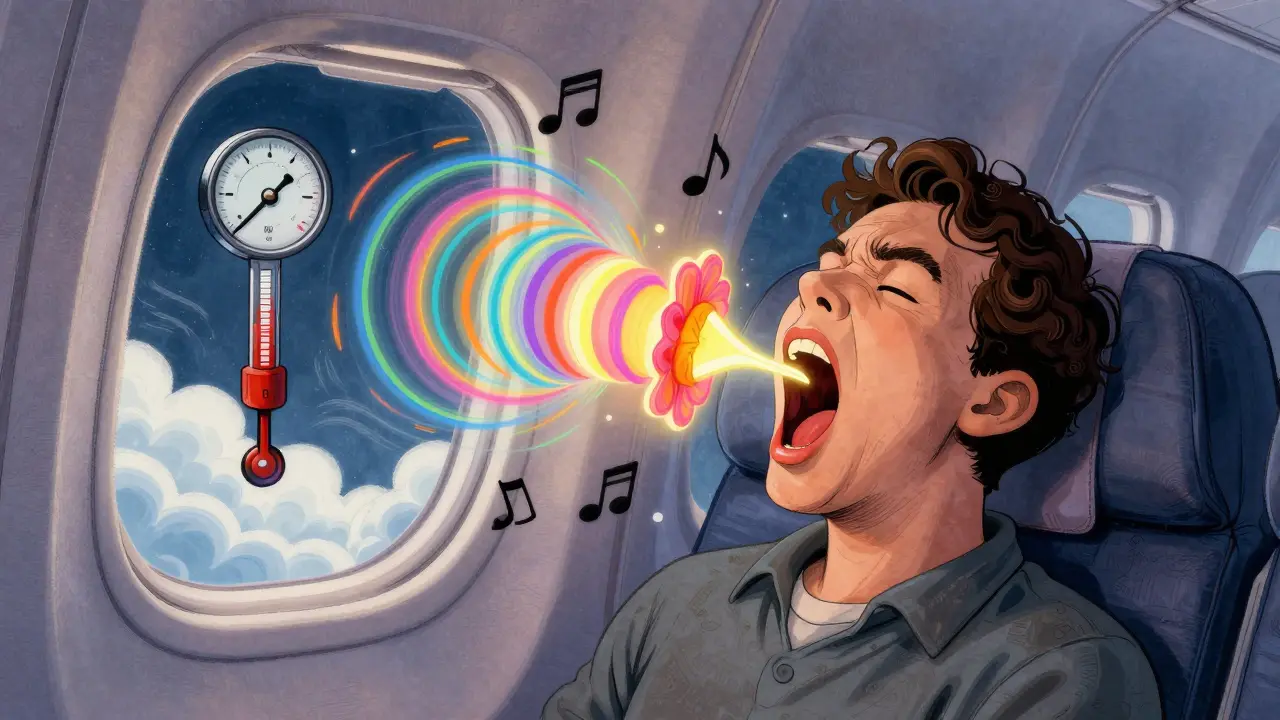
What Can You Do at Home?
Good news: 70% of ETD cases clear up on their own within two weeks. But that doesn’t mean you should just wait. Active steps help - and fast.
Swallowing and yawning: These are your first-line tools. Do them every 15 to 20 minutes when symptoms hit. Chewing gum works too - it forces the tube to open. One study found 78% of people got relief just by yawning or opening their mouth wide.
The Valsalva maneuver: Pinch your nose shut, close your mouth, and gently blow - like you’re trying to pop your ears. Don’t force it. Do it 3 to 5 times an hour. Many people swear by it - especially during flights. But here’s the catch: 45% of first-timers do it wrong. You need to blow with enough pressure to feel the pop, but not so hard that it hurts. If you feel dizziness or pain, stop.
Use a humidifier: Dry air makes mucus thicker. Keeping the air moist helps the tube stay open. Especially helpful at night.
Stay hydrated: Drink water. Thin mucus = easier drainage. Avoid caffeine and alcohol - they dehydrate you.
Don’t use nasal decongestant sprays (like Afrin) for more than 3 days. They work fast - but overuse causes rebound congestion, making things worse.
When Should You See a Doctor?
If symptoms last longer than two weeks, or if your hearing doesn’t improve after trying home remedies, it’s time to see an ENT specialist. They’ll check your eardrum with an otoscope. But here’s the problem: mild ETD often looks normal on exam. That’s why your symptoms matter more than what the doctor sees.
They might do a simple hearing test (tympanometry) to measure how well your eardrum moves. If it’s stiff from pressure, that confirms ETD. They might also check for fluid behind the eardrum - a sign the problem has lasted more than three weeks.
If fluid stays for over a month, you risk developing serous otitis media - a buildup of sticky fluid that can cause hearing loss up to 50 decibels. That’s like trying to hear someone through a closed door.
Medical Treatments: What Actually Works?
Antibiotics? No. The American Academy of Otolaryngology says they don’t help unless there’s an actual infection. Steroids and decongestants are the real players.
Steroid nasal sprays: Fluticasone (Flonase), mometasone (Nasonex). These reduce swelling in the nasal passages and Eustachian tube opening. You need to use them daily for 2 to 4 weeks. Not instant. But effective. Many patients report improved hearing after 10 days.
Antihistamines: Only if allergies are the trigger. If your ETD flares up every spring or fall, this helps. But they can dry out your mucus too much - making it thicker. Use with caution.
Oral decongestants: Pseudoephedrine can help short-term. But avoid if you have high blood pressure or heart issues.
For chronic cases - symptoms lasting more than 3 months - doctors may suggest a procedure.
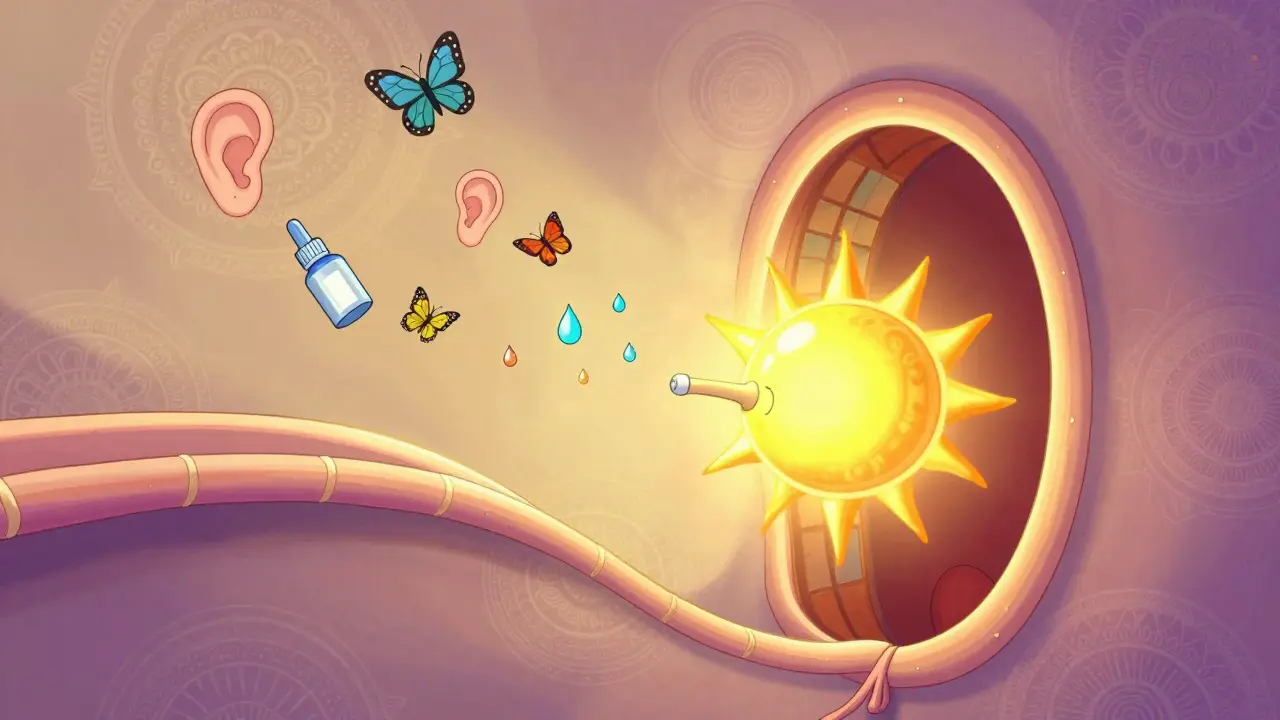
Balloon Dilation: A Modern Fix
Five years ago, the only option for chronic ETD was surgery - inserting tubes through the eardrum. Today, there’s a less invasive option: balloon dilation.
The procedure takes about 20 minutes. You’re awake. Local numbing is used. A tiny balloon is threaded up the nose into the Eustachian tube. It’s inflated for 2 minutes, gently widening the tube. Then it’s deflated and removed.
Success rates? Around 67% at 12 months. Some patients get relief for over a year. One Reddit user, u/ETDWarrior, said it helped for six months before symptoms returned. Others say it’s life-changing.
It’s not a cure-all. But it’s become 220% more common between 2018 and 2022, replacing older surgeries. It’s now offered in many clinics across the UK and US.
What Doesn’t Work - And What Could Make It Worse
Don’t:
- Try to pop your ears by blowing too hard - you can rupture your eardrum.
- Use ear candles - they’re dangerous and ineffective.
- Ignore symptoms for months - fluid buildup can lead to permanent hearing changes.
- Take antibiotics without confirmation of infection - they won’t help ETD and can cause side effects.
Also, avoid flying if you have a cold. If you must fly, start using a nasal spray 2 days before. Chew gum during takeoff and landing. Do the Valsalva maneuver gently.
Long-Term Outlook
Most people recover fully. Children often outgrow it as their tubes grow longer and more vertical. Adults with allergies can manage it with ongoing treatment.
But ETD isn’t going away. With rising allergy rates and air travel increasing, cases are expected to grow 15% per year through 2026. New treatments are coming - like bioabsorbable stents that hold the tube open temporarily. Early trials show 85% of patients improved after 3 months.
The key is early action. Don’t wait. If your ears feel blocked after a cold, start swallowing, chewing, and yawning right away. Use a nasal spray if allergies are involved. See a doctor if it doesn’t clear in two weeks.
Your ears aren’t just for hearing. They’re for balance, comfort, and quality of life. When the Eustachian tube fails, it’s not just noise - it’s isolation. But with the right steps, you can fix it - without surgery, without pills, and without waiting.
Can Eustachian tube dysfunction cause permanent hearing loss?
Usually not - if treated. Long-term blockage (over 3 months) can lead to fluid buildup behind the eardrum, which may cause temporary hearing loss of up to 50 decibels. But once the tube opens and fluid drains, hearing typically returns. Rarely, repeated episodes without treatment can lead to eardrum retraction or scarring, which may cause lasting changes. Early intervention prevents this.
Why does my ear pop when I swallow but not always?
The Eustachian tube opens naturally when you swallow, yawn, or chew - but only if it’s not swollen or blocked. If mucus or inflammation is present, the tube may not open fully, so you won’t hear the pop. That’s a sign of dysfunction. When the tube clears, the popping returns. It’s a good indicator your body is healing.
Is it safe to do the Valsalva maneuver every day?
Yes - if done gently. Doing it 3-5 times a day to relieve pressure is fine. But don’t force it. Blowing too hard can damage your eardrum or inner ear. If you feel pain, dizziness, or ringing, stop. Use it as a relief tool, not a daily routine unless advised by a doctor.
Can allergies cause Eustachian tube dysfunction?
Yes - and it’s the second most common cause after colds. Allergies cause swelling in the nasal passages and Eustachian tube opening. This blocks airflow and traps pressure. If you get ETD every spring or fall, allergies are likely the trigger. Steroid nasal sprays and antihistamines can help break the cycle.
Will ETD go away on its own after a cold?
In most cases, yes. About 70% of people recover within two weeks without any treatment. But that doesn’t mean you should wait. Using swallowing, chewing, and nasal sprays can speed things up. If your ears still feel blocked after 14 days, see a doctor. Waiting too long risks fluid buildup and longer recovery.
Is balloon dilation painful?
Most patients report mild discomfort - like pressure or a strange sensation in the nose and ear. Local anesthesia numbs the area, so you won’t feel sharp pain. Some describe it as a brief popping or clicking during balloon inflation. Recovery is quick: most return to normal activities the same day. No incisions, no stitches.
Kirstin Santiago
January 27, 2026 AT 16:53Been dealing with this since my last cold. Chewing gum all day helped more than I expected. Not magic, but it’s something.
Also, humidifier at night? Game changer. My ears don’t feel like they’re stuffed with cotton anymore.
Kegan Powell
January 28, 2026 AT 14:18It’s wild how something so tiny can mess up your whole life
That little tube is like the silent guardian of your inner ear and when it takes a day off… boom
You’re stuck in a muffled world
And yet nobody talks about it
Like it’s some secret shame
But we all know that feeling
That pop that never comes
It’s not just ears
It’s isolation
And the fact that 70% fix themselves? That’s hope right there
Just gotta be patient and chew like your life depends on it 😊
astrid cook
January 29, 2026 AT 06:17Ugh I hate when people act like this is just "a little pressure"
It’s not. It’s debilitating. I had to quit my job because I couldn’t hear my clients
And now everyone says "just yawn" like I’m some kind of idiot
It’s not a yoga pose
It’s a medical issue
And no one takes it seriously until it’s too late
Anjula Jyala
January 30, 2026 AT 11:42ETD pathophysiology is fundamentally linked to mucociliary clearance impairment secondary to inflammatory cytokine upregulation in the nasopharyngeal mucosa
Most patients fail to recognize the role of Th2-mediated allergic inflammation
Antihistamines are often misused without addressing nasal epithelial edema
Topical corticosteroids remain first-line
And balloon dilation? Evidence supports 67% patency at 12mo per Laryngoscope 2021 meta-analysis
Kathy McDaniel
January 31, 2026 AT 08:24omg yes!! i tried the valsalva thing and almost passed out 😅
but chewing gum like a maniac while i work? total lifesaver
also i drink water like its my job now
no more coffee after 2pm
my ears are finally chillin'
Patrick Merrell
February 1, 2026 AT 03:01Don’t let them fool you. This isn’t natural. It’s the 5G towers. They’re interfering with your ear’s pressure sensors. You think it’s a cold? No. It’s surveillance. They want you to feel off-balance so you don’t notice the control.
And they’re pushing balloon dilation because it’s easier to implant tracking devices through the Eustachian tube than through your phone.
Look up the 2019 FDA leak. They knew.
Marian Gilan
February 2, 2026 AT 23:33My cousin got the balloon thing done last year
Then her whole side of the family started getting weird ear stuff
And her neighbor? Same thing
And now my boss says he’s gonna get it too
Something’s off
Why now? Why so many? Why not just let people heal?
I think they’re testing something
And we’re the guinea pigs
They’re not fixing it
They’re normalizing it
Paul Taylor
February 4, 2026 AT 06:44Look I’ve been dealing with this since I was 12
My dad flew for United
He had it bad
So I learned everything
Swallowing works
Yawning works
Chewing gum works
Humidifier works
Hydration works
But the real key? Consistency
Not one trick
Not a miracle
Just doing the boring stuff every single day
And not giving up when it doesn’t pop right away
It’s not sexy
But it’s real
And if you’re reading this and you’re tired of feeling like you’re underwater
Then just start chewing
Right now
Just chew
Harry Henderson
February 5, 2026 AT 15:25STOP WASTING TIME WITH GUM AND HUMIDIFIERS
IF YOUR EARS ARE STILL BLOCKED AFTER TWO WEEKS YOU’RE DOING IT WRONG
GO SEE AN ENT NOW
NOT NEXT WEEK
NOW
EVERY DAY YOU WAIT IS ANOTHER DAY YOUR EARDRUM IS BEING SUCKED INWARD
YOU THINK YOU’RE BEING PATIENT?
NO
YOU’RE BEING STUPID
GET THE TYPMANOMETRY
GET THE SPRAY
GET THE BALLOON IF YOU HAVE TO
YOUR HEARING ISN’T A SUGGESTION
IT’S YOUR LIFE
suhail ahmed
February 6, 2026 AT 19:03Man, this ETD thing? It’s like your ear’s throwing a tantrum
Like a toddler screaming because the door won’t open
But instead of crying, your ear just… goes quiet
And then you realize you missed half the conversation
And you nod like you got it
But you didn’t
So you start chewing like a cow with a vendetta
And praying for a pop
It’s wild how something so small can steal your connection to the world
But hey - you’re not alone
And the pop? It’s coming
Candice Hartley
February 8, 2026 AT 05:49I didn’t even know what this was called until last month
Now I’m obsessed
And honestly? I’m glad I found this post
It’s like someone finally put words to what I’ve felt for months
Thank you
And also… I’m chewing gum right now 😊
Murphy Game
February 9, 2026 AT 08:02They say 70% clear up on their own
But what about the other 30%?
What if they’re just being ignored?
What if the doctors are missing the real cause?
What if it’s not allergies or colds?
What if it’s the water? The food? The vaccines?
They don’t want you to know
They just want you to chew gum and take sprays
So you don’t ask questions
April Williams
February 9, 2026 AT 20:19My sister had this for 8 months and no one believed her
She went to 4 doctors
They all said "it’s just stress"
Then she had a hearing test and they found fluid behind her eardrum
She needed tubes
Now she’s fine
But she’s never trusting another doctor again
And you shouldn’t either
Don’t let them gaslight you
Trust your ears
They’re screaming
Andrew Clausen
February 10, 2026 AT 22:48Correction: The Valsalva maneuver is not "gently" recommended for daily use. The American Academy of Otolaryngology explicitly warns against repeated forceful maneuvers due to risk of perilymph fistula and sensorineural hearing loss. The phrase "do it gently" is dangerously misleading. If you experience tinnitus or vertigo post-Valsalva, cease immediately and seek otologic evaluation. Your post promotes amateur self-treatment with potentially irreversible consequences.