Gastric Ulcers from Corticosteroids: Prevention and Monitoring Protocols
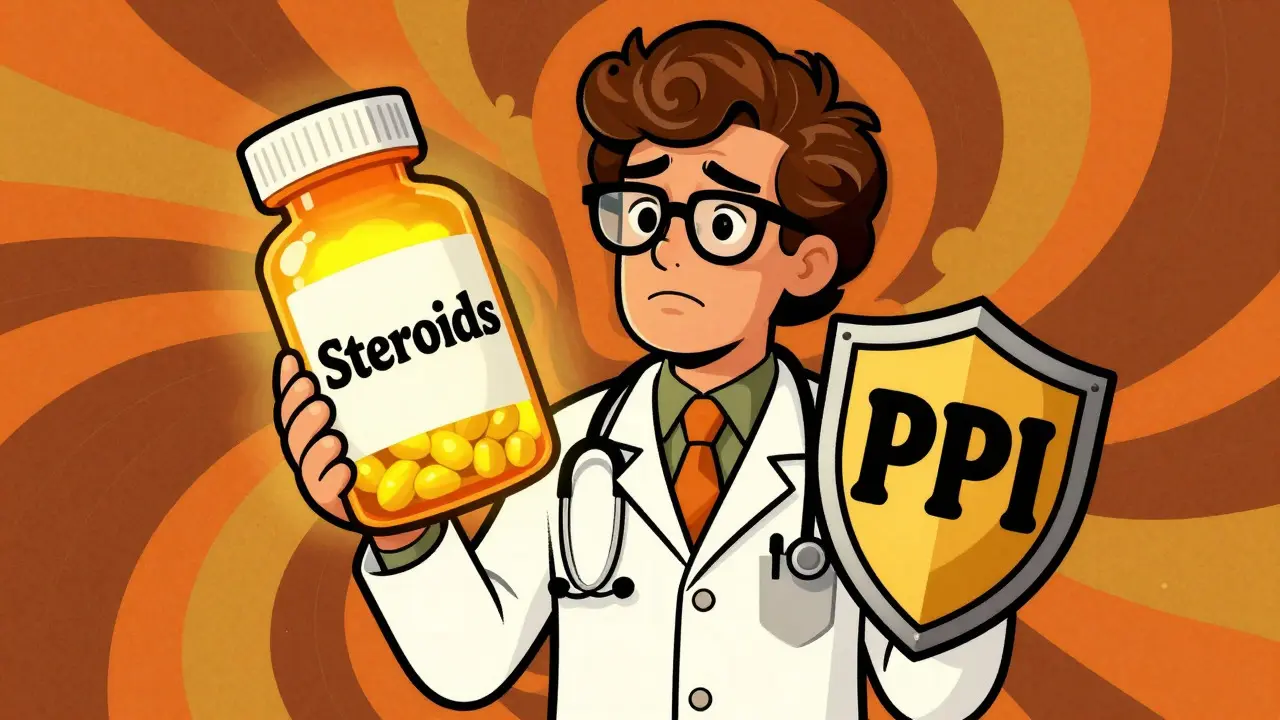
Corticosteroid GI Risk & Protection Checker
Patient Profile Assessment
Select the factors that apply to the current situation.
Assessment Result
PPI Likely Not Required
Current evidence suggests routine proton pump inhibitor (PPI) prophylaxis is not necessary for patients taking corticosteroids alone in an outpatient setting.
- ✓ Monitor: Watch for alarm symptoms (vomiting blood, black stools).
- ✓ Avoid: Try to avoid NSAIDs if possible.
For decades, the medical world operated on a simple rule: if you are taking high-dose corticosteroids, you need stomach protection. It was considered standard practice to prescribe proton pump inhibitors (PPIs) alongside steroids like prednisone to prevent gastric ulcers. But what if that rule is outdated? Recent evidence suggests we might be overtreating patients, exposing them to unnecessary medication risks while failing to address the real dangers. The truth about steroid-induced ulcers is not black and white; it depends heavily on whether you are in a hospital bed or at home, and crucially, what other medications you are swallowing.
This article cuts through the confusion. We will look at why the old guidelines are being challenged, when you actually need protection, and how to monitor for silent threats. If you are managing a condition that requires long-term steroid use, understanding these nuances could spare you from side effects of preventive drugs that may not even be necessary for your specific situation.
The Myth of Steroid-Only Ulcer Risk
It helps to start with the history. Corticosteroids were first synthesized in 1948 by Edward Calvin Kendall and Philip Showalter Hench, work that earned them the 1950 Nobel Prize. Since their introduction, doctors have worried about gastrointestinal complications. However, modern data paints a different picture than our textbooks suggest. A landmark 2013 systematic review published in *Allergy, Asthma & Clinical Immunology* by Messer et al. analyzed large meta-analyses of randomized controlled trials. The finding? There is no significant independent association between corticosteroid monotherapy and peptic ulcer formation.
Let’s break that down. If you are taking only steroids-no painkillers, no blood thinners-the risk of developing an ulcer is surprisingly low. One analysis cited in that review showed peptic ulcers occurred in only 0.4% to 1.8% of corticosteroid users. Another nested case-control study of Medicaid patients found no increased risk of peptic ulcer disease at any dose or duration of glucocorticoid monotherapy. This contradicts the longstanding clinical perception that steroids alone eat away at the stomach lining.
So why does the myth persist? Partly because steroids do cause symptoms. Patients often report heartburn, indigestion, or abdominal discomfort. But as Dr. Lisa Caplan and colleagues noted in the *Journal of the American Academy of Dermatology* (January 2017), these irritation symptoms "did not translate into an increased risk for PUD" (peptic ulcer disease). Symptoms are not the same as structural damage. Treating symptoms without actual ulcer risk leads to overtreatment.
The Real Danger: The NSAID Combination
If steroids alone are relatively safe for the stomach, what changes the equation? The answer is non-steroidal anti-inflammatory drugs (NSAIDs). When you combine corticosteroids with drugs like ibuprofen, naproxen, or aspirin, the risk profile shifts dramatically. The same Medicaid study mentioned earlier found that this combination increases the relative risk of peptic ulcer disease to 4.4 (95% confidence interval [CI], 2-9.7).
Think of it this way: NSAIDs inhibit the production of prostaglandins, which protect the stomach lining. Steroids impair tissue repair and delay wound healing. Together, they create a perfect storm where the stomach loses its defense mechanism while simultaneously losing its ability to fix minor damage. For patients on both classes of drugs, gastroprotective therapy is not just recommended-it is critical. Proton pump inhibitors (PPIs) or misoprostol become essential tools here.
| Scenario | Relative Risk / Odds Ratio | Clinical Recommendation |
|---|---|---|
| Corticosteroid Monotherapy (Outpatient) | No significant increase (OR 1.05) | Routine PPI prophylaxis not supported by evidence |
| Corticosteroid + NSAIDs | High Risk (RR 4.4) | Gastroprotection (PPI/Misoprostol) strongly recommended |
| Corticosteroids (Hospitalized Patients) | Moderate Increase (OR 1.43) | Consider prophylaxis due to higher baseline vulnerability |
| Corticosteroids + Anticoagulants | Elevated Bleeding Risk | Close monitoring; individualize protection strategy |

Hospital vs. Home: Context Matters
Where you take your medication matters more than you might think. A 2014 systematic review in *BMJ Open* by Liu et al., examining over 1.1 million participants, revealed a stark contrast between settings. Overall, corticosteroid use increased the odds ratio for gastrointestinal bleeding or perforation by 40%. However, this risk was exclusively significant in hospitalized patients (OR 1.43, 95% CI 1.23-1.67).
In ambulatory care-meaning patients treated at home or in outpatient clinics-the risk showed no statistically significant increase (OR 1.05, 95% CI 0.94-1.17). Why the difference? Hospitalized patients are often critically ill, dehydrated, stressed, and taking multiple interacting medications. Their bodies are under immense physiological strain. An outpatient patient with asthma taking prednisone for a flare-up is generally stable, eating normally, and mobile. Applying the same strict prevention protocols to both groups ignores this fundamental context gap.
This distinction supports the argument against blanket policies. Prescribing PPIs to every patient starting steroids, regardless of setting, fails to account for the much lower absolute risk in community-based care. The absolute risk in ambulatory patients remains very low, estimated at 0.12 events per 100 person-years according to the *BMJ Open* review.
The Problem with Routine PPI Prophylaxis
Proton pump inhibitors (PPIs) like omeprazole and pantoprazole are powerful drugs. They reduce stomach acid effectively, but they are not harmless. Long-term use has been linked to increased risks of bone fractures, kidney disease, Clostridioides difficile infections, and nutrient deficiencies (such as magnesium and B12). Given that routine PPI use for steroid-only patients lacks strong evidence, we must ask: are we trading one set of risks for another?
The 2023 'Things We Do for No Reason™' commentary in the *Journal of Hospital Medicine* specifically challenged this practice. It argued that routine PPI use for adults on high-dose corticosteroids, who are not taking NSAIDs, lacks evidence-based support. This initiative has sparked real-world changes. At Johns Hopkins, a 2021 quality improvement project discontinued routine PPI prophylaxis for corticosteroid monotherapy. The result? PPI usage dropped by 42.7% without any increase in GI complication rates over 12 months.
Similarly, the University of Wisconsin Hospital reported a 35% reduction in inappropriate PPI prescriptions after implementing their 'Steroid-Only PPI Stewardship Protocol' in early 2023. These real-world data points validate the scientific literature: stopping unnecessary PPIs is safe and reduces drug burden.

Monitoring Strategies: What Actually Works
If we aren't giving everyone a PPI, how do we keep patients safe? The answer lies in precise monitoring and risk stratification rather than blind prophylaxis. Current clinical guidelines lack specific protocols for gastric ulcer monitoring in corticosteroid users, but we can derive best practices from broader cardiovascular and metabolic monitoring recommendations.
Baseline Assessment: Before initiating systemic glucocorticoid therapy, assess key risk factors:
- Concomitant NSAID use (current or recent)
- History of prior peptic ulcers
- Status of Helicobacter pylori infection
- Use of anticoagulants or antiplatelet agents
Symptom Surveillance: Monitor for upper GI symptoms at each follow-up visit. Be vigilant for "alarm symptoms" that require immediate endoscopy:
- Hematemesis (vomiting blood)
- Melena (black, tarry stools)
- Unexplained anemia
- Persistent dyspepsia despite treatment
The Masking Effect: One of the most insidious aspects of corticosteroids is their ability to mask symptoms. Because they are potent anti-inflammatories, they can suppress the pain signals associated with an ulcer. A patient might have a developing bleed but feel no pain. This is why relying solely on patient-reported pain is dangerous. Regular check-ins and objective markers are vital.
Metabolic Monitoring: While not directly related to ulcers, metabolic changes are a common side effect of steroids. Postprandial hyperglycemia (high blood sugar after eating) is more common than fasting hyperglycemia with glucocorticoid use. According to Caplan et al. (2017), monitoring blood glucose via finger stick or basic metabolic panel provides a sensitive indicator of steroid-induced metabolic stress. Uncontrolled diabetes can further impair wound healing, indirectly increasing ulcer risk.
Navigating Clinical Uncertainty
Despite the growing evidence, expert opinion remains divided. In online forums like Reddit’s r/medicine, clinicians debate this issue openly. Some report stopping routine PPIs with no adverse outcomes, citing the 'Things We Do for No Reason™' article. Others share anecdotes of severe bleeds on steroid monotherapy, arguing that individual risk outweighs population-level statistics. This tension highlights a core challenge in medicine: balancing statistical safety with individual liability and fear.
The American College of Gastroenterology has not issued specific guidelines for corticosteroid-related ulcer prevention, leaving clinicians to navigate this gap. However, the trend is moving toward individualization. The American Gastroenterological Association’s 2025 guideline update process includes a dedicated working group examining this exact issue, signaling that formal standards are evolving.
For now, the most prudent approach is shared decision-making. Discuss the risks and benefits with your healthcare provider. If you are on steroids alone, ask if a PPI is truly necessary. If you are also taking NSAIDs or blood thinners, ensure you are on appropriate gastroprotection. And always report new or worsening abdominal symptoms, even if they seem mild, because steroids can hide the severity until it is too late.
Do I need a proton pump inhibitor (PPI) if I am only taking corticosteroids?
Current evidence suggests that routine PPI prophylaxis is not necessary for patients taking corticosteroids alone, especially in outpatient settings. Studies show no significant independent association between corticosteroid monotherapy and peptic ulcer formation. However, if you have additional risk factors such as a history of ulcers, use of NSAIDs, or anticoagulants, your doctor may still recommend protection.
How do NSAIDs affect ulcer risk when combined with steroids?
Combining corticosteroids with NSAIDs significantly increases the risk of peptic ulcer disease and gastrointestinal bleeding. Research indicates a relative risk increase of 4.4 times compared to baseline. This combination impairs the stomach's protective lining and delays healing, making gastroprotective therapy like PPIs or misoprostol highly recommended.
Why are hospitalized patients at higher risk for steroid-related GI issues?
Hospitalized patients face a higher baseline risk due to critical illness, dehydration, physiological stress, and polypharmacy (taking multiple medications). A 2014 BMJ Open review found that the increased odds of GI bleeding or perforation from corticosteroids were exclusive to hospitalized patients, whereas ambulatory patients showed no statistically significant risk increase.
What are the signs of a gastric ulcer that I should watch for?
Key alarm symptoms include hematemesis (vomiting blood), melena (black, tarry stools), unexplained anemia, and persistent dyspepsia. Note that corticosteroids can mask pain, so you might not feel typical ulcer pain. Regular monitoring and reporting of any digestive changes are crucial.
Is there a specific protocol for monitoring patients on long-term steroids?
While specific ulcer monitoring protocols are lacking, general best practices include assessing GI risk factors at baseline, checking for concomitant NSAID or anticoagulant use, testing for H. pylori if indicated, and monitoring for upper GI symptoms at each follow-up. Blood glucose monitoring is also recommended to manage steroid-induced metabolic changes.