IBS vs. IBD: What’s the Real Difference Between Functional and Inflammatory Bowel Disorders?
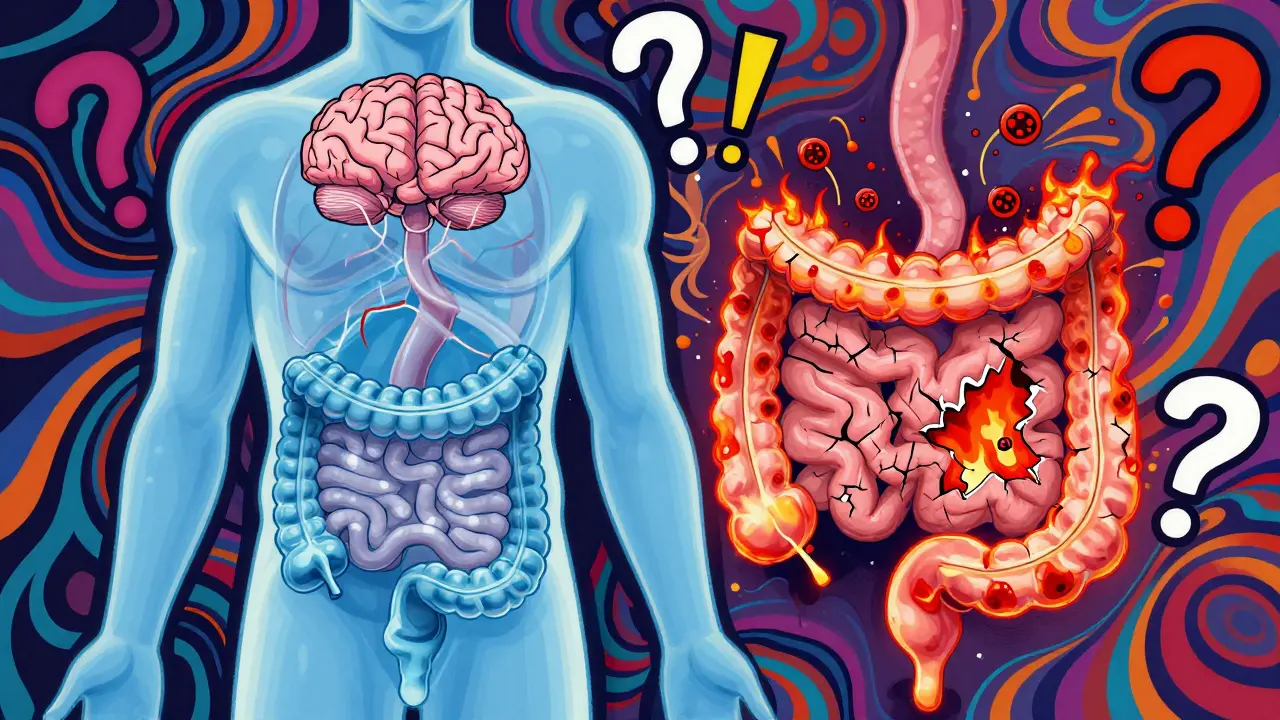
When your stomach hurts, your bowels act up, or you’re stuck in a cycle of bloating and diarrhea, it’s easy to assume you have IBS. But what if it’s something more serious? Many people confuse Irritable Bowel Syndrome (IBS) with Inflammatory Bowel Disease (IBD), even though they’re completely different conditions. One is a functional disorder-meaning your gut looks normal but doesn’t work right. The other is a structural disease with real, visible damage inside your intestines. Getting this wrong can lead to dangerous delays in treatment.
What Is IBS? A Disorder Without Visible Damage
IBS is one of the most common digestive problems in the world. Around 10-15% of people globally have it, and women make up about two-thirds of those cases. It’s not caused by infection, cancer, or inflammation. There’s no ulcer, no swelling, no scar tissue-your colon looks perfectly normal on a colonoscopy. But you still feel awful.
The Rome IV criteria, updated in 2016 by experts from around the world, define IBS by three key signs: abdominal pain at least once a week for three months, along with changes in bowel habits. That means you might have diarrhea, constipation, or both. Bloating hits 76% of people with IBS. Mucus in stool? That’s common too-seen in nearly half of cases. And yes, eating often makes it worse. A big meal, coffee, or stress can trigger hours of cramping.
Here’s the thing: none of the standard tests show anything wrong. Blood work? Normal. Stool tests? Clean. Colonoscopy? No inflammation, no ulcers, no polyps. That’s why doctors call IBS a functional disorder. It’s like a glitch in the software-not the hardware. Your gut nerves are too sensitive. Your muscles contract too hard or too weak. Your brain and gut aren’t talking right.
What Is IBD? When Your Gut Is Actually Damaged
IBD is not one condition-it’s two: Crohn’s disease and ulcerative colitis. Both involve chronic inflammation that eats away at the lining of your digestive tract. Unlike IBS, this isn’t a glitch. This is damage you can see.
In ulcerative colitis, inflammation starts in the rectum and spreads upward, creating open sores and bleeding. In Crohn’s, inflammation can hit anywhere-from mouth to anus-and digs deep into the bowel wall. That’s why people with IBD often have symptoms that IBS patients never do: blood in stool, fever, unexplained weight loss, joint pain, or skin rashes.
Here’s the hard truth: if you’re losing weight without trying, running a low-grade fever, or seeing red blood in your toilet, that’s not IBS. That’s IBD. In fact, 92% of ulcerative colitis patients have bloody stools at diagnosis. In Crohn’s, 17% develop fistulas-abnormal tunnels between organs-and 33% get strictures, where the intestine narrows so badly food can’t pass.
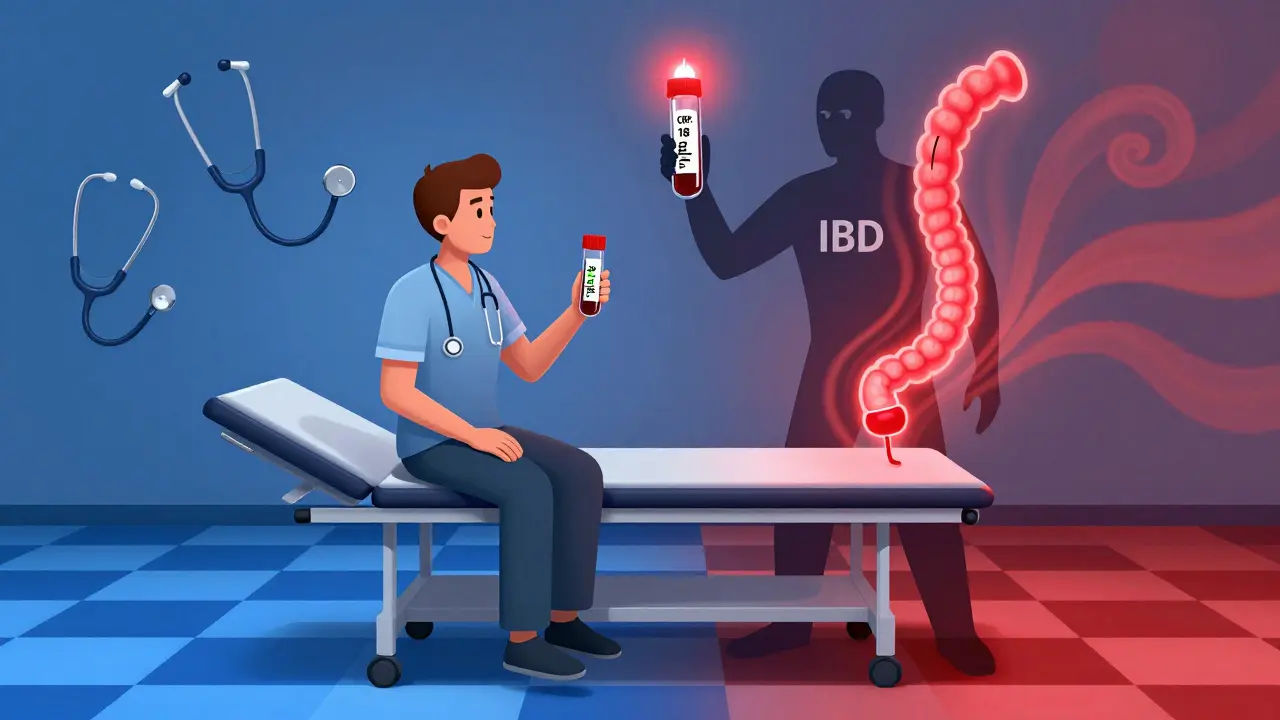
Doctors don’t diagnose IBD by symptoms alone. They need proof. Blood tests show elevated C-reactive protein (CRP) over 5 mg/L-way above normal. Stool tests reveal fecal calprotectin over 250 µg/g, a clear sign of inflammation. Colonoscopy? It shows red, swollen, ulcerated tissue. Biopsies confirm it. MRI scans reveal thickened bowel walls and abscesses. This isn’t guesswork. This is structural disease.
The Critical Difference: Inflammation vs. No Inflammation
The biggest mistake people make is thinking IBS can turn into IBD. It can’t. The Crohn’s & Colitis Foundation says it clearly: IBS does not develop into IBD. But here’s the twist-about one in three people with IBD in remission still have IBS-like symptoms. That means you can have both. And that’s confusing.
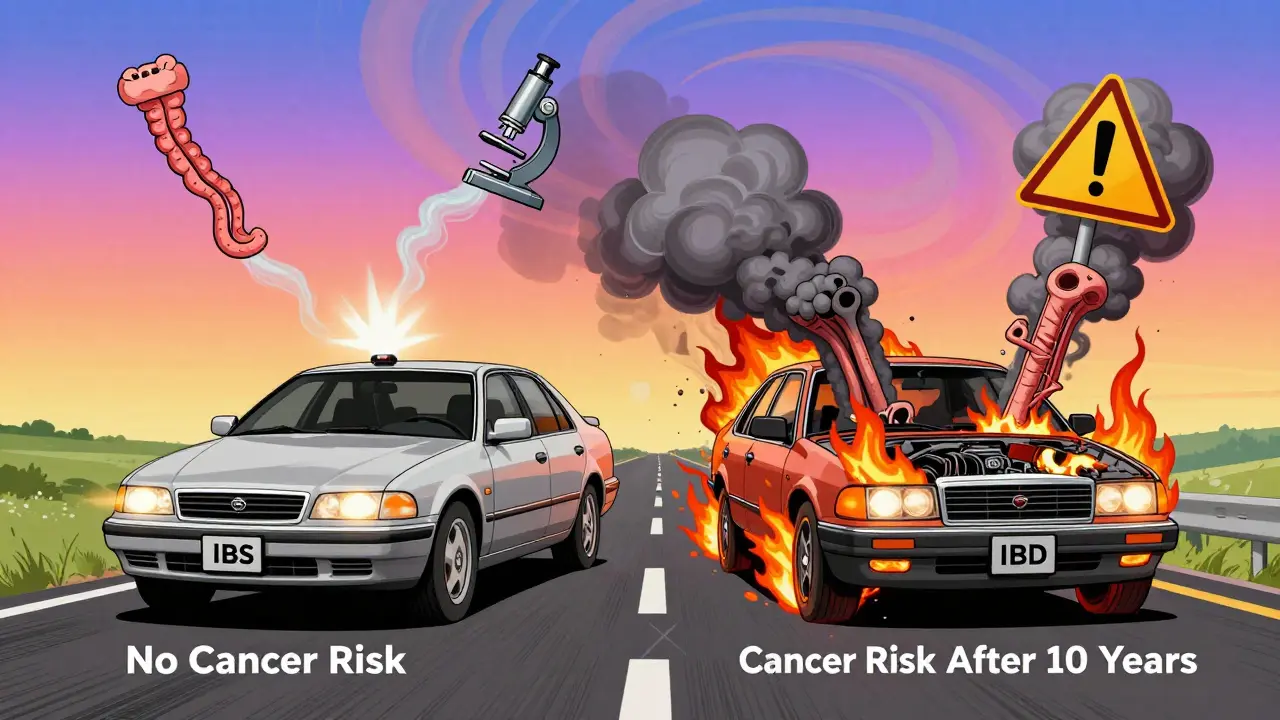
Think of it this way: IBS is like a car alarm that goes off for no reason. The car is fine, but the alarm is hypersensitive. IBD is like a fire inside the engine. The alarm isn’t broken-you’ve got real flames. You can’t treat a fire with noise-canceling headphones.
That’s why lab tests matter. A person with IBS will have normal CRP and calprotectin levels. A person with IBD? Those markers are sky-high. Even a simple blood test can rule out IBD in seconds. If your CRP is under 3 mg/L and calprotectin is under 50 µg/g, and you have no weight loss or bleeding? It’s almost certainly IBS.
And here’s another myth busted: IBS doesn’t cause cancer. The Mayo Clinic confirms it. IBD does. After 10 years of pancolitis (ulcerative colitis affecting the whole colon), your risk of colorectal cancer rises by 2% per year. That’s why regular colonoscopies are life-saving for IBD patients-and completely unnecessary for IBS.
How Doctors Tell Them Apart
There’s no single test for IBS. Diagnosis is all about ruling things out. If you’re under 50, have no family history of colon cancer, no weight loss, no bleeding, and no fever? Your doctor will likely use the Rome IV criteria and call it IBS. But if you’re losing weight, have bloody stools, or your CRP is elevated? They’ll order a colonoscopy right away.
IBD diagnosis is straightforward once you look inside. A colonoscopy with biopsy is the gold standard. Seeing inflammation, ulcers, or granulomas (clumps of immune cells) confirms Crohn’s or colitis. MRI enterography shows fistulas or abscesses you can’t see with a scope. Blood and stool tests back it up.
Alarm symptoms? Never ignore these:
- Bloody stool or black, tarry stools
- Unexplained weight loss (more than 5% of body weight)
- Fever lasting more than a few days
- Anemia (fatigue, pale skin, dizziness)
- Family history of IBD or colorectal cancer
If you have any of these, don’t wait. Don’t assume it’s IBS. See a doctor. Now.
Treatment: Different Problems, Different Fixes
IBS treatment is about managing symptoms, not curing disease. You can’t shut down inflammation because there isn’t any. So doctors focus on:
- Low-FODMAP diet: Reduces gas and bloating in 76% of patients
- Low-dose antidepressants: Help calm overactive gut nerves
- Gut-targeted meds like eluxadoline: For IBS-D (diarrhea-predominant)
- Stress management: Therapy, yoga, mindfulness-because stress worsens symptoms
IBD treatment is about stopping inflammation before it destroys your gut. That means drugs that suppress the immune system:
- Anti-TNF drugs (like infliximab): Put 50-60% of Crohn’s patients into remission
- Corticosteroids: Fast relief for flares, but not for long-term use
- Vedolizumab: Targets only the gut, reducing side effects
- Surgery: Sometimes needed for strictures, fistulas, or uncontrolled bleeding
There’s no cure for IBD-but remission is possible. Many people live full lives with the right treatment. IBS doesn’t need drugs like this. You don’t need to take immune-suppressing meds for a disorder that doesn’t involve inflammation.
Can You Have Both?
Yes. And it’s more common than you think. Studies show 22-35% of people with IBD in remission still meet the criteria for IBS. Their inflammation is under control, but their gut is still oversensitive. That’s why some IBD patients keep having bloating, pain, or urgency even after their colon looks healed.
It’s not a failure of treatment. It’s a separate condition layered on top. Doctors now recognize this. If you’ve been treated for IBD but still have symptoms, ask about IBS. You might need a low-FODMAP diet or gut-directed therapy-not more steroids.
Bottom Line: Don’t Guess. Get Tested.
IBS and IBD both wreck your life. But only one can lead to cancer, surgery, or life-threatening complications. If you’re in pain, don’t self-diagnose. Don’t rely on Google. If you have bleeding, weight loss, or fever, get checked. A simple blood test or colonoscopy can save you years of suffering.
And if you’ve been told you have IBS but your symptoms are getting worse? Go back. Maybe it’s IBD. Maybe it’s both. Either way, you need the right diagnosis to get the right help.
tatiana verdesoto
March 4, 2026 AT 01:08Just wanted to say this post saved me from years of unnecessary stress. I thought I had IBS, but when I started having fevers and lost 12 lbs in two months, I finally pushed for a colonoscopy. Turned out it was Crohn’s. If you’re losing weight without trying? Don’t wait. Get checked.
Thank you for laying it out so clearly.
Mariah Carle
March 5, 2026 AT 17:18IBS is like your phone’s battery draining for no reason 😅
IBD is your phone catching fire. You don’t fix a fire with a new charger.
Just… yeah. This analogy is everything.
Justin Rodriguez
March 6, 2026 AT 00:55Had a patient last month who insisted her bloating was IBS. Normal CRP, normal calprotectin. Low-FODMAP helped. But she kept coming back. Turns out she was on a steroid for eczema that was masking early IBD signs. Doctors miss this all the time. Always check for red flags-even if the profile looks textbook IBS.
Raman Kapri
March 7, 2026 AT 17:37It is not scientifically accurate to claim that IBS cannot develop into IBD. The literature is inconclusive. There are documented cases of mucosal remodeling in long-term IBS patients. You oversimplify a complex pathophysiological continuum. This is dangerous misinformation.
Megan Nayak
March 7, 2026 AT 20:57So let me get this straight. You’re telling me my 8 years of ‘IBS’ might’ve been a slow-burn autoimmune warzone I ignored because I was too scared to get a colonoscopy?
Thanks for the trauma dump, doctor.
Now I have to re-live every panic attack I had in a public bathroom.
Great job.
Tildi Fletes
March 8, 2026 AT 14:15It is imperative to emphasize that the diagnostic criteria for IBS are predicated upon the exclusion of organic pathology. The Rome IV criteria are not arbitrary; they are evidence-based and validated across international cohorts. Furthermore, the elevation of fecal calprotectin above 50 µg/g has a sensitivity of 92% for inflammatory bowel disease. These are not subjective assessments. They are laboratory-confirmed biomarkers. Failure to adhere to this protocol constitutes a breach of clinical due diligence.
Siri Elena
March 8, 2026 AT 22:06Oh honey, IBS? Cute. 😘
So you’re telling me your ‘gut glitch’ somehow turned your colon into a horror movie set? And you didn’t go to the doctor? For YEARS?
Well, I guess Google told you it was ‘stress’…
Meanwhile, I’m over here getting infliximab infusions and you’re still eating kale smoothies.
❤️
Divya Mallick
March 10, 2026 AT 21:57Western medicine is obsessed with biomarkers. You think a CRP level defines suffering? I’ve seen mothers in Mumbai with bloody stools and no access to a lab. They know their bodies. They don’t need a colonoscopy to know their gut is screaming. You reduce pain to numbers. That’s colonial. That’s arrogant. That’s not healing.
Pankaj Gupta
March 11, 2026 AT 11:54While the distinction between IBS and IBD is clinically valid, we must also acknowledge the spectrum of gut dysregulation. Some patients present with low-grade inflammation that doesn’t meet IBD thresholds but still responds to anti-inflammatory diets. The binary framing may overlook transitional states. A more nuanced approach-perhaps integrating gut microbiome profiling-could bridge the gap.
Alex Brad
March 12, 2026 AT 23:24Get tested. If you’re losing weight or bleeding, don’t wait. That’s it.
Renee Jackson
March 14, 2026 AT 09:46Thank you for this comprehensive and compassionate breakdown. It is critical that individuals experiencing gastrointestinal distress are empowered with accurate, evidence-based information. The distinction between functional and inflammatory conditions is not merely academic-it is life-altering. Please continue to advocate for early diagnostic intervention. Your clarity may save lives.
RacRac Rachel
March 15, 2026 AT 22:45OMG this is so helpful 💖 I was scared to go to the doctor for 3 years because I thought I was just ‘anxious’
Got my calprotectin test last week-280. Went straight to GI. Crohn’s confirmed.
Now I’m on vedolizumab and I can actually eat pizza again 😭
Thank you for not making me feel crazy.
Jane Ryan Ryder
March 17, 2026 AT 09:04IBS is just stress
IBD is your fault
you should’ve gone to the doctor sooner
you’re weak
you’re dramatic
you’re just not tough enough
you’re lucky you’re not in a third world country
you’re lucky you even have a colonoscopy
you’re lucky you’re not homeless
you’re lucky you’re not dying
you’re lucky
you’re lucky
you’re lucky
Callum Duffy
March 19, 2026 AT 05:48This is a remarkably balanced and clinically sound exposition. The analogies employed-particularly the car alarm versus engine fire-are both accessible and accurate. The emphasis on biomarkers as gatekeepers to differential diagnosis is essential. I would only add that the psychological burden of chronic GI symptoms, regardless of etiology, warrants integrated care. The gut-brain axis is not a metaphor-it is neurophysiological reality. Holistic management remains the gold standard, even in the presence of structural disease.
Chris Beckman
March 19, 2026 AT 21:09you got the crp wrong. its 5 not 3. you said under 3 is ibs. its under 5. you dont know what ur talking about. fix it. im a nurse. i see this every day. you just made a mistake that could cost someone their life. #clinicalerror