Manufacturing Cost Analysis: Why Generic Drug Production Is Cheaper Than Brand Names
Why does a bottle of generic statins cost a fraction of the price for the brand-name equivalent, even though they contain the exact same active ingredient? The answer isn't magic; it's math. When you look at the manufacturing cost analysis of the financial breakdown of producing pharmaceutical goods from raw materials to final packaging, the gap between branded and generic drugs becomes starkly clear. It is not just about cutting corners. It is about structural differences in how these products are developed, approved, and sold.
In 2023, the global generic pharmaceutical market hit $465 billion. These drugs account for over 90% of prescriptions filled in the United States, yet they make up only about 16% of total drug spending. That disparity tells us everything we need to know about efficiency. If you are trying to understand why your pharmacy bill dropped when your doctor switched you to a generic, or if you are an investor looking at the pharma sector, understanding this cost structure is essential. Let’s break down exactly where the money goes-and where it doesn’t.
The R&D Cliff: Avoiding the Billion-Dollar Gamble
The single biggest reason generic production is cheaper has nothing to do with the factory floor. It has to do with what happened before the factory was even built. Bringing a new, innovative drug to market is incredibly expensive. According to the Tufts Center for the Study of Drug Development, the average cost to develop a novel drug is approximately $2.6 billion. This figure covers decades of research, thousands of failed experiments, and massive clinical trials involving tens of thousands of patients.
Generic manufacturers do not face this cliff. Thanks to the Hatch-Waxman Act of 1984 in the United States, generic producers don't need to prove that their drug works-they just need to prove it is bioequivalent to the brand name. This means demonstrating that the generic drug enters the bloodstream at the same rate and extent as the original. This process costs between $2 million and $5 million. That is less than 0.2% of the cost of developing a new drug. By skipping the discovery phase and early-stage testing, generics eliminate the largest variable in pharmaceutical economics.
| Metric | Brand-Name (Innovator) Drug | Generic Drug |
|---|---|---|
| Average Development Cost | $2.6 Billion | $2-5 Million |
| Time to Market | 10-15 Years | 3-4 Years (ANDA Process) |
| Clinical Trials Required | Phases I, II, III (Full Scale) | Bioequivalence Studies Only |
| Regulatory Pathway | New Drug Application (NDA) | Abbreviated New Drug Application (ANDA) |
Economies of Scale and the Learning Curve
Once the regulatory hurdle is cleared, the actual manufacturing begins. Here, physics and logistics take over. Boston Consulting Group analyzed 15 major generic companies and found a precise pattern: for every doubling of total production volume, the per-unit cost drops by 18%. If you double the volume for a specific Stock Keeping Unit (SKU), that unit cost can plummet by 45%.
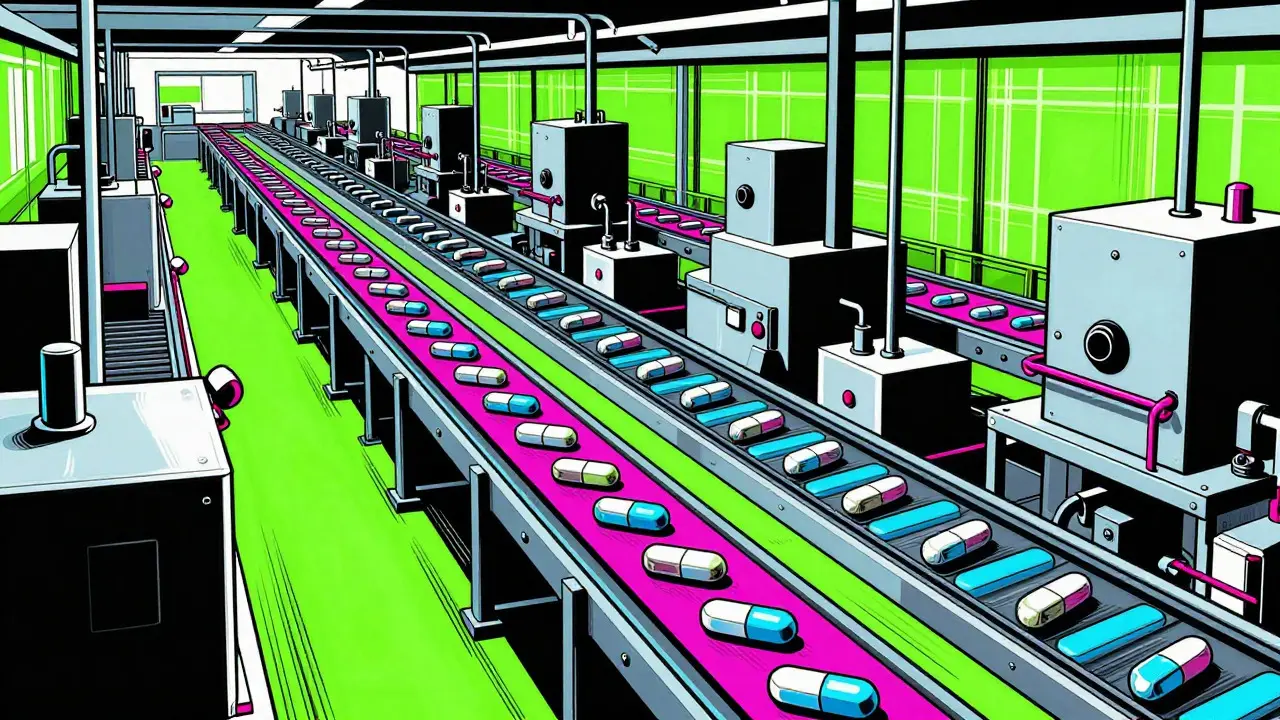
This is known as the learning curve effect. As factories run longer shifts and refine their processes, waste decreases, and efficiency spikes. Generic manufacturers often produce massive volumes of standardized Oral Solid Dosage (OSD) forms like tablets and capsules. These are highly automated. A machine can press millions of pills a day with minimal human intervention. In contrast, complex branded drugs might involve unique delivery systems, specialized coatings, or injectable formats that require more delicate, slower handling.
However, there is a limit. BCG data shows that unit costs start rising again if OSD production exceeds 30-40 billion units or if Semi-Liquid products surpass 1.5-3 billion units. This creates an optimal scale target. Generic companies aim to hit that sweet spot where they are large enough to benefit from automation but not so large that logistical bottlenecks drive costs up.
Marketing and Sales: The Silent Cost Driver
Think about the last time you saw a commercial for a generic antibiotic. You probably didn’t. That is because generic manufacturers spend very little on marketing. Branded drugs rely heavily on direct-to-consumer advertising and sales forces to push doctors toward their specific product. These marketing budgets can run into hundreds of millions annually.
For generics, the "marketing" is essentially the price tag itself. Pharmacists and insurance companies automatically substitute the generic version because it saves money. The Association for Accessible Medicines reports that production costs consume about half of a generic manufacturer's revenue. Compare that to branded drugs, where the margin allows for heavy promotional spend. By stripping away the glossy brochures and TV ads, generics keep their overheads razor-thin.
Supply Chain and Raw Materials
The physical ingredients also play a role. The Active Pharmaceutical Ingredient (API) is the most expensive part of any drug. For generics, APIs are often commodities. Because the molecule is off-patent, multiple suppliers compete to sell the raw powder. This competition drives prices down, although volatility remains-API costs can fluctuate 20-30% annually based on raw material availability.
Excipients-the inactive ingredients that give the pill its shape, color, and stability-are also standardized. Generic makers use established formulas that have been tested and proven. They don't need to experiment with new binders or fillers. This standardization reduces quality assurance costs. While QA is still critical (and accounts for a significant portion of above-site costs), the risk profile is lower because the chemical behavior of the molecule is already well understood.
The Competition Factor: Price Wars
Finally, the market structure forces prices down. When a patent expires, it’s not just one generic company that enters the market. Often, dozens do. The FDA notes that when six or more generic competitors enter the market, prices can drop by more than 95% compared to the brand name. Even with just two competitors, generic prices average 54% lower.
This hyper-competition creates a survival-of-the-fittest environment. Dr. James Robinson, a health economist at UC Berkeley, noted that a 1% improvement in production efficiency can determine whether a generic company survives or exits the market. Manufacturers are constantly optimizing their supply chains, negotiating harder with API suppliers, and automating further to stay under the market price ceiling.
Risks and Trade-offs
Is there a catch? Yes. The extreme pressure to cut costs has led to concerns about supply chain resilience. Dr. Aaron Kesselheim of Harvard Medical School pointed out that thin margins contributed to 350 active drug shortages in 2022. When profits are slim, companies may hesitate to maintain excess inventory or invest in redundant supply lines. Additionally, while small-molecule generics are cheap, "complex generics" like inhalers or injectables still carry higher manufacturing barriers and costs.
Despite these risks, the economic model holds. The Office of Health Economics confirms that the cost of obtaining market authorization for generics is 90% lower than for innovative medicines. As long as patents expire and competition flows in, generic production will remain significantly cheaper than branded alternatives.
Are generic drugs really as effective as brand-name drugs?
Yes. Regulatory agencies like the FDA require generic drugs to demonstrate bioequivalence, meaning they must deliver the same amount of active ingredient into your bloodstream in the same amount of time as the brand-name drug. While inactive ingredients may differ, the therapeutic effect is identical.
Why do some generic drugs still cost almost as much as the brand name?
This usually happens when there is little competition. If only one or two generic manufacturers exist for a specific drug, they have more pricing power. Prices drop dramatically-often by 95%-only when six or more competitors enter the market.
How much does it cost to get a generic drug approved?
The Abbreviated New Drug Application (ANDA) process typically costs between $2 million and $5 million. This is a fraction of the $2.6 billion average required to bring a new innovative drug to market.
Do generic manufacturers skip quality control to save money?
No. Quality assurance is a mandatory and significant part of their costs. However, because the molecular structure is already known and standardized, the testing protocols are more streamlined than the exploratory testing required for new drugs.
Will generic drug prices continue to fall?
Likely yes. Automation and continuous manufacturing technologies are projected to reduce production costs by another 20-25% by 2027. However, geopolitical factors affecting the supply of Active Pharmaceutical Ingredients (APIs) could cause temporary fluctuations.