Paragraph IV Explained: How Generic Drugs Challenge Patents
Imagine a billion-dollar blockbuster drug losing its monopoly overnight. That’s the power of Paragraph IV certification. It is the legal mechanism that allows generic manufacturers to challenge brand-name patents before they expire, shaking up the pharmaceutical market and driving prices down for consumers. If you’ve ever wondered how drugs like Prozac or Lyrica went from exclusive brands to cheap generics while still under patent protection, this process is why.
| Feature | Detail |
|---|---|
| Legal Basis | Hatch-Waxman Act (1984) |
| Reward for First Filer | 180 days of market exclusivity |
| Brand Response Window | 45 days to file lawsuit |
| Automatic Stay | 30 months if sued |
| Avg. Litigation Cost | $7.8 million per case |
The Legal Foundation: Why Paragraph IV Exists
Before 1984, the system was broken. Brand companies held monopolies for decades, while generic makers faced expensive clinical trials just to prove their copycat drugs worked. The Hatch-Waxman Act, signed by President Reagan in September 1984, fixed this imbalance. It created the Abbreviated New Drug Application (ANDA) pathway, letting generics rely on existing safety data instead of repeating trials. But there was a catch: patents. To balance innovation rewards with public access, Congress invented Paragraph IV.
This isn’t just paperwork. When a generic company files an ANDA with a Paragraph IV certification, it is legally declaring that the brand’s patents are invalid, unenforceable, or not infringed by the new drug. Under 35 U.S.C. § 271(e)(2), this filing counts as an "artificial act" of infringement. This triggers immediate legal rights for both sides, setting the stage for high-stakes litigation.
How the Process Unfolds Step-by-Step
The dance begins when a generic manufacturer identifies a target drug listed in the FDA’s Orange Book. They file an ANDA asserting that specific patents won’t stop their product from launching. Once filed, they must notify the brand holder within 20 days. Here is where the clock starts ticking:
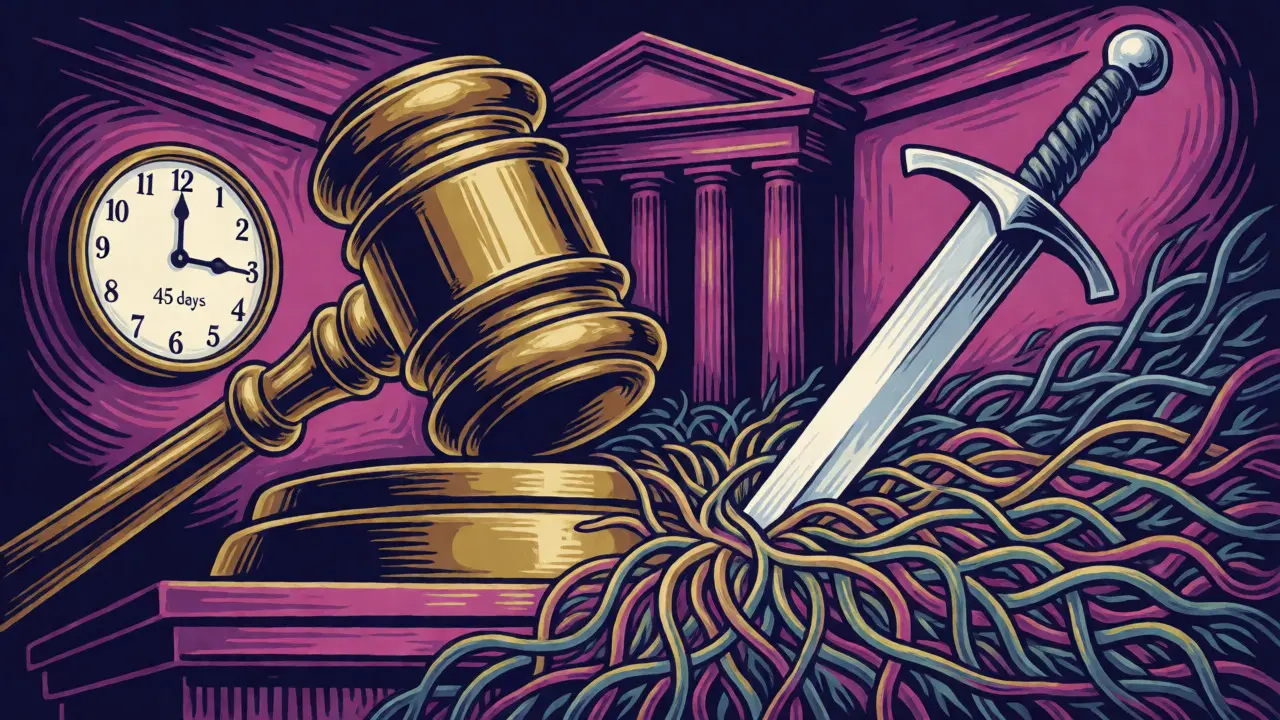
- The 45-Day Window: The brand company has exactly 45 calendar days to sue for patent infringement. If they miss this deadline, they lose the right to trigger the automatic stay.
- The 30-Month Stay: If the brand sues in time, the FDA automatically pauses approval of the generic for 30 months. This gives the brand time to fight the challenge in court.
- Litigation: Both sides argue over claim construction-what the patent words actually mean-and validity. Courts often decide these cases based on technical interpretations rather than medical efficacy.
If the generic wins, the FDA approves the drug immediately. If the brand wins, the generic waits until the patent expires. But what happens if no one sues? The FDA can approve the generic after 45 days, regardless of patent status, because the brand forfeited its procedural advantage.
The Prize: 180 Days of Exclusivity
Why do generic companies spend millions suing giants like Pfizer or AbbVie? For the first-to-file applicant, the reward is 180 days of marketing exclusivity. During this period, only the first successful challenger can sell the generic version. No other generics can enter the market.
This window is lucrative. Since the brand price remains high but competition is limited to one generic, the filer captures 70-80% of the generic market share. Consider the case of Barr Laboratories challenging Eli Lilly’s Prozac. After years of litigation, Barr won in 2000, invalidating a key patent and securing massive sales during its exclusive period. Without this incentive, few companies would risk the cost and uncertainty of Paragraph IV litigation.
Strategic Risks and Costs
Paragraph IV battles are not for the faint-hearted. Average costs hit $7.8 million per case, according to Winston & Strawn LLP. You need deep pockets for expert witnesses, scientific analysis, and legal teams. Plus, there is the risk of losing. In 2017, Mylan lost against Novartis’ Gleevec and faced billions in potential damages for willful infringement.
Brands also have defensive tools. They often employ "evergreening," filing secondary patents for formulations or methods of use to create patent thickets. By 2020, drugs averaged 4.8 patents each, up from 1.2 in 1984. These layers make it harder for generics to win outright. Sometimes, brands settle by paying the generic to delay entry-a practice known as "pay-for-delay." The Supreme Court cracked down on this in FTC v. Actavis (2013), but settlements remain common.
Comparison: Paragraph IV vs. Other Challenges
Not every patent challenge looks the same. Here is how Paragraph IV stacks up against alternatives:
| Mechanism | Venue | Burden of Proof | Exclusivity Reward |
|---|---|---|---|
| Paragraph IV | Federal District Court | Preponderance of Evidence | 180 Days |
| Inter Partes Review (IPR) | PTAB | Clear and Convincing | None |
| BPCIA (Biosimilars) | Federal District Court | Varies | 12 Months |
Paragraph IV offers a lower burden of proof than PTAB proceedings, making it easier to invalidate weak patents. However, IPR is cheaper ($2.1 million avg) and faster. Smart strategists often run parallel tracks: filing an IPR at the USPTO while pursuing Paragraph IV in court. This coordinated approach increases pressure on brand holders, who face attacks from two fronts.
Impact on Consumers and the Market
When Paragraph IV works, consumers win big. Dr. Margaret Kyle’s research shows generic entry drops prices by 79% within six months. Between 2009 and 2019, these challenges saved Americans $1.68 trillion. Yet, barriers persist. Brands use citizen petitions to delay approvals, and complex patent landscapes slow down even strong cases.
Recent laws like the CREATES Act help generics get samples needed for testing, removing another hurdle. Still, the game is evolving. With effective exclusivity stretching to 14.7 years due to strategic patenting, the battle between innovation incentives and affordable access continues. Understanding Paragraph IV helps you see behind the curtain of drug pricing-it’s not just chemistry; it’s law.
What does a Paragraph IV certification actually say?
It states that the patents listed for the reference drug are either invalid, unenforceable, or will not be infringed by the generic product. It serves as formal notice to the brand owner.
How long does the FDA wait after a Paragraph IV filing?
If the brand company files a patent infringement lawsuit within 45 days, the FDA imposes an automatic 30-month stay on approval. If no suit is filed, approval can proceed after 45 days.
Who gets the 180-day exclusivity period?
The first generic manufacturer to file a substantially complete ANDA with a Paragraph IV certification and successfully defend the patent challenge receives this exclusive market period.
Can a brand company block generic entry forever using Paragraph IV?
No. While the 30-month stay delays approval, it doesn't prevent it indefinitely. If the court rules in favor of the generic, the FDA approves the drug immediately upon decision.
What happens if multiple generics file Paragraph IV certifications?
Only the first-to-file applicant gets the 180-day exclusivity. Others must wait for that period to end or for the first filer to launch their product before they can enter the market.