Pterygium: How Sun Exposure Causes Eye Growth and What Surgery Can Do

A pterygium isn’t just a spot on your eye-it’s a warning sign. If you’ve ever looked in the mirror and seen a fleshy, pinkish wedge creeping from the white of your eye toward your pupil, you’re not alone. This growth, often called pterygium, affects millions worldwide, especially those who spend time outdoors under the sun. It’s not cancer. It’s not an infection. But left unchecked, it can blur your vision, make contact lenses unbearable, and leave you feeling like your eyes are always grittier than they should be.
What Exactly Is a Pterygium?
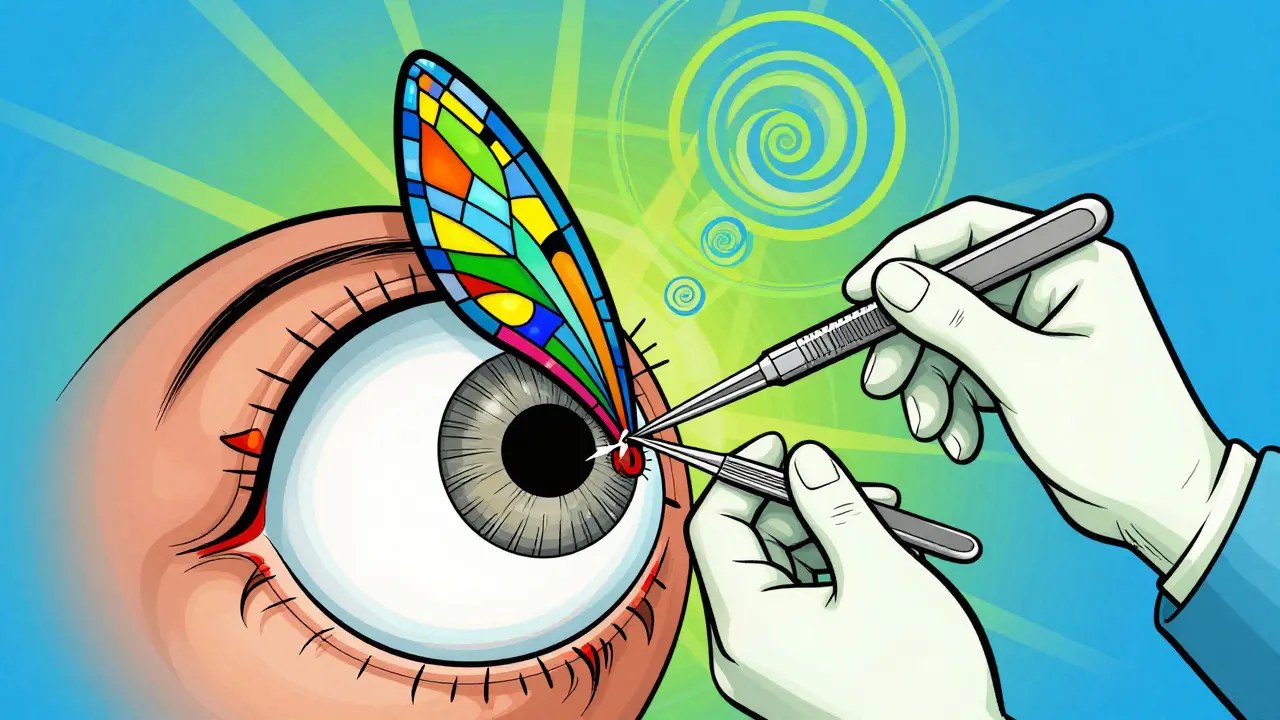
A pterygium is a growth of the conjunctiva-the clear, thin membrane that covers the white part of your eye. It starts near the nose, usually, and slowly stretches across the sclera toward the cornea, the clear front surface of your eye. When it crosses that line, it becomes a pterygium. If it stays on the white part only, it’s called a pinguecula. The difference matters because only pterygium can interfere with vision.
It looks like a small, triangular wing-hence the name, from the Greek word pterygion, meaning “little wing.” The tissue is often pink or red, with visible tiny blood vessels. At first, it might be no bigger than a pinhead. But under constant sun exposure, it can grow to 2-5 millimeters wide at the base, and sometimes even cover part of the pupil.
It’s not rare. Around 12% of Australian men over 60 have it. In places near the equator, like parts of Central America, Southeast Asia, or northern Australia, the rate jumps to 20% or higher. Globally, about 15 million people are diagnosed each year. It’s the third most common eye surface disorder after cataracts and glaucoma.
Why Does the Sun Cause It?
The science is clear: ultraviolet (UV) light is the biggest trigger. Studies show people living within 30 degrees of the equator have more than double the risk. For every 15,000 joules of UV radiation your eyes absorb over your lifetime, your chance of developing pterygium goes up by 78%.
It’s not just beach days or tropical vacations. Think about your daily routine: commuting in a car without UV-blocking windows, walking the dog in the morning, fishing, gardening, or working outside. Even on cloudy days, up to 80% of UV rays still get through. Over years, that adds up.
Some people think genetics play a role-studies show higher rates among close relatives. But most experts agree environmental exposure accounts for at least 85% of cases. Men are diagnosed more often than women, likely because they spend more time in high-UV outdoor jobs like farming, construction, or fishing.
And it’s not just about location. The UV index matters. When it hits 3.0 or higher-which happens over 200 days a year in tropical zones-your eyes need protection. Yet, most people don’t wear sunglasses unless it’s blazing bright. That’s the mistake.
How It Affects Your Vision
Early-stage pterygium often causes little more than redness, irritation, or the feeling that something’s stuck in your eye. But as it grows, things change.
If the growth reaches the cornea, it can distort its shape. That leads to astigmatism-something you might not notice until your vision suddenly becomes blurry, even with your current glasses. Contact lens wearers often complain they can’t wear their lenses anymore. The pterygium creates an uneven surface that makes lenses slip, rub, or feel uncomfortable.
Advanced cases can block your line of sight. One Reddit user, who’d surfed for 15 years without eye protection, said his vision started blurring when the growth reached his pupil. That’s not an exaggeration. Surgeons have seen cases where pterygium covers 30% of the cornea, making reading, driving, or recognizing faces difficult.
And here’s the catch: it doesn’t always grow fast. Some people have had the same small pterygium for 20 years. Others see it double in size within a year. That’s why regular eye exams are crucial-especially if you’re in a high-risk group.
Surgical Options: When and How
Most pterygia don’t need surgery. If it’s small, not bothering you, and not growing, your doctor will likely just monitor it. But if it’s affecting your vision, causing constant discomfort, or just looks unsightly, surgery becomes an option.
The most common procedure is surgical removal. But here’s the problem: if you just scrape it off, it comes back in 30-40% of cases. That’s why modern techniques focus on preventing recurrence.
Conjunctival autograft is now the gold standard. During this surgery, the pterygium is removed, and a small piece of healthy conjunctiva is taken from another part of your eye (usually near the top) and stitched over the area. It’s like patching a hole with your own tissue. Recurrence rates drop to about 8.7%.
Mitomycin C is often used with the graft. It’s a mild chemotherapy drug applied during surgery to kill off the cells that cause regrowth. Used correctly, it cuts recurrence down to 5-10%. It’s safe when applied briefly and washed out afterward.
A newer option gaining traction is amniotic membrane transplantation. This uses tissue from donated placenta, which has natural anti-inflammatory and healing properties. European guidelines now recommend it for recurrent pterygium, with success rates above 90% in preventing regrowth.
The surgery itself takes 30-45 minutes. It’s done under local anesthesia-you’re awake but feel no pain. Recovery is usually quick: most people return to normal activities in a week. But the healing process takes longer. You’ll need steroid eye drops for 4-6 weeks to reduce swelling and inflammation. Some patients say the drops are more annoying than the surgery.
What to Expect After Surgery
Post-op discomfort is normal. Your eye will be red, watery, and sensitive to light for the first few days. That’s why many patients avoid screens and driving for a few days. The redness can last up to six weeks, which bothers some people cosmetically.
But the results? Most patients report immediate relief from irritation. Eighty-seven percent of reviews on health platforms mention “significant relief.” Sixty-five percent say their vision improved right away. One patient on RealSelf said, “The surgery took 35 minutes, but the steroid drops regimen for 6 weeks was more challenging than expected.” That’s the trade-off.
Recurrence is still the biggest fear. About one in three patients see it come back without proper treatment. That’s why follow-up visits are non-negotiable. Your doctor will check for signs of regrowth at 1 month, 3 months, and 6 months after surgery.

Prevention: Your Best Defense
Here’s the truth: surgery fixes the problem, but it doesn’t stop the cause. If you keep exposing your eyes to UV light, you’re just setting yourself up for another one.
The best prevention? Wear sunglasses that block 99-100% of UVA and UVB rays. Look for the ANSI Z80.3-2020 standard on the label. Wraparound styles work best-they stop UV from entering from the sides. A wide-brimmed hat adds another 50% protection.
Don’t wait until you see a growth. Start now. Even if you’re 25 and think you’re fine, UV damage builds up silently. One patient on r/EyeHealth said: “Wearing UV-blocking sunglasses daily has stopped the progression of my early-stage pterygium.” That’s the power of prevention.
Also, consider UV-protective contact lenses if you wear them. Some brands now include built-in UV filters. Not a replacement for sunglasses, but an extra layer.
What’s New in Treatment
The field is evolving. In March 2023, the FDA approved OcuGel Plus, a preservative-free lubricant designed specifically for post-surgery patients. Clinical trials showed it reduced dryness and irritation by 32% compared to standard eye drops.
Researchers are also testing topical rapamycin, a drug that stops abnormal cell growth. Early Phase II trials showed a 67% drop in recurrence at 12 months. If approved, this could become a daily drop to prevent regrowth-no surgery needed.
Laser-assisted removal is on the horizon. By 2027, experts predict 78% of surgeons will use lasers to remove pterygium with more precision and less tissue damage. It’s not common yet, but it’s coming.
Who’s at Risk-and What to Do
You’re at higher risk if:
- You live near the equator (within 30° latitude)
- You spend more than 4 hours a day outdoors
- You’re male and over 40
- You work in construction, farming, fishing, or outdoor sports
- You don’t wear UV-blocking sunglasses regularly
If any of this sounds familiar, get your eyes checked. No special test is needed-just a simple slit-lamp exam by an optometrist or ophthalmologist. It takes five minutes. No needles. No pain.
And if you already have a pterygium? Don’t panic. Most stay small. But track it. Take photos of your eye every six months with good lighting. Compare them. If it’s growing, talk to your doctor.
And remember: once you’ve had it, you’re more likely to get it again. Prevention isn’t optional. It’s essential.
Can pterygium go away on its own?
No, pterygium doesn’t disappear without treatment. It might stop growing if UV exposure is reduced, but it won’t shrink or vanish on its own. Left untreated, it can continue to grow and affect vision. Early intervention with sunglasses and eye protection can prevent progression, but surgery is the only way to remove it completely.
Is pterygium surgery painful?
The surgery itself isn’t painful. Local anesthesia numbs the eye, so you won’t feel anything during the procedure. Afterward, you may experience mild discomfort, burning, or a gritty feeling for a few days. Most patients manage this with over-the-counter pain relievers and prescribed eye drops. The worst part for many is the 4-6 weeks of steroid drops needed to prevent swelling and recurrence.
Can I still wear contact lenses after pterygium surgery?
Yes, most people can wear contact lenses again after surgery, but not right away. You’ll need to wait until your eye is fully healed-usually 4 to 8 weeks. Your doctor will check your cornea’s shape before giving you the green light. If the pterygium caused astigmatism, your lens prescription may need to be updated. Some patients find they can wear lenses more comfortably after surgery because the surface of the eye is smoother.
How long does it take to recover from pterygium surgery?
Most people return to normal daily activities within a week. However, full healing takes 4-6 weeks. Redness and sensitivity to light can last up to two months. You’ll need to use steroid and antibiotic eye drops for 4-6 weeks to prevent infection and regrowth. Avoid swimming, dusty environments, and rubbing your eyes during recovery. Follow-up visits are critical-especially at the 1-month and 3-month marks.
Are there non-surgical treatments for pterygium?
There’s no cure without surgery, but you can manage symptoms. Artificial tears help with dryness and irritation. Lubricating gels like OcuGel Plus, approved in 2023, are designed specifically for post-pterygium care and reduce discomfort better than standard drops. Anti-inflammatory drops may help if the area is swollen or red. But these don’t stop growth-they only make you more comfortable. The only way to remove the tissue is surgery.
Can pterygium cause permanent vision loss?
Permanent vision loss is rare, but possible if the pterygium grows large enough to cover the center of the cornea and cause severe astigmatism. In extreme cases, it can block light from entering the eye. Early detection and treatment prevent this. Most people who get surgery before the growth reaches the pupil regain full vision. Delaying treatment increases the risk of lasting visual changes.
Mel MJPS
January 28, 2026 AT 12:07I had a tiny pterygium for years and didn’t even notice until my optometrist pointed it out. I started wearing my cheap polarized sunglasses every day-even to the grocery store-and it hasn’t grown since. Simple stuff, but it works.
Also, I use those UV-blocking contacts now. Not a cure, but it feels like I’m giving my eyes a break.
Kathy Scaman
January 29, 2026 AT 20:39My dad got it after 30 years of fishing in Florida. He refused surgery until it started blurring his vision-then he was like ‘okay fine, I’ll do it.’
Turns out the steroid drops were worse than the surgery. He cried over eye drops for six weeks. Worth it though. Vision’s perfect now.
Anna Lou Chen
January 30, 2026 AT 04:50Let’s be real-the pterygium isn’t the disease, it’s the symptom of a civilization that commodifies sunlight while denying its biological consequences.
We’ve engineered UV into our architecture, our vehicles, our lifestyles-and then wonder why our conjunctiva rebels.
The human eye evolved under equatorial skies, not behind tinted windshields and LED screens.
This isn’t a medical issue-it’s a metaphysical rupture between organism and environment.
Amniotic membrane transplants? Mitomycin C? These are Band-Aids on a corpse.
We need a cultural reckoning with phototoxicity, not surgical patch jobs.
And yes, I’ve read the studies. And no, sunglasses don’t solve the epistemological crisis of ocular neglect.
Mindee Coulter
January 30, 2026 AT 22:48Just got my first pair of wraparounds with the ANSI label and I feel like a superhero
Wear them while biking, gardening, even walking the dog
No more red eyes in the morning
Why didn’t I do this sooner
Chris Urdilas
February 1, 2026 AT 21:14So let me get this straight-you spend 20 years in the sun, get a growth that looks like a tiny wing on your eyeball, and now you’re supposed to wear sunglasses like it’s 1998?
Meanwhile, the guy who sat in an office all day with a 12-hour screen binge gets macular degeneration.
Who’s the real villain here, the sun or our collective denial?
Also, I’ve seen people with pterygium and they look like they’ve been in a fight with a seagull. No shame in the game.
Phil Davis
February 2, 2026 AT 18:54My brother had surgery last year. He said the worst part wasn’t the drops or the redness-it was the way people stared at his eye like it was a Halloween prop.
He got asked if he was in a band or if it was a tattoo.
Turns out, the human eye is just… weirdly fascinating to people.
Anyway, he’s fine now. But he still wears his sunglasses indoors. Just in case.
Irebami Soyinka
February 3, 2026 AT 04:56USA and Canada think they’re safe? LOL
You think UV is bad in Lagos? We have sun that burns your soul before breakfast.
I’ve seen boys with pterygium so big they look like they got a second eyelid.
But we don’t whine-we wear our hats, we use our coconut oil, we pray to Oya.
And if you still get it? That’s your fault for not respecting the sun.
Stop buying fancy drops and start respecting your ancestors’ wisdom.
👁️🔥
Sue Latham
February 4, 2026 AT 19:22Oh my god I just realized I’ve been wearing ‘UV protection’ sunglasses from that 2010 clearance sale at Target.
They probably block 12% of UV if it’s a cloudy Tuesday.
I’m getting new ones today. Like, right now.
Also, I’ve been using that OcuGel Plus thing-why didn’t anyone tell me this existed? It’s like a spa day for my eyeballs.
And no, I don’t care if it costs $45. My cornea deserves better than Walmart’s ‘sunglasses for $5’.
Lexi Karuzis
February 5, 2026 AT 06:09Wait… so you’re telling me the government doesn’t warn us about this? And eye doctors just… wait? And sunglasses are optional? And UV rays are still getting through clouds? And they’re testing topical rapamycin? But it’s not FDA-approved yet? And the real reason pterygium is rising is because of 5G satellites reflecting UV? And the eye drops contain nanoparticles that make you forget your own name? And the ‘autograft’ is just a cover-up for corporate eye surgery profits? And if you don’t wear UV-blocking contact lenses AND a hat AND sunglasses AND stay indoors after 10am, you’re basically signing a death warrant for your vision? And this is why your eyes are failing? And nobody’s talking about it? And why is the FDA so slow? And why is this not on the news? And why are we still letting corporations sell us fake UV protection? And why are we still letting people walk around without protection? And why are we still letting this happen? And why? And why? And why?
Brittany Fiddes
February 5, 2026 AT 22:10Oh, so now we’re romanticizing the ‘tropical eye’ like it’s some kind of poetic badge of honor?
Let me tell you, in the UK, we don’t get pterygium because we don’t have the arrogance to believe the sun is our friend.
Here, we wear hats indoors, we use UV-filtering window film, and we treat sunlight like a hostile entity.
And yet, you Americans think a $15 pair of sunglasses from the beach stand is ‘protection’?
Pathetic.
My ophthalmologist in London told me pterygium is a third-world eye disease.
And you’re proud of it?
Ambrose Curtis
February 7, 2026 AT 09:10Been a nurse for 12 years, seen a ton of these.
Most patients are shocked it’s not cancer.
One guy thought it was a spider egg.
Another tried to scrape it off with a credit card.
Don’t do that.
Surgery is way less scary than you think.
They numb your eye, you just feel pressure.
And yeah, the drops suck-but they’re your new best friends.
And if you’re gonna surf, fish, or work outside-just wear the damn shades.
It’s not that hard.
James Dwyer
February 9, 2026 AT 05:01Just got my first pterygium check-up and the doc said it’s tiny and stable.
Best news I’ve had all year.
I’m wearing my sunglasses now, even when it’s cloudy.
And I’m telling everyone I know.
You don’t need to wait until it’s big.
Protect your eyes like they’re your favorite phone.
Because they’re way more important.
doug b
February 9, 2026 AT 10:15My uncle got his removed last year.
He’s 72, retired fisherman, lived in Florida since he was 18.
He said the surgery was a breeze.
The drops? A nightmare.
He forgot to put them in three times and the doc gave him a lecture that lasted 20 minutes.
Now he wears his shades everywhere.
Even to church.
And he’s not even embarrassed.
He says, ‘I’d rather look like a spy than go blind.’
Wise man.
Howard Esakov
February 11, 2026 AT 07:16Oh wow, a whole article about a ‘little wing’ on the eye and nobody mentioned the real issue: the fact that 90% of people who get pterygium are men who think ‘I don’t need sunglasses, I’ve got good vision.’
Meanwhile, women are out here in wraparounds like it’s fashion week.
And yet, men are the ones getting the surgeries.
It’s not about UV exposure.
It’s about masculinity.
And your ego.
And your refusal to look like a person who cares about their health.
Just wear the damn glasses.
It’s not a weakness.
It’s a power move.