Stability Testing for Generics: FDA Requirements Explained
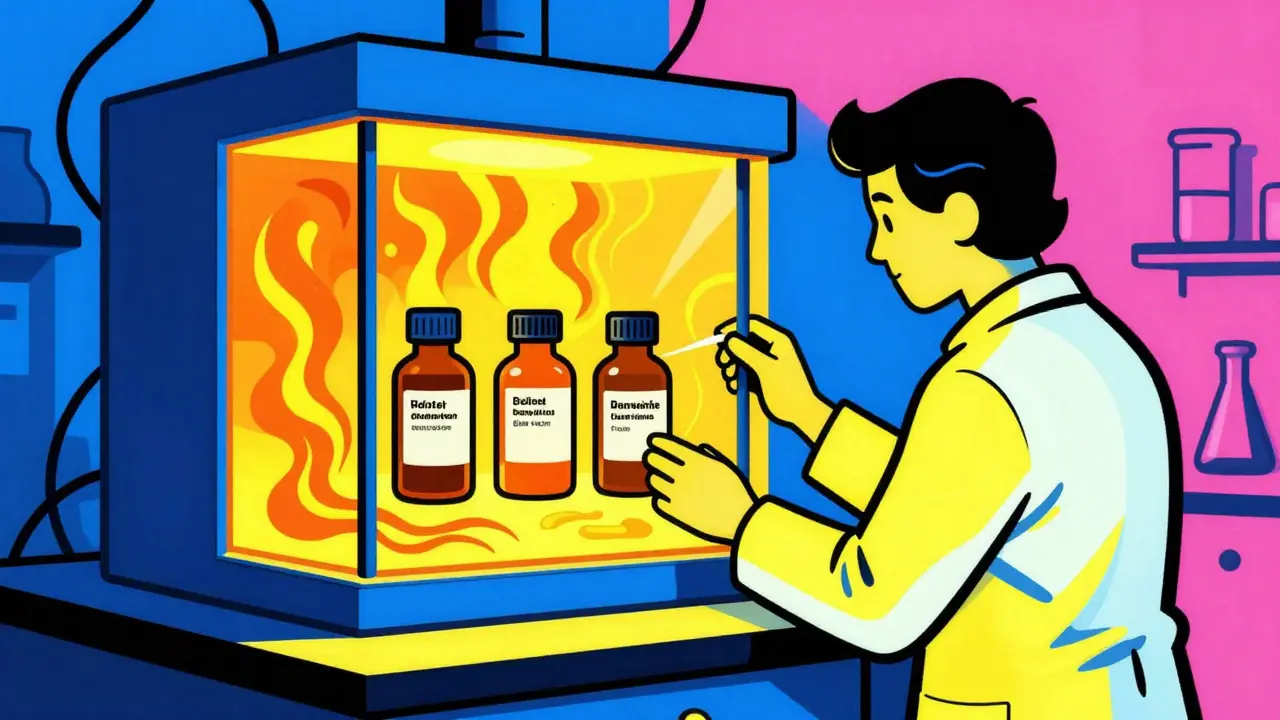
Imagine buying a bottle of blood pressure medication that looks exactly like the brand-name version but loses its potency after just three months on the shelf. This is precisely why stability testing is the rigorous scientific process used to determine how drug quality changes over time under various environmental conditions matters so much in pharmaceutical regulation. For generic drugs, this isn't just about quality control; it's a legal requirement enforced by the U.S. Food and Drug Administration (FDA) to ensure patient safety. If you are developing or reviewing an Abbreviated New Drug Application (ANDA), understanding these rules is not optional-it is the difference between approval and a Complete Response Letter.
The Regulatory Foundation: Hatch-Waxman and ICH Guidelines
To understand where we stand today, we have to look at the foundation laid by the Hatch-Waxman Act is the 1984 legislation that created the modern pathway for generic drug approval via ANDAs. This act established that generics must be bioequivalent to their Reference Listed Drugs (RLDs). But bioequivalence alone doesn't guarantee that the drug will stay effective until the expiration date printed on the box. That’s where international standards come in.
The FDA relies heavily on guidelines from the International Council for Harmonisation (ICH) is a global organization that harmonizes regulatory requirements for pharmaceuticals to ensure quality and safety. Specifically, the guidance document ICH Q1A(R2) is the standard guideline for stability testing of new drug substances and products, revised in 2003 sets the baseline. However, for generics, the FDA issued specific clarifications in their 2018 guidance titled "ANDAs: Stability Testing of Drug Substances and Products Questions and Answers." This document bridges the gap between general ICH principles and the specific realities of generic manufacturing. It mandates that your stability data must prove your generic performs equivalently to the RLD throughout its intended shelf life.
Core Technical Requirements for Generic Stability Studies
So, what exactly does the FDA expect to see in your submission? The requirements are precise and non-negotiable. First, you cannot test just one batch. The FDA requires stability studies on at least three primary batches of the drug product. These batches must be manufactured at a minimum pilot scale that meets current Good Manufacturing Practices (cGMP) as defined in 21 CFR Parts 210 and 211. Why three? Because manufacturing variability exists, and you need statistical confidence that the process is robust.
Here is the breakdown of the testing schedule you must follow:
- Batch Size: Minimum pilot scale, representative of commercial production.
- Number of Batches: At least three distinct batches.
- Container Closure: Must be identical to the final marketing package. You cannot test in vials if you plan to sell in bottles.
- Testing Frequency: Every 3 months during the first year, every 6 months during the second year, and annually thereafter through the proposed shelf life.
You also need to test all attributes that could change during storage. This includes physical properties (like hardness or dissolution rate), chemical purity (degradation products), biological activity, and microbiological limits. If your drug has preservatives, you must test their efficacy over time. If it’s a complex delivery system, you must test functionality. Missing any of these is a common reason for rejection.
| Study Type | Temperature | Relative Humidity | Minimum Data Required for Submission |
|---|---|---|---|
| Long-Term | 25°C ± 2°C | 60% ± 5% | 12 months (for proposed shelf life ≥ 12 months) |
| Accelerated | 40°C ± 2°C | 75% ± 5% | 6 months |
| Intermediate | 30°C ± 2°C | 65% ± 5% | Required only if excursions occur at accelerated conditions |
Submission Strategy: Completeness vs. Full Review
A major point of confusion for many applicants is how much data to submit initially. The FDA uses a two-step review process: Completeness Assessment and Scientific Review. You do not need to wait 12 months to file your ANDA, but you can’t file with nothing either.
For the Completeness Assessment, the FDA requires:
- A detailed stability protocol.
- Commitments to continue the study.
- Data showing the studies have started.
- Initial results plus one additional time point for both accelerated and long-term studies.
This means if you propose a 24-month shelf life, you might submit initial data and one 3-month data point for long-term, and initial and one 1-month data point for accelerated. However, for the Full Scientific Review, the bar is higher. You generally need 6 months of accelerated data and 6 months of long-term data from pilot-scale batches before the FDA will approve the application. If you don’t meet these milestones, your application stalls. Dr. Jane Axelrad, former FDA Deputy Director for Generic Drugs, noted that stability data is the single most common reason for Complete Response Letters, accounting for nearly 35% of deficiency letters in recent years. Don’t let your application become a statistic.
Common Pitfalls and How to Avoid Them
Even experienced manufacturers trip up on stability testing. Based on FDA inspection reports and industry analyses, here are the biggest traps:
1. Inadequate Protocol Design Ninety-eight percent of completeness assessment failures relate to missing or inadequate protocols. Your protocol must explicitly reference USP chapters <1151> Pharmaceutical Dosage Forms and <1010> Analytical Data. Vague descriptions like "we will test for impurities" are not enough. You must specify which impurities, which methods, and acceptance criteria.
2. Environmental Control Failures It sounds simple, but keeping a stability chamber at 25°C ± 2°C is harder than it looks. FDA 483 observations in 2022 showed that temperature deviations exceeding ±2°C accounted for 18.4% of stability data invalidations. One facility had average excursions of 4.7°C occurring twice a month. Use automated environmental monitoring systems with alarms. Manual logging is prone to human error and is increasingly viewed skeptically by inspectors.
3. Insufficient Method Validation Your analytical methods must be "stability-indicating." This means they can separate the active ingredient from its degradation products. Thirty-one percent of Complete Response Letters cited insufficient validation of these methods. If your HPLC method can’t distinguish between the drug and its breakdown products, your purity data is useless.
4. Ignoring Container Closure Interactions If you change the bottle size or the cap liner, you may need to retest. The FDA requires testing for each individual strength and container size unless you use scientifically justified bracketing or matrixing designs. Bracketing tests the extremes (e.g., smallest and largest sizes), while matrixing tests a subset of combinations. These strategies were approved in 67.3% of ANDAs that requested them in 2022, but you must justify them statistically in your protocol.
Generics vs. Innovators: What’s Different?
You might wonder if generics get a pass because the brand-name drug (RLD) already has decades of stability data. The short answer is no. While you can reference the RLD’s degradation pathways to support your design, you must conduct your own formal studies. Your formulation, excipients, or manufacturing process might introduce unique stability risks.
However, there is one advantage: you typically don’t need to conduct extensive forced degradation studies to discover new degradation pathways, as those are already characterized for the RLD. Your job is to demonstrate that your product follows the same profile. The challenge lies in execution. A 2021 analysis noted that 92.7% of stability-related deficiencies in generic applications stemmed from inadequate protocols or insufficient data points, compared to 78.4% for innovator applications. This suggests that generic manufacturers, often operating under tighter margins and timelines, face steeper challenges in meeting these rigorous standards.
Future Outlook: What’s Changing in 2026?
Regulatory landscapes shift. As of mid-2026, keep an eye on the FDA’s draft guidance Q1 Stability Testing of Drug Substances and Drug Products, released in June 2025. Key proposed changes include:
- Mandatory 24-Month Data: All new ANDAs may soon require 24 months of stability data upfront, up from the current 12-month norm.
- Quality by Design (QbD): Greater emphasis on designing stability studies based on critical quality attributes rather than just checking boxes.
- Nanomaterials: Specific new requirements for drugs containing nanomaterials, which behave differently under stress.
Additionally, the ICH is revising Q1C(R2) for photostability testing, which will affect climate zone-specific storage conditions for roughly 73% of generic products. Costs are expected to rise by over 20% between 2023 and 2027 due to these stricter demands. Planning now for longer data collection periods will save you from delays later.
Practical Next Steps for Manufacturers
If you are preparing an ANDA, start with a pre-submission meeting with the FDA. Internal data shows this reduces deficiency rates by 42.6%. Ensure your stability chambers are calibrated and monitored automatically. Validate your analytical methods thoroughly before starting the study. And remember, stability testing is not a race; it’s a marathon. Rushing the process leads to rejected applications, which cost far more in lost time and resources than waiting for the data to mature.
How many batches are required for generic drug stability testing?
The FDA requires stability studies on at least three primary batches of the drug product. These batches must be manufactured at a minimum pilot scale that complies with current Good Manufacturing Practices (cGMP).
What is the minimum stability data required for ANDA submission?
For Completeness Assessment, you need a protocol, commitments, and initial data plus one additional time point for both accelerated and long-term studies. For full scientific review, the FDA typically requires 6 months of accelerated data and 6 months of long-term data.
Can generic manufacturers use bracketing or matrixing for stability testing?
Yes, if scientifically justified. Bracketing involves testing only the extreme strengths and container sizes, while matrixing tests a subset of combinations. These approaches were approved in 67.3% of ANDAs that included such requests in 2022, provided the justification is robust.
Why do so many generic ANDAs fail stability reviews?
Common reasons include inadequate testing protocols (missing specific methodologies), insufficient data points, failure to test all required attributes, and environmental control failures in stability chambers. Stability data accounts for approximately 34.6% of all Complete Response Letters for generics.
Do generic drugs need to match the brand-name drug's exact stability profile?
While generics don't need to replicate the brand-name drug's historical data, they must demonstrate equivalent performance and degradation profiles. You must conduct your own studies to prove that your specific formulation and manufacturing process yield a stable product with the proposed shelf life.
What are the upcoming changes to FDA stability testing guidelines?
The FDA's 2025 draft guidance proposes mandatory 24-month stability data for new ANDAs, increased use of Quality by Design (QbD) principles, and specific requirements for nanomaterials. ICH revisions to photostability testing are also expected to impact climate zone-specific storage conditions.