Food Labels and Allergies: Hidden Allergens and Safety in 2025
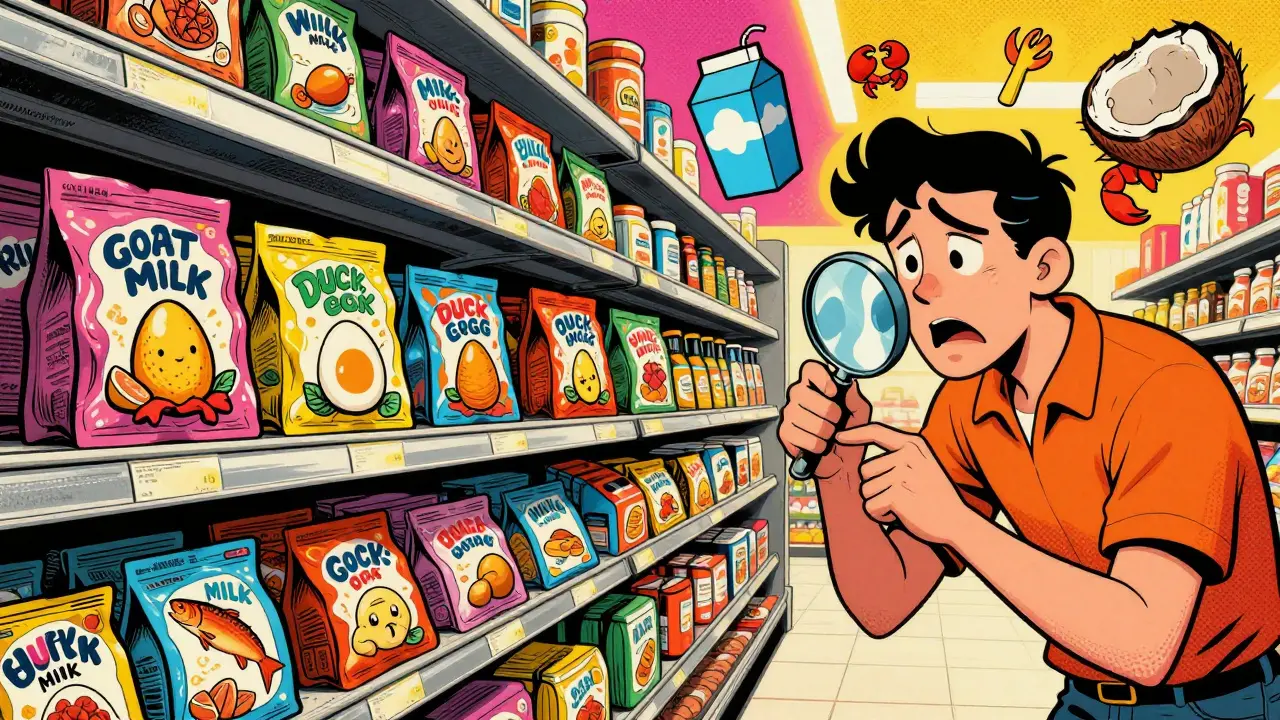
Every time you pick up a packaged food, you’re making a decision that could mean the difference between a safe meal and a trip to the ER. For the 32 million Americans with food allergies, reading labels isn’t just a habit-it’s a survival skill. And since January 2025, the rules have changed. The FDA’s updated guidance on food allergen labeling brings clearer rules, stricter definitions, and new risks you need to know about.
What’s Actually in Your Food? The New Labeling Rules
Before 2025, a label might say “milk” or “egg.” Now, it has to say goat milk or duck egg. That’s not a minor tweak-it’s a game-changer. If you’re allergic to cow’s milk but can tolerate goat milk, you used to have to call the manufacturer. Now, the label tells you right away. Same with eggs: quail, duck, chicken-each source must be named. This change alone helps millions of people avoid accidental exposure.
Fish labels now require species-level detail. “Fish” isn’t enough anymore. Is it trout? Shark? Lamprey eel? Each belongs to a different category-bony, cartilaginous, or jawless-and each can trigger a different reaction. If you’re allergic to cod but not tuna, you need to know which one’s in there.
Tree nuts got a major update too. Coconut is no longer considered a tree nut under federal labeling rules. That’s good news for the 0.04% of people allergic to coconut, but it also means people with peanut or almond allergies can now safely eat coconut milk or coconut oil without fear of mislabeling. This wasn’t a scientific error-it was a long-overdue correction based on how the immune system actually reacts.
The Shellfish Trap: What’s Missing from the Label
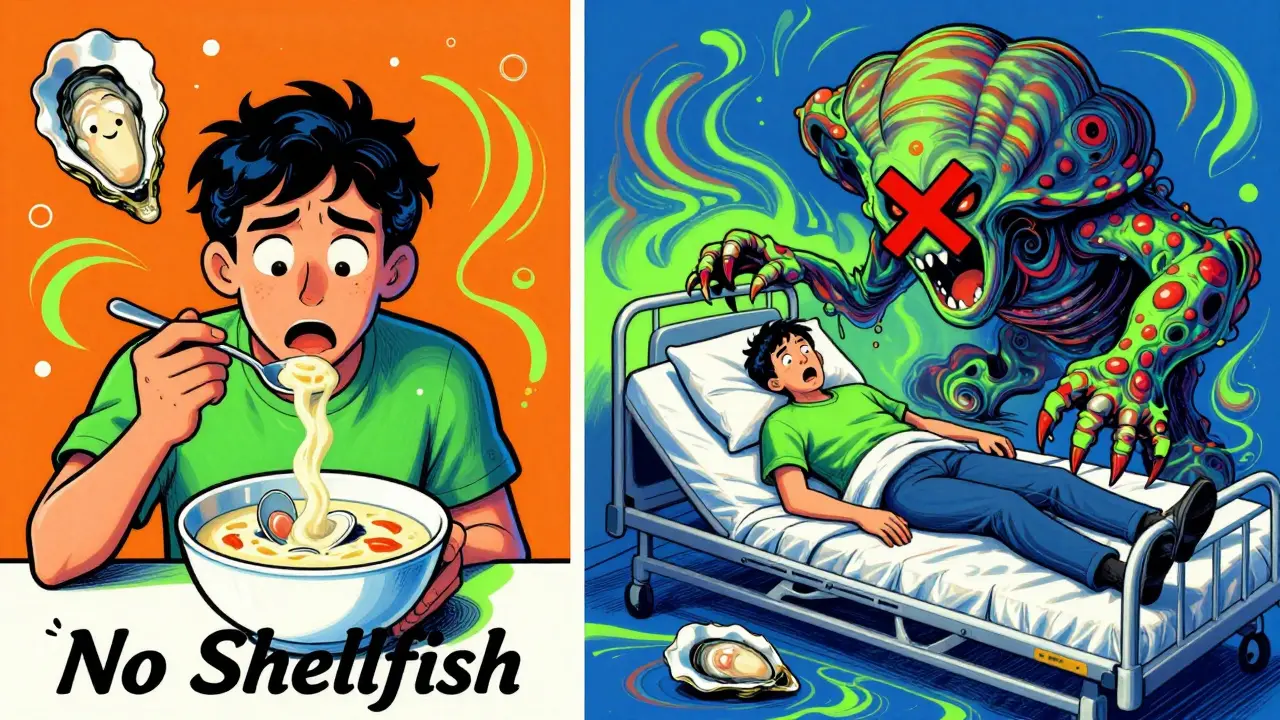
Here’s where things get dangerous. Shellfish used to mean shrimp, crab, lobster-and also oysters, clams, and scallops. Now, under the 2025 FDA guidance, shellfish means only crustaceans. Mollusks? They’re off the list. That means if you’re allergic to oysters, your label might say “no shellfish” and you’ll assume it’s safe. It’s not. The allergen isn’t required to be listed. An estimated 1.5 million Americans have mollusk allergies, and many don’t even realize they’re at risk because the label doesn’t warn them.
Reddit threads from r/foodallergies show real panic. One user wrote: “I ate a clam chowder labeled ‘no shellfish’ and ended up in the hospital. I thought ‘shellfish’ meant shrimp and crab. I didn’t know clams were different.” That’s exactly what the FDA didn’t anticipate. The change makes labeling simpler for manufacturers, but it leaves a blind spot for consumers.
“Free-From” Claims Can’t Be Lied About
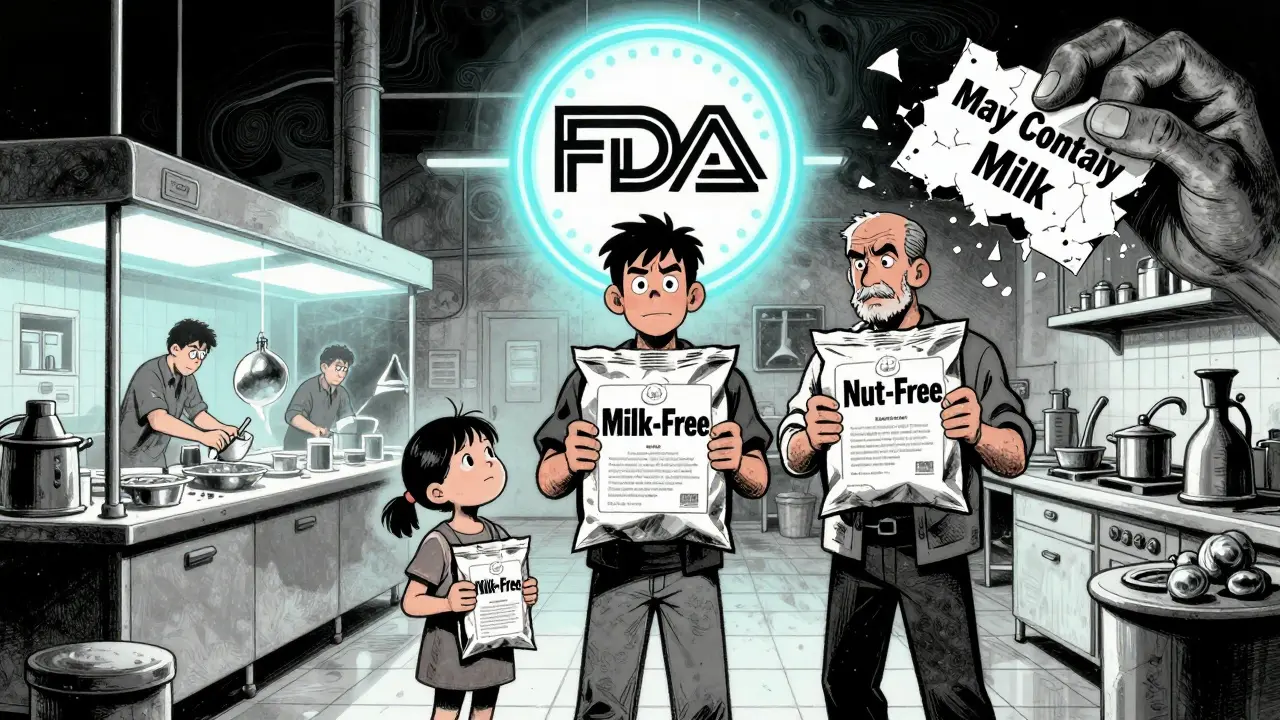
You’ve seen it: “Gluten-Free,” “Nut-Free,” “Dairy-Free”-then right below it: “May contain traces of milk.” That contradiction used to be legal. Now, it’s not. If a product says “milk-free,” it can’t also say “may contain milk.” The FDA says that’s misleading. Companies can’t have it both ways. If they claim a product is free of an allergen, they must prove it.
This means manufacturers now have to test their equipment, clean more thoroughly, and track every ingredient source. It’s expensive. Small companies might pay $5,000 to $15,000 to update one product line. But for families with kids who’ve had anaphylaxis, it’s worth it. No more guessing. No more hoping.
What About Cross-Contact? The Gray Area
“Made in a facility that also processes peanuts.” “Produced on shared equipment.” These statements are still voluntary. The FDA doesn’t require them. But if a company chooses to use them, they must be truthful. You can’t say “may contain peanuts” if your facility hasn’t touched peanuts in three years. That’s false advertising now.
But here’s the catch: cross-contact isn’t always avoidable. Even if a company cleans everything perfectly, airborne flour or dust from a nearby line can still trigger a reaction. That’s why some families avoid all products with advisory labels-even if they’re “truthful.” The science doesn’t yet tell us what level of exposure causes a reaction in every person. So many choose to play it safe: no advisory label = no risk. But that’s not always realistic.
Sesame, Soy, and the Future of Allergen Labels
Sesame became the ninth major allergen in 2023. Now, it’s required on every label. But the FDA isn’t stopping there. In January 2025, they released a separate document called “Evaluating the Public Health Importance of Food Allergens Other Than the Major Food Allergens.” That’s code for: we’re looking at adding more.
What’s next? Maybe mustard, celery, or lupin-common allergens in Europe but not yet tracked in the U.S. The FDA says they’ll use data on hospital visits, reaction severity, and prevalence to decide. If a food causes enough serious reactions, it could become mandatory to label. That’s the direction we’re heading.
For now, soy and wheat remain on the list. But even those have new traps. “Wheat” might mean semolina, farina, or spelt. “Soy” could be soy lecithin, soy protein isolate, or hydrolyzed vegetable protein. The label doesn’t always spell it out. That’s why you still need to read the full ingredient list-even if the “Contains” statement looks clean.
Who’s Affected? Real Numbers, Real Risks
Here’s what’s at stake:
- 32 million Americans have food allergies-5.6 million are children.
- 4.5 million are allergic to milk. Many are only allergic to cow’s milk, not goat or sheep.
- 2 million are allergic to eggs. Some react to chicken, but not duck or quail.
- 1.5 million are allergic to mollusks-oysters, clams, scallops. None of these are labeled as shellfish anymore.
- 0.04% are allergic to coconut. That’s small, but they’re no longer forced to avoid all tree nuts.
These aren’t abstract numbers. They’re parents, teachers, athletes, students. They’re the kid who had to bring their own lunch every day. The adult who can’t eat at a restaurant without calling ahead. The person who carries an EpiPen everywhere-even to the movies.
What You Should Do Now
Here’s your action plan:
- Check every label-even familiar brands. The “Contains” statement might look the same, but the ingredient list has changed.
- If you’re allergic to milk or eggs, look for the animal source. Don’t assume “milk” means cow’s milk.
- Be extra careful with seafood. “Shellfish” now means shrimp, crab, lobster only. Oysters and clams? They’re not labeled as allergens anymore.
- Don’t trust “free-from” claims unless the label has no “may contain” statement. If both appear, it’s a red flag.
- Keep a list of safe brands. Many companies are updating labels faster than others. Find the ones you can trust.
- Report confusing or misleading labels to the FDA. Consumer feedback drives change.
There’s no perfect system. But the 2025 guidance is the most accurate, science-backed labeling system the U.S. has ever had. It’s not foolproof, but it’s a huge step forward. The goal isn’t to scare you-it’s to give you the tools to eat with confidence.
Is coconut still considered a tree nut on food labels in 2025?
No. As of the FDA’s January 2025 guidance, coconut is no longer classified as a tree nut for allergen labeling purposes. This change was made because coconut is botanically a fruit, not a nut, and most people with tree nut allergies can safely eat it. Labels now list coconut separately, reducing unnecessary avoidance by those with peanut or almond allergies.
Can a product say “milk-free” and “may contain milk” on the same label?
No. The FDA’s 2025 guidance explicitly prohibits this. If a product claims to be free of an allergen, it cannot include a voluntary advisory statement like “may contain” for that same allergen. This rule prevents consumer confusion and ensures that “free-from” claims are trustworthy.
Are mollusks like oysters and clams labeled as allergens?
No. Under the 2025 FDA rules, shellfish allergen labeling only applies to crustaceans: shrimp, crab, and lobster. Mollusks-including oysters, clams, scallops, and mussels-are no longer required to be labeled as allergens. This creates a serious risk for the 1.5 million Americans allergic to mollusks, who may mistakenly assume a “no shellfish” label means the product is safe for them.
Do I still need to read the full ingredient list if the “Contains” statement looks clean?
Yes. The “Contains” statement only lists the top nine allergens in plain language, but allergens can appear under other names in the ingredient list. For example, “casein” is a milk protein, and “lecithin” can be soy-based. Always check the full list-even if the “Contains” box says nothing.
What should I do if I find a misleading food label?
Report it to the FDA through their Safety Reporting Portal or by calling 1-888-SAFEFOOD. Include the product name, brand, lot number, and a photo of the label. The FDA uses these reports to identify patterns and enforce compliance. Consumer reports are one of the main ways new labeling issues get addressed.
Angel Molano
January 13, 2026 AT 22:29This 'mollusk loophole' is a death sentence waiting to happen.
Kimberly Mitchell
January 15, 2026 AT 18:35The FDA’s terminology shift from 'shellfish' to 'crustaceans only' is a textbook example of regulatory over-optimization. You've removed ambiguity for manufacturers, but created a lethal cognitive dissonance for consumers who've spent decades internalizing 'shellfish = everything from the sea.' The science is sound, but the communication strategy is catastrophic. This isn't labeling-it's linguistic negligence.
Vinaypriy Wane
January 15, 2026 AT 20:30I’ve been managing my son’s clam allergy for years-this change terrifies me. I’ve told him, 'If it’s seafood and you’re not sure, don’t touch it.' But now, even the labels are lying by omission. How many parents will find out too late? I’ve written to my rep. This needs to be reversed.
Diana Campos Ortiz
January 17, 2026 AT 03:10Just checked my favorite coconut milk brand-it says 'tree nut free' now and I cried. My daughter’s almond allergy used to mean no coconut anything. Now she can have her smoothies without me checking 17 labels. Thank you, FDA, for finally listening to the science-not the fear.
Robin Williams
January 17, 2026 AT 08:49Labels are just the beginning. The real issue? We treat allergies like a checklist, not a lived reality. You can have the most perfect label in the world, but if your school cafeteria doesn’t train staff, or your friend doesn’t get that 'may contain' means 'I’m risking your life,' you’re still in danger. Change the culture, not just the font size.
Scottie Baker
January 17, 2026 AT 14:37So now I’m supposed to trust a company that says 'milk-free' but won’t tell me if their conveyor belt touched dairy yesterday? Bullshit. They’re cutting corners. I’ve seen the inspections-half these plants are dirty. This law is a PR move. It doesn’t protect anyone. It just makes them look good.
Anny Kaettano
January 17, 2026 AT 20:15For the parents reading this: you’re not overreacting. You’re not paranoid. You’re a scientist, a detective, and a warrior. The FDA updated the rules, but your vigilance is what keeps your child alive. Keep the list. Keep the EpiPen. Keep asking questions. And when someone says 'it’s just a little bit,' remind them: for your kid, it’s everything.
James Castner
January 19, 2026 AT 03:34One must consider the epistemological framework underlying allergen labeling: the transition from categorical taxonomy to immunological specificity represents a paradigm shift in public health policy. The removal of coconut from the tree nut classification is not merely semantic-it is an ontological correction grounded in immunological evidence, wherein IgE-mediated responses to coconut proteins demonstrate negligible cross-reactivity with true tree nut allergens. The exclusion of mollusks, however, constitutes a dangerous reductionist heuristic, wherein regulatory convenience overrides biological complexity. The FDA’s reliance on epidemiological prevalence over immunological distinctness in defining 'major allergens' risks institutionalizing ignorance. We must demand a tiered labeling system: mandatory for IgE-mediated allergens with >1% prevalence, advisory for those with subclinical but clinically significant reactivity, and transparently documented cross-contact protocols-not mere voluntary disclaimers. This is not regulation; it is the bare minimum of ethical responsibility.
Adam Rivera
January 20, 2026 AT 18:01Just got back from a trip to India-coconut is everywhere, and no one here even thinks of it as a nut. Meanwhile, in the US, we’ve been avoiding it for years because of labels. It’s wild how culture shapes fear. Glad the FDA caught up. Now let’s get mustard on the list before we all start having reactions to curry.
lucy cooke
January 21, 2026 AT 04:54Oh, darling, this is just the latest chapter in the grand tragedy of American bureaucracy: we’ve turned food into a battlefield of semantics, where a comma can kill and a footnote becomes a funeral notice. The FDA, in its infinite wisdom, has created a new lexicon of dread-where 'shellfish' now means 'only the ones that pinch,' and 'free-from' is a cruel joke whispered by corporate lawyers. We are not consumers. We are test subjects in a lab of linguistic absurdity. And yet... I still read every label. Because the world is cruel, and the truth is always buried under Helvetica.
John Tran
January 22, 2026 AT 18:41Okay, so I’ve been reading this whole thing and I think we’re missing the point. It’s not about coconut or mollusks or whether 'may contain' is allowed-it’s about how we’ve turned food safety into a game of hide-and-seek with death. Every label is a riddle. Every ingredient list is a trap. And the FDA? They’re just changing the rules mid-game. And now people like me, who’ve been managing peanut allergies since we were five, are supposed to trust a system that still lets companies say 'gluten-free' while making it on the same line as bread? I don’t care if it’s 'scientifically accurate'-if I have to spend 20 minutes reading a label just to eat a granola bar, then the system has already failed. We need a universal symbol. A color code. A QR code that tells you if it’ll kill you. Not more words. Not more jargon. Just… a sign. A simple, honest sign. Because I’m tired of being a detective. I just want to eat.