Generic Patent Case Law: Landmark Court Decisions That Shape Drug Prices
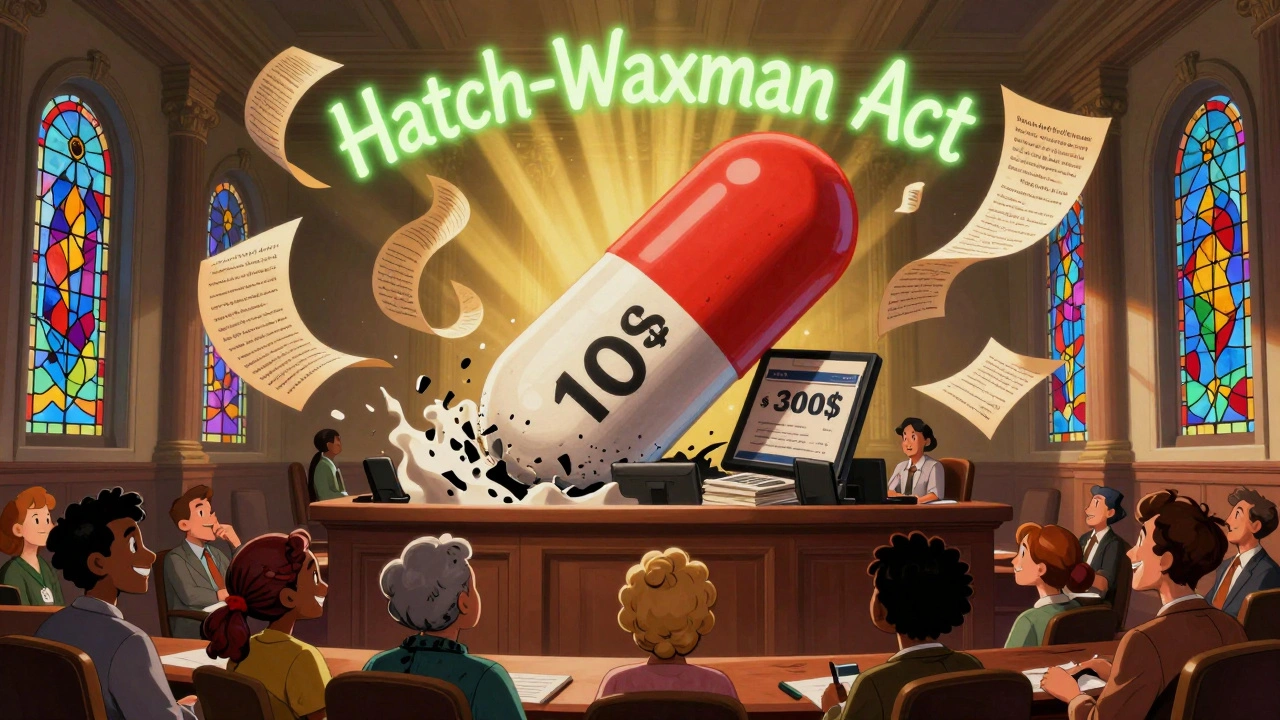
When you pick up a generic version of your prescription drug and pay $10 instead of $300, you’re not just saving money-you’re benefiting from decades of court battles that decided who gets to make that drug, and when. This isn’t about legal jargon. It’s about real people who can’t afford brand-name medications because of patent delays. And behind every cheap pill on the shelf is a landmark court decision that either blocked or cleared the path for generics.
How the System Was Built: The Hatch-Waxman Act
In 1984, Congress passed a law that changed everything: the Drug Price Competition and Patent Term Restoration Act, better known as the Hatch-Waxman Act. Named after its sponsors, Senators Orrin Hatch and Henry Waxman, this law wasn’t meant to help lawyers-it was meant to help patients. It created a clear path for generic drug makers to bring cheaper versions to market without having to repeat expensive clinical trials. But it also gave brand-name companies a way to protect their patents. The deal was simple: generics could file an application (called an ANDA) and say, “Our drug is the same, but we’re not infringing your patent.” If they challenged a patent directly (called a Paragraph IV certification), they triggered a legal countdown. The brand company had 30 days to sue. If they did, the FDA had to wait 30 months before approving the generic-unless a court ruled the patent was invalid or not infringed. This system was designed to balance innovation and access. But over time, the balance started tipping.Landmark Decision #1: Amgen v. Sanofi (2023)
Before 2023, many biotech companies got away with writing patents that claimed millions of possible drugs based on just a handful of examples. Amgen held a patent on a class of cholesterol-lowering drugs, listing only 26 antibody variants out of what could be millions. They argued that anyone who made a similar antibody was infringing. The Supreme Court said no. In a unanimous 9-0 decision, the Court ruled that a patent can’t claim everything that does something without showing how to make all of it. This was a huge win for generics. It meant biologics-complex drugs made from living cells-could no longer hide behind vague, overly broad patents. The decision forced companies to be more specific. For generic makers, this opened the door to challenge more biologic patents. But it also meant they had to do more homework before filing. Teva’s legal team said the cost of preparing a single generic application jumped by about $1.2 million after this ruling because they now needed deeper scientific analysis.Landmark Decision #2: Allergan v. Teva (2024)
While Amgen v. Sanofi made it harder for brand companies to claim too much, Allergan v. Teva made it easier for them to hold onto their patents longer. The case centered on whether a patent filed later could be used to invalidate an earlier one-just because it expired sooner. Allergan had a patent on a glaucoma drug. Teva challenged it using a later-filed patent that expired earlier. The Federal Circuit said: that’s not how it works. Only the patent that was actually listed in the Orange Book matters. You can’t use a different patent-no matter how old or new-as a weapon to knock out the one the brand company is relying on. This decision strengthened the position of brand companies. It meant they could stack patents strategically, filing new ones on minor changes (like a different salt form or delivery method) to extend their monopoly. Critics call this “patent evergreening.” Supporters say it’s just smart IP management. Either way, it’s now legal-and common. As a result, 72% of patent attorneys surveyed in 2024 believe this ruling will lead to more of these tactics.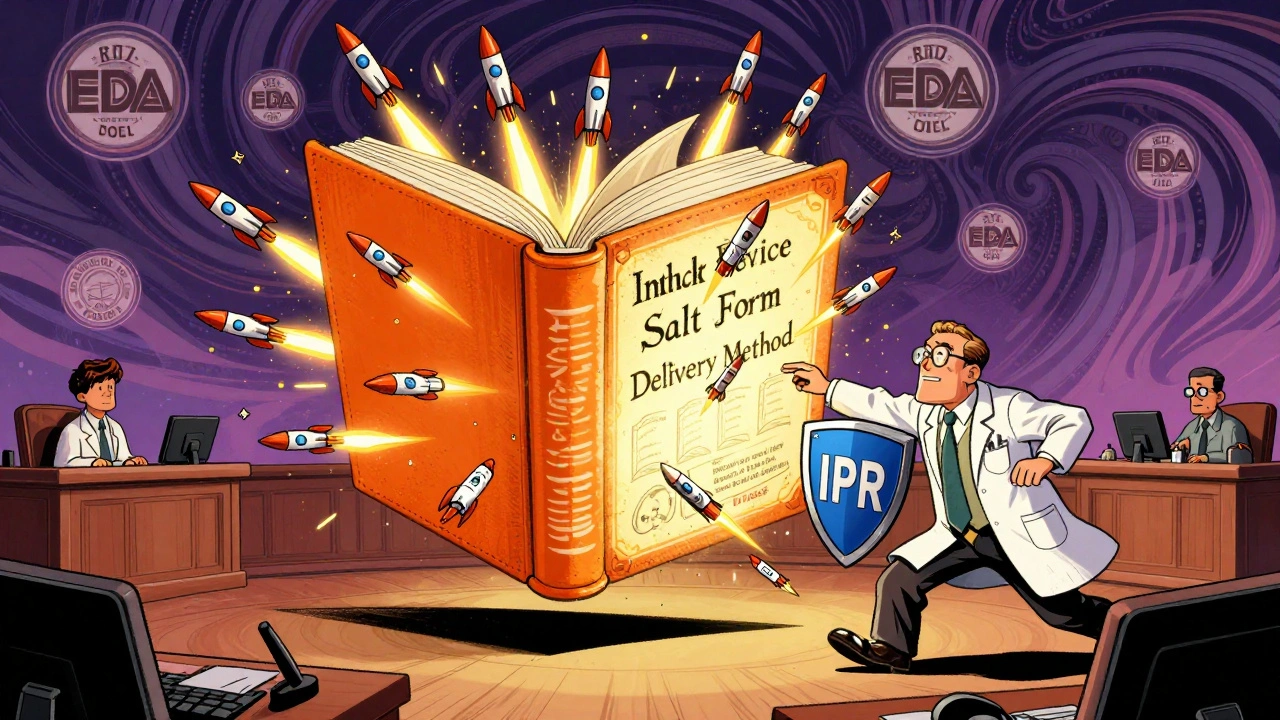
Landmark Decision #3: Amarin v. Hikma (2024)
This case didn’t involve the drug itself. It involved the label. Amarin made a heart drug approved only for one use: reducing triglycerides in high-risk patients. Hikma made a generic version and labeled it the same way-but added marketing materials suggesting it could also be used for other heart conditions, even though those uses weren’t FDA-approved. Amarin sued, claiming Hikma was inducing doctors to prescribe the drug for unapproved uses. The court agreed. Even though the generic’s label matched the brand’s, the extra marketing crossed the line. This was the first major case where a generic company was held liable for induced infringement based on promotional materials. Now, every generic maker has to be careful. Their labels must be exact. But their ads, websites, and sales pitches? Those can’t hint at off-label uses. In 2023, 63% of brand companies that sued over labeling won. It’s a quiet but powerful tool to delay generics without touching the patent itself.The Orange Book: The Secret Weapon in Patent Battles
You won’t find this on TV, but the FDA’s Orange Book is where most patent wars begin. It’s a public list of all drugs and their patents. Brand companies have 30 days to list a patent after it’s issued. If they don’t, the generic can move forward without fear of a lawsuit. But if they list too many-or list patents that don’t even cover the drug-they risk being sued for antitrust violations. The FDA’s 2022 draft guidance warned against “improper listings.” In 2024, the Federal Circuit ruled in Teva ProAir that listing a patent for an inhaler device when the drug itself wasn’t patented was misleading. That decision sent shockwaves through the industry. Now, companies are being more selective-but also more aggressive in choosing which patents to list. According to a 2024 survey, 58% of pharmaceutical professionals say Orange Book listings have become “more complex and litigious.” That means more delays, more lawsuits, and more uncertainty for generic makers trying to enter the market.How Patent Challenges Are Changing: IPRs and the PTAB
Before 2011, the only way to challenge a patent was in federal court. Now, generic companies have another tool: inter partes review (IPR) at the Patent Trial and Appeal Board (PTAB). It’s faster, cheaper, and often more effective. In 2023, 78.3% of generic patent challenges used IPRs. Why? Because the PTAB doesn’t assume patents are valid. Federal courts do. That’s a big deal. In court, the burden is on the generic to prove the patent is invalid. At the PTAB, the patent owner has to prove it’s valid. That flips the script. And since 2012, over 80% of IPRs targeting pharmaceutical patents have resulted in at least one claim being canceled. But it’s not a silver bullet. Brand companies now file “counter-IPRs” to block generics. And the Federal Circuit has started tightening the rules. In 2023, Bristol-Myers Squibb v. Sandoz showed that international patent rules can affect U.S. cases-especially for biologics. If a patent’s priority claim is invalid in Europe, it can be challenged in the U.S. too.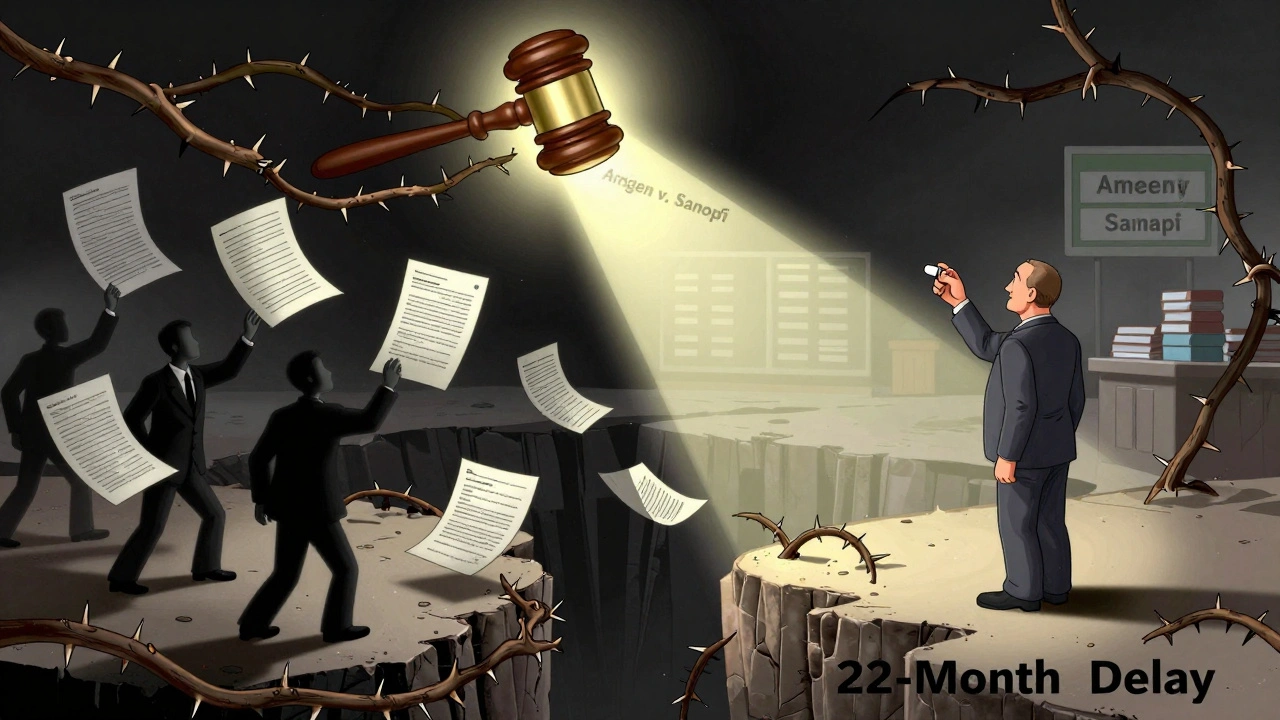
What’s at Stake: Real People, Real Costs
Behind every court decision is a patient who can’t afford their medicine. The FTC found that when a generic enters the market, prices drop by 80-85% within a year. That’s life-changing for someone on insulin, cancer drugs, or heart medication. But delays cost money. In one Reddit thread, a patient named “MedSavings43” wrote that their insulin alternative was delayed 22 months due to patent litigation. They paid $8,400 out of pocket. That’s not an outlier. Evaluate Pharma estimates that unresolved patent disputes will delay $127 billion in generic sales through 2026. And it’s not just about price. It’s about access. When a generic is blocked for years, people skip doses. They go without. They die sooner.Where the Law Is Headed
The Supreme Court has denied a rehearing in Amgen v. Sanofi, meaning the stricter enablement standard stands. The FDA is pushing new rules in 2025 to make Orange Book listings more transparent-targeting evergreening. And biosimilars (generic versions of biologics) are set to explode. By 2027, they’ll make up 31% of all generic patent cases, up from 14% today. But the biggest threat isn’t legal-it’s complexity. Patent thickets around blockbuster drugs are growing. Some drugs have over 100 listed patents. Courts are struggling to keep up. The Brookings Institution warns that, without reform, generic entry could be delayed by 4.3 years beyond patent expiry for the biggest drugs. Meanwhile, the FTC is stepping up enforcement. In 2024, they announced they’d go after “improper patent listings” with renewed vigor. If they succeed, we could see a 15-20% drop in artificial delays.What This Means for You
If you take generic medication, you’re already living with the results of these cases. If you’re a patient, advocate, or just someone who cares about affordable healthcare, understand this: patent law isn’t abstract. It’s the reason your pills cost what they do. The courts are trying to balance two things: rewarding innovation and ensuring access. Right now, the system is tilted. But each new ruling-whether it’s Amgen, Allergan, or Amarin-is a step toward fixing it. The next time you pick up a cheap prescription, remember: someone fought a legal battle to make that possible. And someone’s still fighting to stop it.What is the Hatch-Waxman Act and why does it matter for generic drugs?
The Hatch-Waxman Act of 1984 created a legal pathway for generic drug manufacturers to bring cheaper versions of brand-name drugs to market without repeating expensive clinical trials. It lets generics file an ANDA and challenge patents through Paragraph IV certification. If the brand company sues, a 30-month stay kicks in-unless the court rules the patent is invalid or not infringed. This law balances innovation incentives with patient access, and it’s the foundation of nearly all U.S. generic drug litigation today.
How do generic drug makers challenge a patent?
Generic companies challenge patents by filing an Abbreviated New Drug Application (ANDA) with a Paragraph IV certification, claiming the patent is invalid or won’t be infringed. This triggers a 30-day window for the brand company to sue. If they do, the FDA delays approval for up to 30 months. Generics can also file an inter partes review (IPR) at the Patent Trial and Appeal Board (PTAB), which is often faster and more effective than court litigation. In 2023, over 78% of generic patent challenges used IPRs.
What is the Orange Book and why is it important?
The Orange Book is the FDA’s official list of approved drug products and their associated patents. Brand-name companies must list patents covering their drugs within 30 days of issuance. If they don’t, generics can enter without legal risk. If they list too many or irrelevant patents, they risk antitrust lawsuits. The Orange Book is the starting point for nearly all generic patent disputes. In 2024, the FDA proposed stricter rules to prevent improper listings that delay generic entry.
Can a generic drug company be sued for marketing a drug in ways not approved by the FDA?
Yes. In Amarin v. Hikma (2024), a generic maker was found liable for induced patent infringement because its marketing materials suggested off-label uses-even though the label matched the brand’s. Courts now treat promotional materials as separate from labeling. If a generic promotes uses not approved by the FDA, it can be sued even if the drug itself is legally approved. This tactic has succeeded in 63% of similar cases in 2023.
Why do some generic drugs take years to come to market even after a patent expires?
Patent thickets-where brand companies file dozens of overlapping patents on minor changes-can delay generics for years. Courts often grant 30-month stays when lawsuits are filed. IPRs and litigation can drag on for 2-4 years. The median Hatch-Waxman case lasts 28.7 months. In some cases, like with biologics or complex drugs, delays can stretch beyond 4 years. Evaluate Pharma estimates unresolved patent disputes will delay $127 billion in generic sales through 2026.
Evelyn Pastrana
December 10, 2025 AT 17:00So let me get this straight - we pay $300 for a pill because some lawyer figured out how to write a patent that says ‘this exact shade of blue capsule’ is magic? And we call this innovation? 🙄
Meanwhile, my cousin skips her insulin doses because the generic got held up for 22 months. Thanks, patent thickets.
Also, who approved the Orange Book being a battlefield? It’s not a video game, it’s a life-saving list.
Lisa Whitesel
December 10, 2025 AT 22:25Generic makers are gaming the system too. They file ANDAs with Paragraph IV certs like it’s a lottery ticket. Then they wait for the brand to sue so they can drag it out for years. The system isn’t broken - it’s rigged for both sides.
And don’t get me started on PTAB. It’s a patent graveyard where innovation goes to die under the guise of ‘access’.
Simran Chettiar
December 11, 2025 AT 21:15It is interesting to observe how the legal architecture surrounding pharmaceutical patents reflects a deeper philosophical tension between the individual right to health and the collective imperative to incentivize innovation.
When a corporation holds a patent for a molecule that could alleviate suffering, is it not a moral obligation to share that knowledge? Or does intellectual property transcend human need?
The Hatch-Waxman Act was a compromise, yes - but compromises often favor the powerful. The courts now serve as arbiters not of justice, but of corporate calculus.
And yet, the very existence of biosimilars suggests that even in a system designed to protect monopoly, the tide of accessibility cannot be fully contained.
Perhaps the real revolution is not in the courtroom, but in the patient who refuses to accept the price tag on their survival.
Richard Eite
December 13, 2025 AT 12:43USA invented this system and now we’re letting foreigners and greedy pharma CEOs ruin it
Every time a generic gets delayed, it’s a win for China and India
We built the best drug industry in the world and now we’re letting lawyers kill it
Fix the patent office or shut it down
Katherine Chan
December 14, 2025 AT 14:05It’s wild to think that a single court decision can mean the difference between someone taking their medicine or not
These aren’t just legal terms - they’re life or death
Every time a patent gets challenged fairly, someone gets to breathe easier
Let’s keep pushing for transparency and fairness - not just for big pharma, but for the people who need these drugs the most
Hope is cheaper than a brand-name pill
Philippa Barraclough
December 14, 2025 AT 16:26The evolution of patent litigation in the pharmaceutical sector reveals a troubling trend toward procedural complexity that increasingly obscures the original intent of the Hatch-Waxman Act.
While the PTAB has provided a more expedient forum for challenging patents, its high cancellation rate raises questions about the quality of initial patent examinations.
The Orange Book’s role as a de facto litigation trigger has created perverse incentives for strategic patent listing, often unrelated to the actual composition or use of the drug.
Furthermore, the judicial interpretation of induced infringement in cases like Amarin v. Hikma introduces a chilling effect on generic marketing practices, potentially stifling patient education.
It is worth considering whether the current framework prioritizes litigation volume over therapeutic access, and whether regulatory intervention - such as the FDA’s proposed Orange Book reforms - might recalibrate the balance more effectively.
Tim Tinh
December 14, 2025 AT 18:12Man I never realized how much goes into why my $10 pill exists
Like I just thought generics were cheaper because they’re ‘copycats’
Turns out some genius lawyer fought a 4-year court battle so I could afford my blood pressure med
Big ups to the people who actually make this system work
And also… yeah the system’s messed up but at least we’re talking about it now
Ruth Witte
December 15, 2025 AT 13:45GENERIC DRUGS = FREEDOM 💪
Every time you pick up a $10 pill, you’re voting for a fairer system
Keep fighting the patent trolls 🙌
And if you can, tell your friends - this stuff matters more than you think 😊
Katherine Rodgers
December 15, 2025 AT 14:00Oh wow the Supreme Court actually did something useful for once
Amgen v Sanofi? Yeah that was the only time a judge didn't just rubber stamp a pharma patent
Too bad Allergan v Teva undid half of it by letting them patent the color of the pill
Also the Orange Book is a joke - it's basically a patent spam folder
And don't even get me started on how generics get sued for using the word 'same' in their ads
Someone needs to burn this whole system down
Lauren Dare
December 17, 2025 AT 02:22The term ‘patent evergreening’ is a misnomer. It implies deception. In reality, it’s simply the legitimate exercise of intellectual property rights under statutory frameworks designed to reward innovation.
The PTAB’s high invalidation rate reflects procedural asymmetry, not patent weakness.
And the notion that ‘delayed access’ equates to ‘malice’ ignores the economic reality of R&D investment - which costs billions.
When you conflate litigation with exploitation, you undermine the very mechanisms that fund the next lifesaving drug.
Lola Bchoudi
December 17, 2025 AT 09:35It’s important to recognize that the Hatch-Waxman Act created a structured pathway for market entry - a rare example of regulatory clarity in pharmaceutical law.
The challenge lies not in the statute itself, but in its implementation: the strategic use of Paragraph IV certifications, the timing of Orange Book listings, and the increasing reliance on IPRs as litigation tools.
For generic manufacturers, the legal landscape demands not just scientific rigor but also tactical legal planning - a burden that disproportionately affects smaller firms.
Reform should focus on reducing procedural ambiguity, not eliminating incentives for innovation.
Taya Rtichsheva
December 18, 2025 AT 14:47so like… the orange book is basically just a list of patents that pharma companies add even if they dont really apply
and then they sue anyone who tries to make a generic
and the courts are like ‘oh cool sure’
and the patient pays 8k for insulin
and we wonder why healthcare is broken
no one’s even trying
just saying
Christian Landry
December 19, 2025 AT 03:15bro i just got my generic metformin for $4 and i’m crying
not because i’m sad - because i realize someone fought a legal war so i could live
also the orange book is wild like a game of chess with 100 pieces
and i didn’t even know any of this existed
thanks for explaining it
Katie Harrison
December 20, 2025 AT 10:51It is imperative to note that the expansion of biosimilars - while promising - introduces novel regulatory and legal complexities that are not adequately addressed by current frameworks.
The Amgen v. Sanofi precedent, while laudable in its intent, may inadvertently impede the development of complex biologics by imposing enablement standards that are incompatible with the nature of biological innovation.
Furthermore, the Federal Circuit’s narrowing of patent invalidation via later-filed patents in Allergan v. Teva, while legally defensible, reinforces structural barriers to competition.
Without a unified, transparent, and expedited adjudication mechanism, the promise of affordable biologics remains unfulfilled.
Michael Robinson
December 22, 2025 AT 05:14It’s funny how we call it ‘patent law’ when it’s really just a game of who can write the longest, most confusing document and then sue anyone who tries to understand it.
People think innovation means inventing something new.
But in pharma, innovation often means finding a new way to say ‘this pill is still mine’ for another 10 years.
And the saddest part? We all play along because we’re too tired to fight.
Evelyn Pastrana
December 23, 2025 AT 08:10Wait - so if a generic company says ‘this is the same drug’ but adds ‘for heart health’ on their website, they get sued?
But the brand company can advertise off-label uses for years and no one cares?
That’s not justice. That’s hypocrisy.