Goiter: Understanding Thyroid Enlargement and the Role of Iodine Supplementation

A goiter isn’t just a lump in the neck-it’s a sign your thyroid is working overtime. This swelling happens when the thyroid gland, a small butterfly-shaped organ at the base of your throat, grows larger than normal. It’s not always painful, and sometimes you won’t even notice it until someone else points it out. But when it gets big enough, it can make swallowing hard, change your voice, or even make breathing feel like a chore. The good news? Most goiters are treatable. And often, the fix starts with something simple: iodine.
What Causes a Goiter?
The thyroid needs iodine to make hormones that control your metabolism, energy, and body temperature. If you don’t get enough iodine, the gland starts working harder to compensate. It grows bigger to trap more of the scarce iodine, and that’s how a goiter forms. This is still the #1 cause of goiter in countries without iodized salt-places like parts of Africa, South Asia, and remote mountain regions.
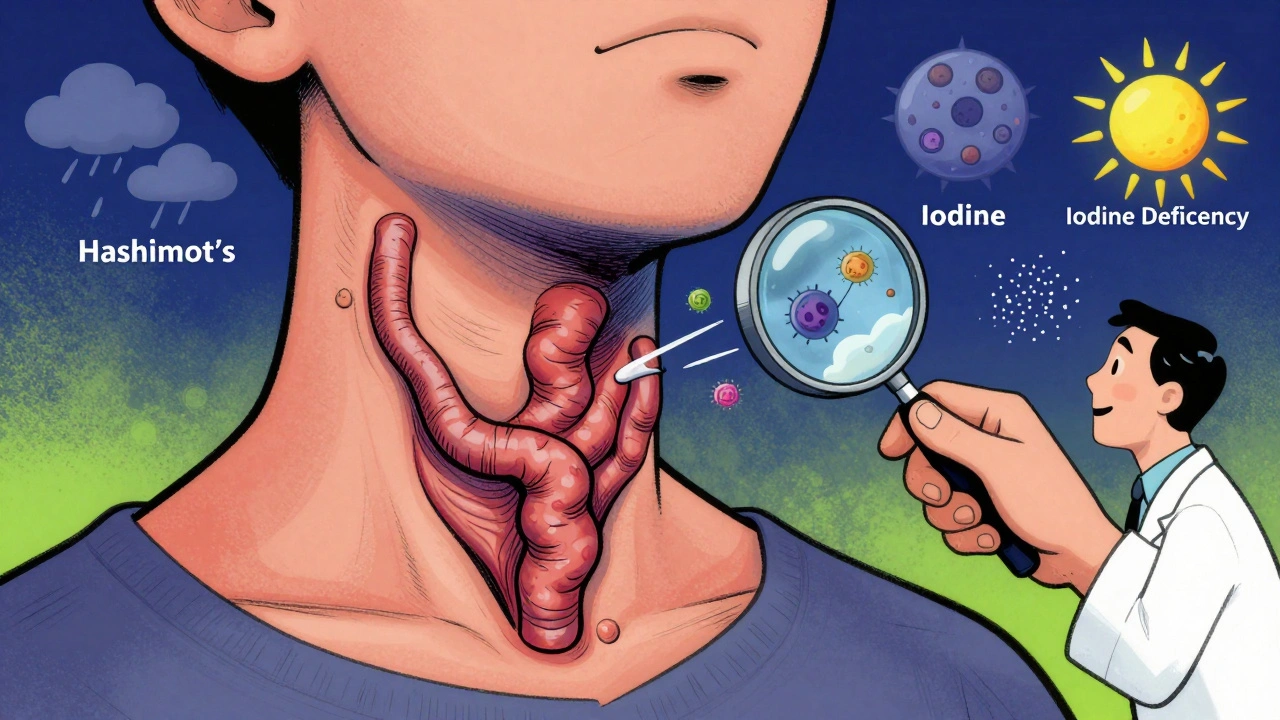
In the U.S., though, things are different. Since the 1920s, salt has been fortified with iodine. So now, most goiters here come from autoimmune problems. Hashimoto’s thyroiditis is the biggest culprit. Your immune system accidentally attacks your thyroid, causing inflammation and swelling. Another common cause is Graves’ disease, where the thyroid gets overstimulated and produces too much hormone-this often leads to a toxic goiter that’s both enlarged and overactive.
Other causes include thyroid nodules, thyroid cancer (rare), or even certain medications. But if you’re in a region where salt isn’t iodized, or if you avoid salt entirely, iodine deficiency is almost always the root.
How Big Is Too Big?
A healthy thyroid weighs about 15 to 20 grams-roughly the size of a walnut. When it grows past 25 milliliters in volume (about the size of a golf ball), it’s officially considered a goiter. In severe cases, it can balloon to 50 or even 100 grams. That’s like having two or three walnuts in your neck.
Doctors use ultrasound to measure it. If it’s pressing on your windpipe or esophagus, you might cough when lying down, feel like food gets stuck, or notice your voice is hoarse. These aren’t just annoyances-they’re warning signs. Left unchecked, a large goiter can lead to serious breathing problems or even sleep apnea.
Iodine Supplementation: The Simple Fix for Deficiency
If your goiter is caused by not enough iodine, the treatment is straightforward: give your body what it’s missing. The recommended daily amount for adults is 150 micrograms (mcg). For pregnant women, it jumps to 220 mcg, and for those breastfeeding, it’s 290 mcg. That’s because the baby’s brain needs iodine to develop properly.
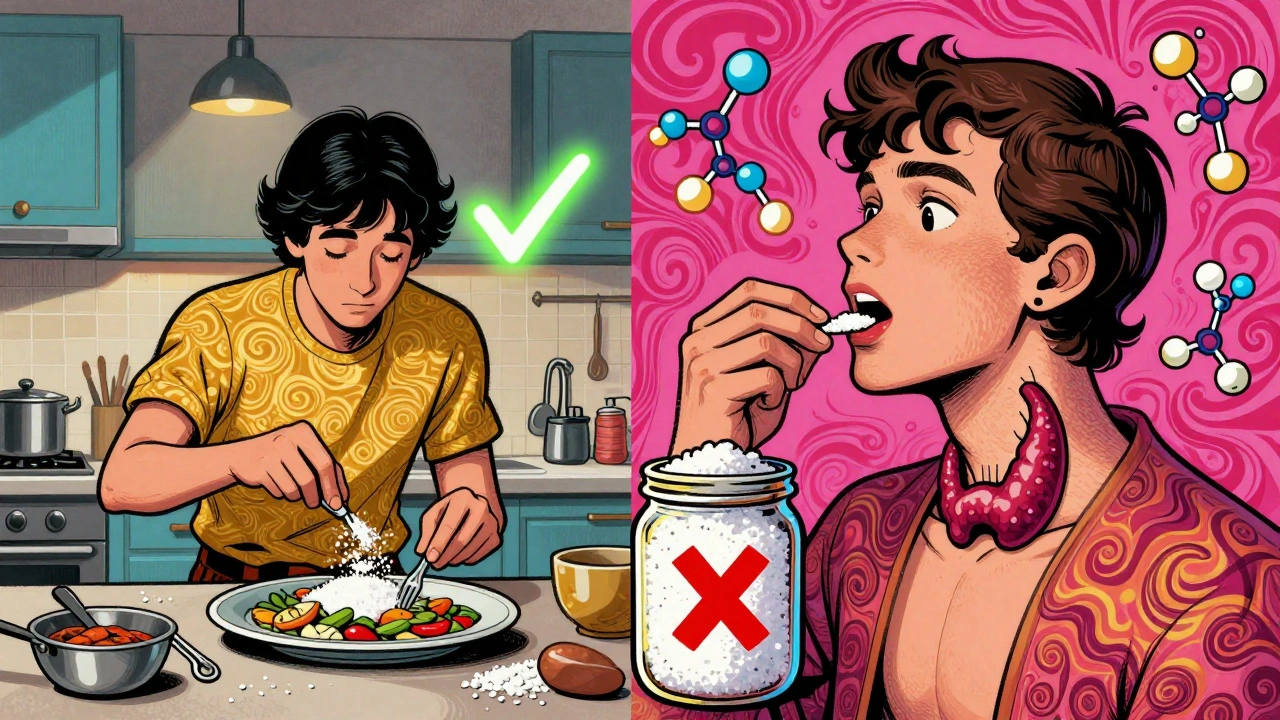
Iodized salt is the easiest way to get it. One gram of iodized salt contains about 45 mcg of iodine. So just half a teaspoon a day covers your needs. But if you’re on a low-salt diet, or you use sea salt or Himalayan salt (which rarely contains added iodine), you might need supplements. Potassium iodide tablets-usually 90 to 150 mcg daily-are safe and effective.
Studies show that with consistent iodine supplementation, goiter size can shrink by 30 to 40% in just 6 to 12 months. In many cases, especially in younger people, the thyroid returns to normal size completely. It’s not magic-it’s biology. The gland stops straining once it has enough iodine.
What About Autoimmune Goiters?
If your goiter comes from Hashimoto’s or Graves’ disease, iodine won’t help-and too much can even make things worse. In Hashimoto’s, the gland is already damaged. Supplementing iodine won’t fix the immune system’s attack. Instead, doctors prescribe levothyroxine, a synthetic thyroid hormone. It replaces what your thyroid can’t make and often reduces swelling a little-usually 10 to 20%. But because the tissue becomes scarred over time, it rarely goes back to normal size.
For Graves’ disease, the goal is to calm down the overactive gland. Medications like methimazole block hormone production. Over 12 to 18 months, this can shrink the goiter by 40 to 60%. But if meds don’t work, or if the goiter is huge, you might need radioactive iodine. This treatment destroys part of the thyroid. It’s very effective-50 to 60% shrinkage-but it almost always leads to permanent hypothyroidism. That means you’ll need to take thyroid pills for the rest of your life.
When Surgery Becomes Necessary
Surgery isn’t the first option. But if your goiter is over 80 to 100 milliliters, or if it’s causing breathing or swallowing trouble, removing part or all of the thyroid might be the only way to feel better.
A total thyroidectomy removes about 30 to 40 grams of tissue. Afterward, you’ll need lifelong hormone replacement. Some people experience voice changes (in about 15% of cases) or low calcium levels (in 8%), because the nearby parathyroid glands can get affected. Patient satisfaction with surgery is lower than with medication or supplements-only 42% report being happy with the outcome, mainly because of these side effects.
What Doesn’t Work
Many people wonder if selenium, zinc, or other supplements help. A major 2021 Cochrane Review looked at 12 studies and found no meaningful benefit from selenium for reducing goiter size. The odds of improvement were nearly the same as taking a placebo. Some European doctors still recommend it for autoimmune cases, but there’s no solid proof it makes a difference.
And don’t try to treat a goiter with seaweed or kelp supplements. They’re wildly inconsistent in iodine content-one capsule might have 50 mcg, another might have 5,000. Too much iodine can trigger thyroid problems, especially in people with underlying conditions. Stick to regulated supplements or iodized salt.
Who’s at Risk?
Women are three times more likely than men to develop a goiter. After age 40, the risk goes up for everyone. If you have a family history of thyroid disease, or if you’ve had radiation to your head or neck, you’re also at higher risk.
People who avoid dairy, eggs, or seafood-common dietary sources of iodine-are also more vulnerable. Vegans who don’t take supplements are especially at risk if they don’t use iodized salt.
Even in the U.S., about 5% of the population has a goiter. That’s 1 in 20 people. And while iodized salt has cut down cases dramatically, around 1.9 billion people worldwide still live in areas where iodine deficiency is common.
What You Can Do Now
If you’ve noticed a swelling in your neck, don’t ignore it. See a doctor. A simple blood test can check your thyroid hormone levels. An ultrasound will show the size and structure of the gland. From there, they can tell if it’s iodine-related, autoimmune, or something else.
If you’re diagnosed with an iodine-deficient goiter, start taking 150 mcg of iodine daily. Use iodized salt in cooking. Eat dairy, eggs, or seafood a few times a week. Within a year, you’ll likely see improvement.
If you have an autoimmune goiter, follow your doctor’s plan. Don’t self-treat with iodine. It won’t help-and could hurt.
And if you’re pregnant or planning to be, make sure you’re getting at least 220 mcg of iodine every day. Your baby’s brain depends on it.
The Bigger Picture
Since the 1990s, global efforts to add iodine to salt have cut goiter rates in half. That’s one of public health’s biggest wins. But it’s not over. Millions still go without iodized salt. And in wealthier countries, we’re seeing a rise in people avoiding salt entirely-often for health reasons-without replacing iodine elsewhere.
The FDA now requires iodine content to be labeled on salt packages. That’s progress. But awareness is still low. Most people don’t know the difference between table salt and sea salt when it comes to iodine.
Goiter is a problem with a simple solution-for many. But only if we know what we’re dealing with.
Monica Evan
December 11, 2025 AT 06:51I had a goiter back in college and no one knew why until my grandma noticed my neck looked like I swallowed a golf ball
Turns out I was vegan and using sea salt because it looked "artisanal"
Started taking iodine pills and within 8 months it was gone
My voice stopped sounding like a frog on helium too
Lisa Stringfellow
December 12, 2025 AT 19:49So let me get this straight-you’re saying the solution to a complex endocrine disorder is just adding salt to your food?
What’s next, aspirin for cancer?
They’ve been selling this iodine fairy tale since the 1920s to keep people from asking hard questions about Big Pharma
Kristi Pope
December 14, 2025 AT 03:40Monica you’re not alone-so many of us don’t realize how much our salt choices matter
My mom had a goiter after she went paleo and stopped using iodized salt
She thought Himalayan salt was "more natural"-turns out it’s basically rock with zero iodine
She started taking a 150 mcg supplement and within a year her thyroid looked normal again
It’s wild how something so simple can fix something so scary
And if you’re pregnant or planning to be? Please don’t skip this
Your baby’s brain is literally built with iodine
It’s not just a supplement-it’s a building block
Aman deep
December 15, 2025 AT 17:55Back in Bihar we didn’t have iodized salt until the 90s
My aunt had a goiter so big she couldn’t lie flat
Then the government started giving out iodine tablets at the clinic
She took them for 6 months and it shrunk like a balloon losing air
People still think it’s a curse or bad luck here
But it’s just biology-and a cheap fix
Thanks for writing this
It’s exactly what people in my village need to hear
Doris Lee
December 17, 2025 AT 09:37My sister got diagnosed with Hashimoto’s last year and her doctor told her to take iodine
She did and it made her feel worse
Turns out she had the autoimmune kind
So please everyone-get tested first
Don’t just guess and swallow pills
Thyroid stuff is sneaky
Aileen Ferris
December 18, 2025 AT 07:12Iodine is a government mind control tool
They put it in salt so we don’t get smart
Ever wonder why the thyroid is shaped like a butterfly?
That’s because it’s a symbol for the New World Order
And the WHO is in on it
Michelle Edwards
December 19, 2025 AT 02:22Rebecca I know you’re scared but iodine isn’t a conspiracy
My cousin had a goiter from being vegan and not supplementing
She was terrified of pills so she started eating seaweed snacks
Turns out one snack had 1200 mcg-she ended up in the ER with thyroid storm
So yeah, iodine helps-but only if you do it right
Stick to the 150 mcg, use iodized salt, and talk to your doctor
You got this
Sarah Clifford
December 21, 2025 AT 01:14So if I eat a bag of chips with iodized salt every day I’m good?
What if I’m allergic to salt?
Is there a pill for that?
Also my dog has a goiter now
Monica Evan
December 22, 2025 AT 21:23Sarah your dog probably doesn’t have a goiter
Dogs don’t get iodine deficiency goiters like humans
They get thyroid tumors but it’s super rare
And they don’t eat salt the way we do
Take your dog to the vet
And maybe lay off the chips for a bit