How to Read Directions for Extended-Release Medications on Labels
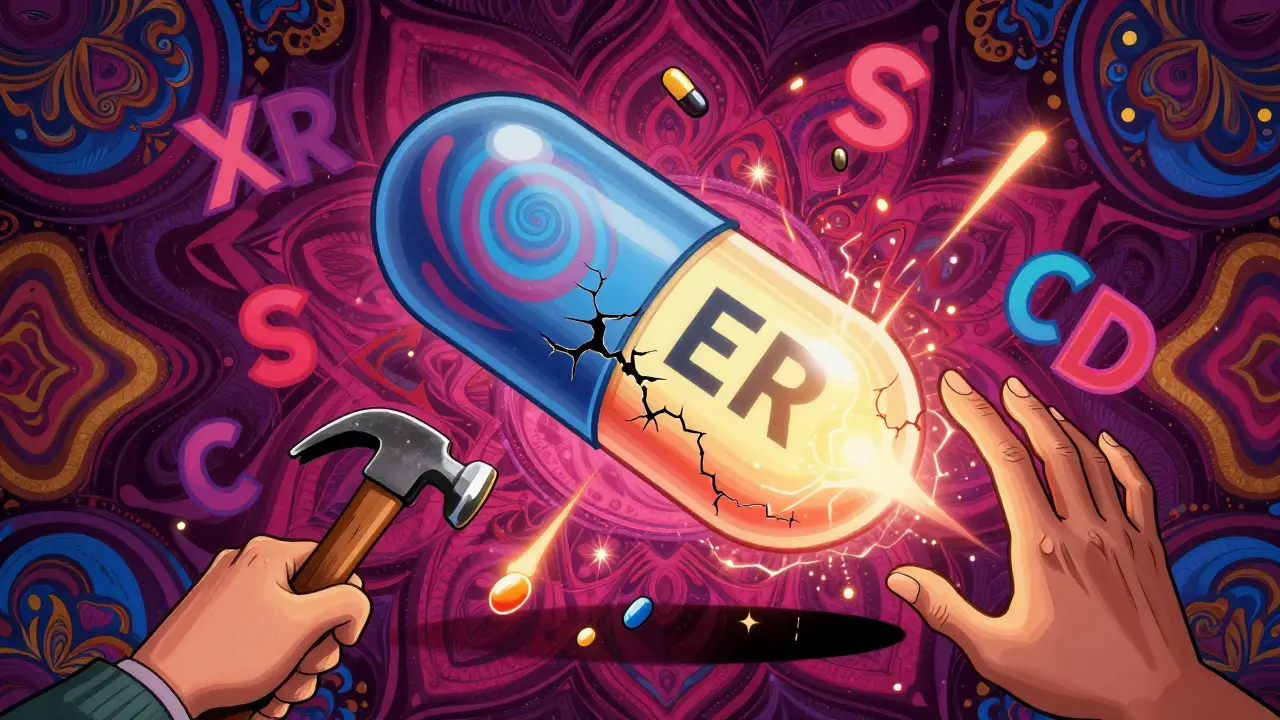
Reading the label on your extended-release medication isn’t just about knowing when to take it-it’s about staying safe. If you crush, split, or chew a pill labeled ER, XR, SR, or CR, you could be swallowing a full day’s dose all at once. That’s not a mistake most people make on purpose. It’s usually because the label doesn’t explain clearly enough what those letters mean, or how serious the consequences can be.
What Do ER, XR, SR, CR, and CD Really Mean?
You’ve probably seen these letters on your pill bottle: ER, XR, SR, CR, CD. They’re not random. They tell you how the drug is built to work inside your body.- ER = Extended Release
- XR = eXtended Release
- SR = Sustained Release
- CR = Controlled Release
- CD = Continuous Delivery
Look for the Time Frame
The label won’t just say “Extended Release.” It will usually say something like “24-hour extended release” or “12-hour sustained release.” That’s the key detail.- “24-hour” means one dose lasts a full day. You take it once.
- “12-hour” means you take it twice a day-morning and night.
- Some OTC pain relievers like Aleve PM say “12-hour pain relief.” That’s still extended-release, but it’s designed for shorter use.
The Most Important Warning: Do Not Crush, Split, or Chew
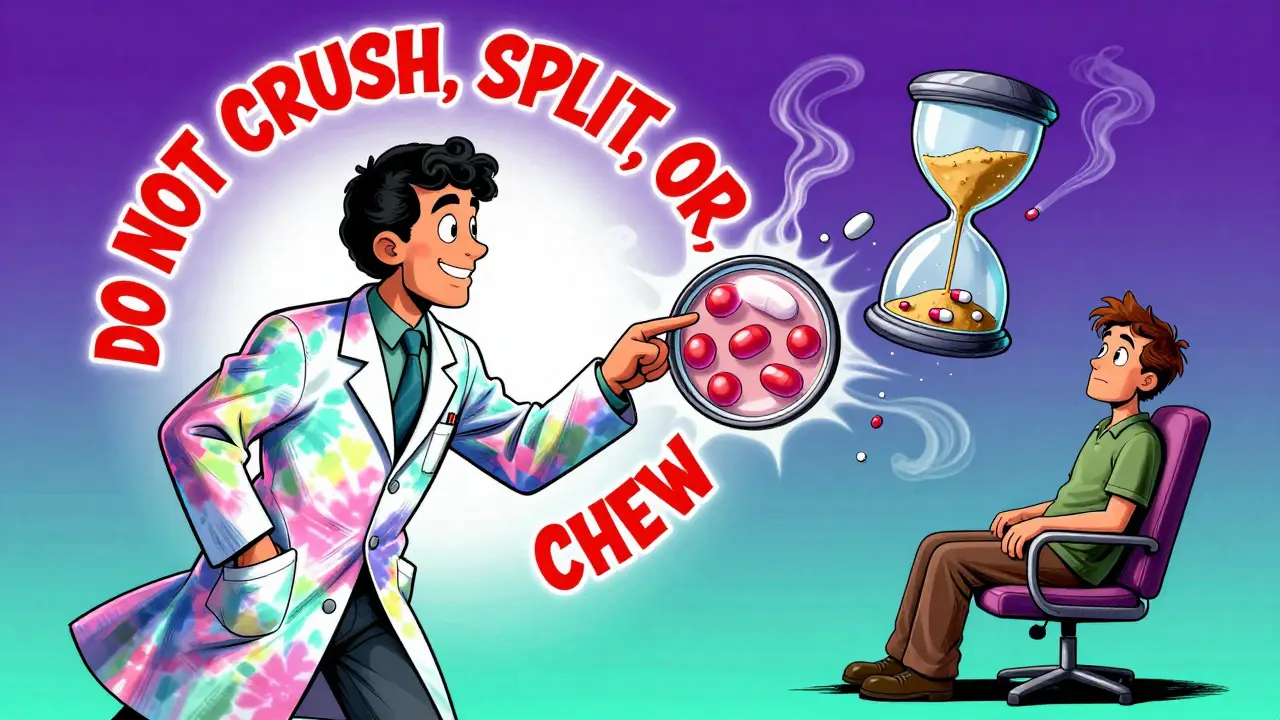
This isn’t a suggestion. It’s a life-or-death rule. Extended-release pills are built like tiny time-release machines. The coating, the matrix, the beads-they’re all designed to control how fast the drug enters your bloodstream. If you crush or chew the pill, you break that system. Suddenly, instead of getting 12 hours of steady medicine, you get the whole dose in 10 minutes. The FDA has documented over 1,200 adverse events between 2018 and 2022 from people who did this. One case involved someone crushing OxyContin and snorting it-resulting in a near-fatal overdose. Another person took Adderall XR at night thinking it would help them focus all day. Instead, they stayed awake for 36 hours because the full dose hit their system at once. Look for the words “DO NOT CRUSH, SPLIT, OR CHEW” on the label. They’re usually in bold, red, or uppercase. Starting in January 2024, the FDA requires all new extended-release medications to use high-contrast warnings like this. If you don’t see it, ask your pharmacist to point it out.Timing Matters More Than You Think
It’s not just about how often you take it. When you take it matters too. Some extended-release medications work best at specific times:- Niaspan (niacin): Taken at bedtime to reduce flushing (hot flashes and redness).
- Metformin XR: Often taken with the evening meal to lower morning blood sugar spikes.
- Concerta (ADHD): Designed to work through the school day, so it’s taken in the morning.
- Cardizem CD (diltiazem): Taken in the morning to control blood pressure throughout the day.
Brand Names Can Trick You
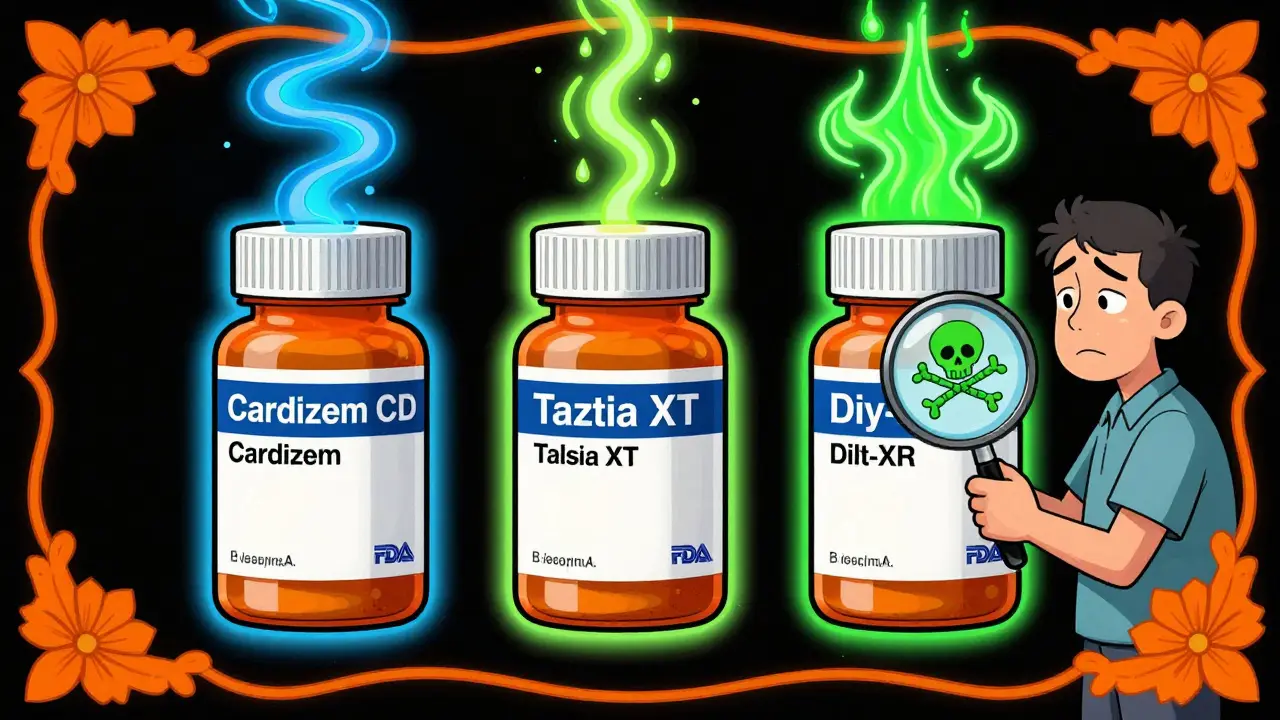
Generic drugs are cheaper, but they’re not always interchangeable-even if they have the same active ingredient. Take diltiazem, a blood pressure drug. There are at least three different 24-hour extended-release versions on the market: Cardizem CD, Taztia XT, and Dilt-XR. All contain the same medicine. But they’re not the same in how they release it. The FDA doesn’t consider them “AB rated,” meaning you can’t swap them without your doctor’s approval. The same goes for Adderall XR and generic versions. Some generics use different release tech and may not work as long or as smoothly. If you switch brands and notice side effects or reduced effectiveness, tell your doctor. Don’t assume “same drug = same effect.”Check the Inactive Ingredients Too
Most people ignore the list of “inactive ingredients.” But that list can tell you how the pill works. Extended-release pills often contain polymers like hydroxypropyl methylcellulose, ethylcellulose, or polyethylene oxide. These aren’t just filler-they’re the actual release mechanism. If you’re allergic to any of these, you might have a reaction. More importantly, if you’re taking multiple extended-release drugs, you could be getting too much of the same polymer, which could interfere with absorption. The FDA’s Inactive Ingredient Database tracks exactly how much of each excipient is in each approved product. Your pharmacist can check this if you’re unsure.What to Do If You’re Confused
You’re not alone. A 2022 FDA study found 42% of adults over 65 misunderstood “extended release” to mean “longer-lasting effect,” without realizing the danger of crushing it. Here’s what to do:- Ask your pharmacist: Say, “Can you show me how this pill works and why I shouldn’t crush it?”
- Use the teach-back method: After they explain, say, “So if I crush this, the whole dose hits me at once, right?” If they say yes, you got it.
- Scan the QR code: Newer labels have QR codes that link to short videos explaining how to take the pill.
- Request a Medication Guide: For high-risk drugs like opioids or certain heart meds, the law requires your pharmacy to give you a printed guide. Don’t skip it.
Why This Matters More Than Ever
Right now, over 68% of Medicare Part D prescriptions are for extended-release medications. That’s because they help people stick to their treatment. One patient with multiple sclerosis said switching to a once-daily extended-release pill boosted her adherence from 62% to 98%. But that only works if you take it right. The industry is changing fast. By 2027, nearly half of all new drugs will be extended-release. New technologies are even being developed to release medicine for 48 to 72 hours. That’s great for convenience-but it also means labels will get more complex. The FDA admits current labeling isn’t good enough. Consumers still don’t understand the difference between “ER” and “CR,” or why one pill can’t be swapped for another. That’s why you have to be your own advocate.Final Checklist: Before You Take Any Extended-Release Pill
Before you swallow it, check:- Does the label say “ER,” “XR,” “SR,” “CR,” or “CD”? If yes, don’t crush or split.
- Is there a time frame? “24-hour” or “12-hour”? That tells you how often to take it.
- Does it say “DO NOT CRUSH, SPLIT, OR CHEW”? If not, ask your pharmacist.
- Is there a specific time of day? Morning? Night? Take it exactly as written.
- Is this a brand name? If you switched from a brand to a generic, did your doctor approve the change?
Can I split an extended-release pill in half if I need a lower dose?
No, unless the label or your doctor specifically says it’s safe. Most extended-release pills are designed so splitting them destroys the slow-release mechanism. Even if it looks like it’s scored, the coating or matrix inside may not split evenly. You could end up taking too much or too little. Always ask your pharmacist or doctor before splitting any pill.
What should I do if I accidentally crush or chew an extended-release pill?
Call your doctor or poison control immediately. Don’t wait for symptoms. You may have taken a full day’s dose all at once. Signs of overdose include dizziness, rapid heartbeat, confusion, nausea, or trouble breathing. Even if you feel fine, the effects can show up hours later. Keep the pill bottle with you when you call-it helps them identify the drug and release mechanism.
Are extended-release medications more expensive?
Yes, typically 20% to 35% more than immediate-release versions. That’s because of the extra technology and testing required. But many people save money long-term by avoiding hospital visits caused by missed doses. Insurance often covers extended-release versions for chronic conditions like high blood pressure or diabetes because they improve adherence. Ask your pharmacy if a generic extended-release option is available-it’s usually cheaper than the brand name.
Can I switch from an immediate-release pill to an extended-release version on my own?
No. The dosing is different. A 10mg immediate-release pill isn’t the same as a 10mg extended-release pill. The extended version delivers the same total dose over time, but not all at once. Switching without medical supervision can cause underdosing or overdose. Always talk to your doctor before changing how you take any medication.
Why do some extended-release pills have weird names like Concerta or OxyContin?
Those are brand names that include the release technology. Concerta uses OROS (Osmotic Release Oral System), a special tablet that pushes the drug out through a tiny hole. OxyContin uses a matrix system that dissolves slowly. The brand name tells you the tech behind it. Generic versions might use different systems, so even if they have the same active ingredient, they’re not always interchangeable. That’s why your doctor needs to specify the exact product.
Jacob Milano
January 4, 2026 AT 04:58Man, I never realized how much science is baked into these pills. I thought ER just meant ‘takes longer to kick in’-turns out it’s like a tiny drug-powered rocket ship with a delay fuse. Crushing one is like pulling the pin on a grenade and calling it ‘just a pill.’ Wild how the coating’s basically a molecular prison guard.
And the part about polymers? I used to think ‘inactive ingredients’ meant ‘boring filler.’ Now I’m googling hydroxypropyl methylcellulose like it’s a superhero alias. Mind blown.
Enrique González
January 4, 2026 AT 23:25Good post. Took me three years to learn this the hard way.
Shanna Sung
January 6, 2026 AT 23:19They’re hiding something. Why do they make these pills so hard to split if they’re not trying to keep you dependent? Big Pharma wants you buying new bottles every month. They don’t care if you live or die as long as your insurance keeps paying. And don’t get me started on QR codes-that’s surveillance disguised as education. I scanned one once. It asked for my zip code.
John Ross
January 8, 2026 AT 16:17Let’s clarify the pharmacokinetic taxonomy here. ER/XR/SR/CR/CD are not interchangeable descriptors-they represent distinct release matrices governed by different dissolution kinetics. ER typically implies zero-order kinetics via osmotic pumps (e.g., OROS), while CR often utilizes diffusion-controlled polymeric matrices. SR is a loosely regulated term-sometimes just marketing fluff. CD is a proprietary term used by specific manufacturers like Cardizem CD’s unique pulsatile delivery system.
And yes, generics are frequently non-AB rated because the FDA allows bioequivalence thresholds of 80–125%-meaning a generic could release 20% slower or faster than the brand. That’s not a bug, it’s a regulatory loophole.
Ashley Viñas
January 10, 2026 AT 03:02It’s honestly embarrassing that people still don’t get this. I mean, if you can’t read a label that says ‘DO NOT CRUSH’ in bold red letters, maybe you shouldn’t be managing your own meds. I’ve seen so many people on Reddit asking if they can crush Adderall XR for a ‘faster high’-like, do you have a death wish? Or just zero impulse control?
And switching generics without consulting your doctor? That’s not frugal, that’s reckless. You wouldn’t swap out your car’s engine for a ‘similar’ one you found on eBay. Why do it with your brain chemistry?
Brendan F. Cochran
January 10, 2026 AT 23:03fuckin’ A this is why america is falling apart. people dont read no more. i crushed my xr pill once cause i was in a hurry and now i got the shakes for 8 hours. my boss thought i was on coke. i had to call in sick. now i read the label. every damn time. no more bullsh*t. also if you dont like the cost of these pills then get a better job. this is not rocket science.
jigisha Patel
January 11, 2026 AT 21:38According to the FDA’s 2023 Pharmacovigilance Report, 67% of adverse events related to extended-release formulations occurred in patients over 65 who were polypharmacy users. Furthermore, 89% of these incidents involved misinterpretation of release terminology. The data indicates a systemic failure in patient education infrastructure. It is imperative that healthcare providers implement mandatory verbal and written reinforcement protocols, particularly for high-risk agents such as opioids and cardiovascular drugs. Failure to do so constitutes negligence.
Justin Lowans
January 12, 2026 AT 08:16One of the clearest, most compassionate explanations I’ve ever read on this topic. I work in a pharmacy and see this confusion every day. People think ‘ER’ means ‘extra strong’ or ‘longer-lasting effect’-not ‘don’t break this thing open or you’ll overdose.’
I always show patients the pill and point to the coating. I say, ‘Imagine this is a water balloon filled with syrup. If you pop it, it all gushes out. If you let it sit, it drips slowly.’ They get it. It’s not magic-it’s just science they never learned.
Also, props for mentioning the inactive ingredients. Most people don’t realize that the ‘filler’ is the actual delivery system. That’s wild.
Michael Rudge
January 12, 2026 AT 11:25Wow, another feel-good public service announcement from the medical-industrial complex. Let me guess-next you’ll tell us to drink our vitamins and wear sunscreen while we’re at it. Of course you shouldn’t crush pills. But let’s be real: if you’re taking Adderall XR to stay awake for a 72-hour coding sprint, you already know what you’re doing. And if you’re scared of a little overdose, maybe you shouldn’t be on controlled substances at all.
Also, QR codes? Really? I’m not scanning a code on my pill bottle like I’m at a museum exhibit. I’ll call my doctor. Like a grown-up.
Ethan Purser
January 13, 2026 AT 10:19I used to think these pills were just slow-motion magic. Then I crushed one out of boredom during a breakup. Three hours later, I was sobbing on my bathroom floor, heart pounding like a jackhammer, convinced I was dying. I called 911. They laughed. Said I’d be fine.
Turns out I wasn’t dying-I was awakening. That moment cracked me open. I realized I’d been treating my body like a vending machine: insert cash, get result. But these pills? They’re not snacks. They’re conversations between your biology and chemistry. And when you break the silence? The silence breaks back.
Now I take my meds like prayers. Quiet. Reverent. Never rushed.
Doreen Pachificus
January 13, 2026 AT 19:39Just read this while waiting for my refill. Funny how we all just swallow these things without thinking. I’ve been on metformin XR for 5 years and never knew it was supposed to be taken with dinner. I’ve been taking it at breakfast. No wonder my sugar spikes at noon.
Thanks for the nudge. Going to call my pharmacist tomorrow.
Jacob Milano
January 14, 2026 AT 08:53Wait-so if I take my Concerta at night, I’ll be wired until noon? That explains why I’ve been sleeping 14 hours and still feel like a zombie. I’ve been doing it wrong for 3 years. Thanks, Doreen. You just saved my weekend.