National Prescription Drug Take-Back Days: What to Expect
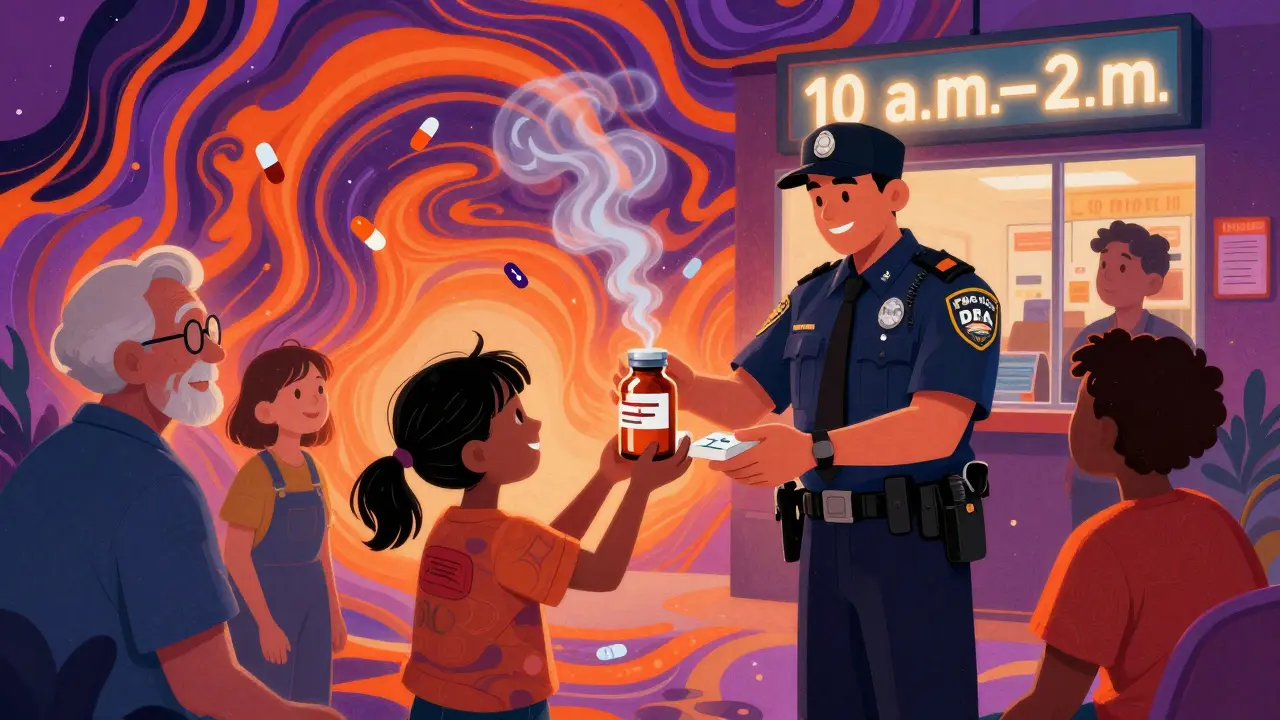
Every year, millions of unused or expired prescription drugs sit in bathroom cabinets, kitchen drawers, and medicine chests across America. Many people don’t know what to do with them-flushing them down the toilet, tossing them in the trash, or just leaving them where they are. But those habits aren’t just careless-they’re dangerous. Prescription drugs in the wrong hands can lead to addiction, accidental overdose, or environmental harm. That’s where National Prescription Drug Take-Back Days come in.
What Exactly Is a Prescription Drug Take-Back Day?
National Prescription Drug Take-Back Days are biannual events run by the U.S. Drug Enforcement Administration (DEA). They happen twice a year-once in April and once in October-on the last Saturday of each month. The next one is scheduled for October 25, 2025, from 10 a.m. to 2 p.m. local time. During those four hours, you can walk into a police station, hospital pharmacy, clinic, or other designated site and drop off any unused, expired, or unwanted prescription medications. No questions asked. No ID needed. No cost. The program started in 2010, and since then, it’s collected nearly 10 million pounds of prescription drugs. In April 2025 alone, over 620,000 pounds of pills, patches, and capsules were turned in across the country. That’s more than 300 tons of potentially dangerous medication removed from homes and kept out of landfills and waterways.What Can You Bring?
Not everything goes in the collection bins. The DEA has clear rules about what’s accepted and what isn’t. Here’s what you can safely drop off:- Pills and tablets
- Capsules
- Patches (like fentanyl or nicotine patches)
- Liquid medications (as long as they’re sealed in their original containers)
- Vials and blister packs
- Syringes or needles (sharps)
- Illicit drugs like heroin or cocaine
- Thermometers or inhalers
- Over-the-counter meds (unless mixed with prescription drugs in the same container)
- Alcohol or cosmetics
Where Do You Go?
There are about 4,500 collection sites nationwide during each event. Most are located at local police stations, sheriff’s offices, or DEA-authorized pharmacies. Some hospitals and clinics also host sites-University Hospitals in Ohio, for example, runs three permanent drop-off locations and participates in the biannual events too. You don’t need to find a site on your own. The DEA’s website, takebackday.dea.gov, has a searchable map updated with every event. You can also use the free Dispose My Meds app, which has been used by over 340,000 people to find nearby drop-off points. Just enter your zip code, and it shows you the closest locations, hours, and what’s accepted. If you live in a rural area, don’t assume you’re out of luck. In 2025, the DEA launched 120 mobile collection units-specialized vehicles that travel to towns more than 25 miles from a permanent site. These units are already showing results: pilot programs in states like West Virginia and Montana saw an 18% increase in participation.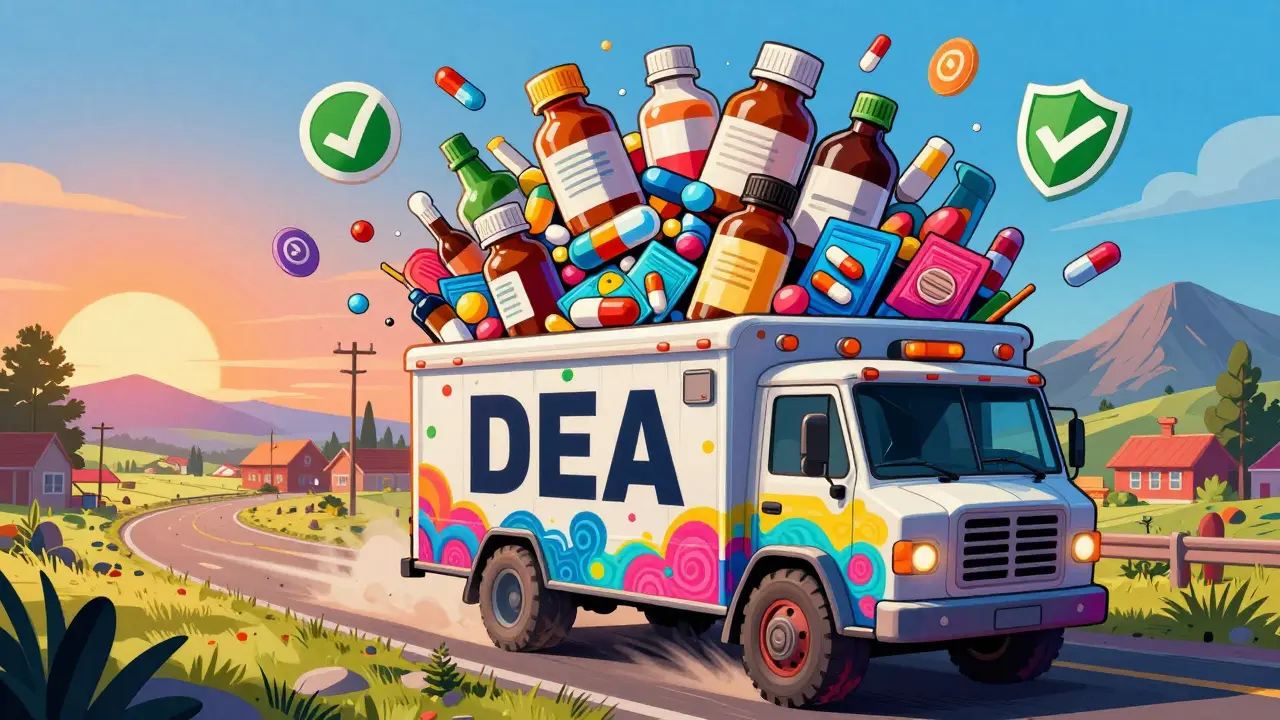
What Happens After You Drop Off Your Medications?
Once you hand over your pills, they’re no longer yours. Law enforcement officers take custody of the medications immediately. They’re stored securely at the site until they’re transported to a DEA-approved incineration facility. There, the drugs are destroyed under federal supervision. No resale. No recycling. No dumping. Just safe, permanent disposal. This process isn’t just about cleaning out medicine cabinets. It’s a public health strategy. The National Survey on Drug Use and Health found that 57.9% of people who misuse prescription painkillers get them from friends or family-often from unsecured home medicine cabinets. By removing these drugs from homes, Take-Back Days directly reduce access to substances that can lead to addiction.Why It Matters: The Real Impact
The numbers tell a clear story. In 2024, over 54,700 people died from opioid overdoses in the U.S. Experts from the National Institute on Drug Abuse say that most of these deaths are preventable-and one of the best ways to prevent them is to stop the drugs from ever leaving the home. A 2024 survey by the American Society of Addiction Medicine found that only 19% of Americans properly dispose of unused prescriptions. That means 81% are keeping them, throwing them away unsafely, or giving them to someone else. That’s a massive gap. Take-Back Days help close that gap. People who participate often report feeling relieved. One Reddit user wrote: “Dropped off my mom’s unused opioids at the police station-no questions asked, took 2 minutes, and I know they won’t end up in a teen’s hands.” That’s the whole point. No judgment. No paperwork. Just a simple way to protect your family and community.What If You Miss the Event?
You don’t have to wait six months to dispose of your meds. There are over 14,250 permanent DEA-authorized collection sites across the country-many of them in pharmacies like CVS and Walgreens. As of August 2025, these two chains have installed permanent kiosks in more than 1,200 locations. These kiosks work year-round, 24/7, and accept the same items as the Take-Back Days. If your local pharmacy doesn’t have one yet, check with your city or county health department. Some local governments run their own drop-off programs. You can also look for mail-back programs-some pharmaceutical companies offer prepaid envelopes to send back unused pills. Just make sure the program is DEA-approved.
Common Misconceptions
There’s a lot of confusion around how this works. Here are the most common myths-and the truth:- Myth: You can flush pills down the toilet. Truth: Only a few specific drugs (like fentanyl patches) are on the FDA’s flush list. For everything else, flushing harms water systems and wildlife.
- Myth: Throwing meds in the trash is fine. Truth: If you mix pills with coffee grounds or cat litter and seal them in a container, it’s safer-but still not ideal. Take-back programs are the only guaranteed safe method.
- Myth: Only opioids need to be disposed of. Truth: Any unused prescription-antibiotics, antidepressants, blood pressure meds, sleeping pills-can be dangerous if misused.
- Myth: The DEA tracks who drops off meds. Truth: The process is completely anonymous. No names, no IDs, no records.
How to Prepare for the Next Event
When the next Take-Back Day rolls around in October 2025, here’s how to make it easy:- Go through your medicine cabinet now. Gather all expired or unused prescriptions.
- Check the DEA website or app to find your nearest drop-off location.
- Keep liquids in their original bottles. Fold patches in half.
- Bring the meds in a bag or box-no need to sort them.
- Arrive between 10 a.m. and 2 p.m. on the last Saturday of October.
- Drop them off. Walk away. No one will ask you why you have them.
What’s Next for the Program?
The DEA is working on ways to make disposal even easier. One pilot program is testing alerts in electronic health records-when a doctor prescribes a new medication, patients might get a message: “Don’t forget to dispose of your old pills.” There’s also growing support for making permanent kiosks the standard, not the exception. With CVS and Walgreens expanding their networks, and federal funding locked in through 2025 and beyond, the future of safe disposal looks brighter than ever. But progress depends on participation. The more people use these services, the more likely they’ll become routine. Right now, 75% of Americans still dispose of meds the wrong way. That’s not because they don’t care-it’s because they don’t know how. Take-Back Days are the simplest, safest, and most effective solution we have. All you need to do is show up.Can I drop off my neighbor’s unused pills?
Yes. You can drop off medications belonging to anyone-even family members, friends, or elderly neighbors. The program is designed to be used by caregivers and family members who are responsible for managing medications. No identification or proof of ownership is required.
What if I have a large amount of medication to dispose of?
There’s no limit on how much you can bring. If you have several bottles, boxes, or containers, just bring them all. Collection sites are prepared for large drops, especially from households caring for elderly or chronically ill individuals. Law enforcement staff will help you unload and sort your items.
Are there any fees for using a Take-Back site?
No. All DEA Take-Back Day events are completely free. You don’t pay anything to drop off medications. The program is funded by federal grants and supported by local law enforcement agencies. Be cautious of any service that charges you for disposal-it’s not official.
Can I drop off medications from a deceased loved one?
Yes. Many people use Take-Back Days to dispose of medications left behind after a loved one’s passing. It’s a common and encouraged use of the program. Bring the medications in their original containers if possible, but even if labels are faded or missing, staff will still accept them.
What if my pharmacy doesn’t have a drop-off kiosk?
Check the DEA’s website or the Dispose My Meds app for the nearest authorized collection site. It might be at a police station, hospital, or community center. You can also contact your local health department-they often have information about regional disposal options or upcoming events.
Brady K.
January 2, 2026 AT 02:19Let’s be real-this program is the only thing keeping Big Pharma from turning our bathrooms into opioid warehouses. We’re talking about 10 million pounds of controlled substances being incinerated like contraband in a war zone. That’s not policy, that’s damage control. And yet, 81% of people still hoard their meds like they’re gold bars. The DEA’s doing the heavy lifting while we’re out here debating whether fentanyl patches are ‘too scary’ to touch. Pathetic.
Kayla Kliphardt
January 3, 2026 AT 14:45I’ve been meaning to clean out my cabinet but I’m nervous about what happens after I drop it off. Do they really destroy it all? Or is there a chance it gets repurposed somehow? I just want to know it’s truly gone.
John Chapman
January 4, 2026 AT 04:09THIS. IS. A. GAME. CHANGER. 🙌 I dropped off my dad’s old painkillers last year and cried in the parking lot. Not because I was sad-because I finally felt like I did something right. We need more of this. Like, EVERY pharmacy should have a kiosk. Like, NOW. 🚨💊 #TakeBackTheFuture
Urvi Patel
January 5, 2026 AT 13:37anggit marga
January 7, 2026 AT 00:25Joy Nickles
January 7, 2026 AT 09:20Okay so I just went to my local Walgreens and they had a kiosk… BUT the label on my bottle was peeling off so I was like ‘ehhh maybe it’s fine’ and tossed it in anyway… and then I panicked for 3 hours because what if they think I’m a dealer?? 😭 I mean… I’m not… right??
Emma Hooper
January 7, 2026 AT 10:30Look, if you’re still keeping that 2018 oxycodone bottle ‘just in case’-you’re not a hoarder, you’re a time traveler stuck in the 2000s. That’s not preparedness, that’s a liability with a prescription label. And if you think flushing is fine? Honey, the fish are already filing complaints.
Martin Viau
January 8, 2026 AT 12:10Canada’s been doing this since 2012 with zero fanfare. We have permanent drop boxes in every pharmacy, no event needed. You Americans make a whole documentary out of a basic public health function. It’s impressive. Also, why is the DEA running this? Shouldn’t Health Canada’s equivalent be handling it? Feels like bureaucratic cosplay.
Marilyn Ferrera
January 8, 2026 AT 22:34Always use the original container. Always fold patches sticky-side in. Always drop off at DEA sites-never mail-back unless verified. These aren’t suggestions. They’re protocols. And yes, it’s anonymous. No records. No exceptions.
Robb Rice
January 9, 2026 AT 04:58Just wanted to say thank you for the detailed breakdown. I’ve been meaning to clean out my medicine cabinet for months, and this finally gave me the push. I’ll be there on October 25th. No excuses. And yes, I double-checked the DEA site-my local police station is listed. Small victories.
Harriet Hollingsworth
January 10, 2026 AT 16:01I saw my neighbor drop off a whole box of meds last year. I asked her why she didn’t just give them to her son who’s in pain. She said ‘because he’s an addict’ and I thought-why didn’t she just give them to me? I’m not an addict. I’m just tired. And now I’m mad. This system is broken.
Frank SSS
January 12, 2026 AT 12:52Okay but let’s be honest-how many of these meds are just antidepressants from 2017 that someone forgot about? I mean, we’re incinerating Zoloft like it’s cocaine. Meanwhile, people are still getting prescriptions for stuff they don’t need in the first place. This is a bandaid on a bullet wound.
Paul Huppert
January 12, 2026 AT 14:40My grandma passed last year and I found 14 bottles in her nightstand. I didn’t know what to do. Took them to the police station. They smiled, thanked me, and said ‘good job.’ That’s all I needed. No judgment. Just peace.
Hanna Spittel
January 12, 2026 AT 16:47Wait… so the government is collecting drugs… but they’re not tracking who brought them? 😳 That’s the perfect cover for a drug ring. I bet they’re just collecting it to resell on the dark web later. I saw a documentary about this. They use the bins to harvest pills. Trust no one.
Deepika D
January 13, 2026 AT 03:33Let me tell you something-this isn’t just about pills. This is about dignity. When my cousin in Delhi lost her husband to cancer, she kept his pain meds for two years. Not because she wanted them-but because she couldn’t let go of him. When she finally brought them to a drop-off site, the woman who took them said, ‘Thank you for honoring his memory by letting him go.’ That’s when I understood. It’s not about disposal. It’s about closure. And we need more spaces like this-where grief doesn’t have to be silent. Bring your meds. Bring your pain. Bring your memories. They’ll take them gently. And you? You walk out lighter.