Pneumothorax: Recognizing Collapsed Lung Symptoms and Emergency Treatment
What Exactly Is a Pneumothorax?
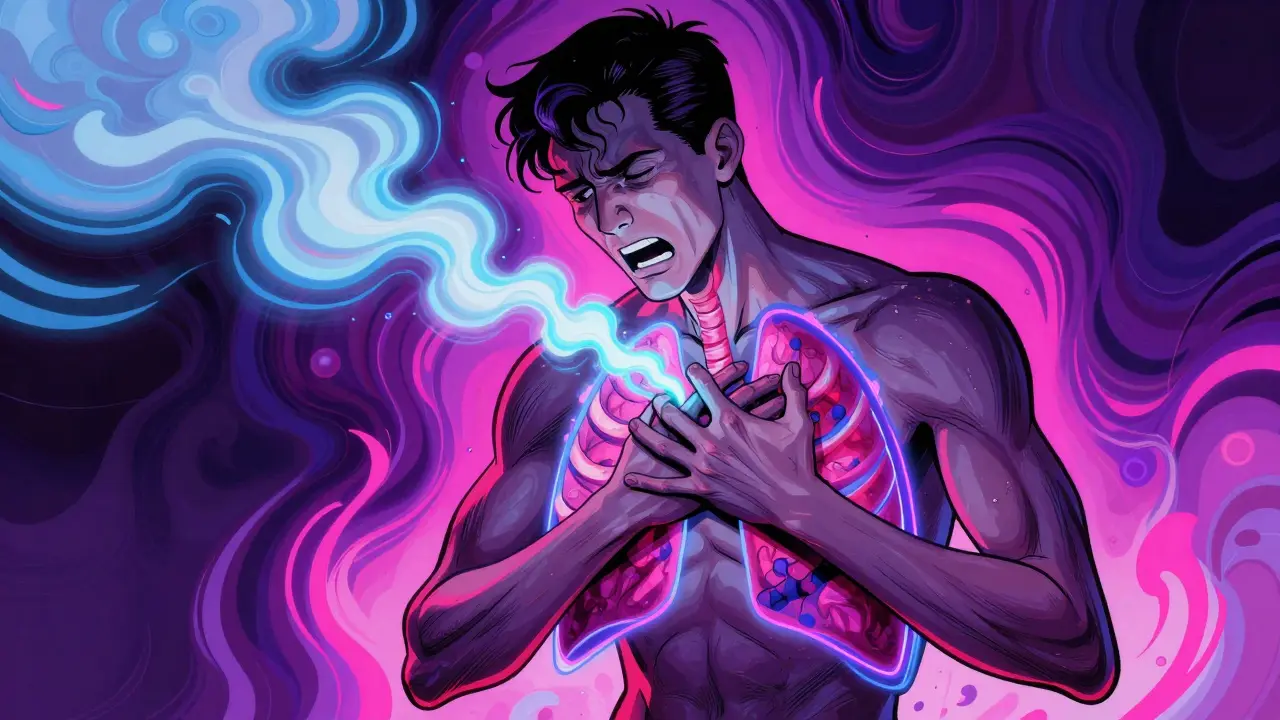
A pneumothorax, or collapsed lung, happens when air leaks out of the lung and gets trapped between the lung and the chest wall. This pocket of air pushes on the lung, making it hard to expand fully when you breathe. It doesn’t mean the lung bursts-it just can’t fill with air the way it should. You might hear it called a collapsed lung, but that’s misleading. The lung doesn’t disappear; it just shrinks partway because of the pressure from the trapped air.
This isn’t rare. About 1 in 5,000 people will have one in their lifetime, and it’s more common in tall, thin young men, especially those who smoke. The good news? Many small cases heal on their own. The bad news? If it gets worse, it can kill you in minutes. That’s why knowing the signs and acting fast matters more than almost anything else.
Key Symptoms You Can’t Ignore
The most common symptom is sudden, sharp chest pain on one side. It’s not dull or achy-it’s like a knife stabbing you when you take a deep breath or cough. About 9 out of 10 people with pneumothorax describe it this way. The pain often shoots up into the shoulder on the same side. That’s not random. It’s a known pattern doctors look for.
Shortness of breath follows close behind. If the collapse is small-under 15% of the lung-you might only feel it when climbing stairs. But if it’s bigger, over 30%, you’ll struggle to catch your breath even sitting still. Some people panic because they feel like they can’t get enough air, no matter how hard they try.
Other signs include a rapid heartbeat (over 130 beats per minute), low oxygen levels (below 90% on a pulse oximeter), and cool, clammy skin. These aren’t subtle. In tension pneumothorax-a life-threatening version-the windpipe can shift away from the affected side. But here’s the catch: that sign only shows up in about 1 in 3 cases. Waiting for it means waiting too long.
When It Becomes an Emergency
Not every pneumothorax needs surgery. But if you’re dizzy, blue around the lips, or can’t speak in full sentences, you’re in danger. That’s tension pneumothorax. Air keeps building up, squeezing the heart and major blood vessels. Blood can’t pump properly. Oxygen drops fast. Without immediate treatment, death can happen in under 10 minutes.
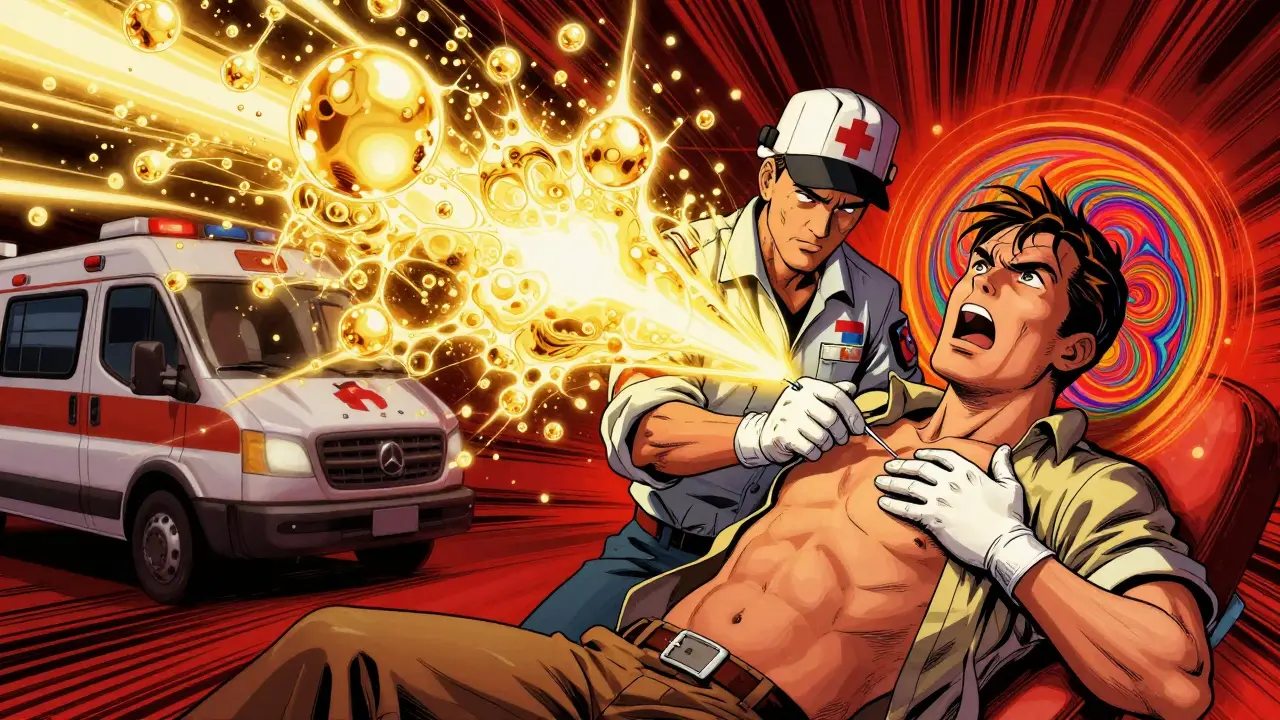
Emergency teams don’t wait for X-rays if someone looks unstable. If you have chest trauma, sudden breathlessness, and low blood pressure, they’ll stick a needle into your chest right away to let the air out. This isn’t risky-it’s lifesaving. The rule is simple: if you’re crashing, treat it before you test it.
Studies show that every 30-minute delay in treatment raises the risk of complications by over 7%. That’s why paramedics are trained to act on symptoms alone. You don’t need to see a scan to know this is urgent.
How Doctors Diagnose It
Most hospitals start with a chest X-ray. It catches about 9 out of 10 cases. But if you’re lying down after a car crash, it can miss up to half of them. That’s why many trauma centers now use ultrasound-called E-FAST-right at the bedside. A trained provider can spot air leaking from the lung with 94% accuracy in under a minute.
The key sign on ultrasound is the "lung point"-a spot where the lung still moves against the chest wall. When you see that, you know there’s air where it shouldn’t be. CT scans are more precise, showing even tiny leaks, but they take longer and expose you to radiation. They’re used when the X-ray is unclear or if the patient has other injuries.
Doctors also check your oxygen levels and run blood tests. Low oxygen and low carbon dioxide levels (respiratory alkalosis) are classic signs. They don’t confirm pneumothorax alone, but they help build the picture fast.
Treatment: What Happens Next
If the collapse is small-less than 2 cm on an X-ray-and you’re breathing okay, you might just go home with oxygen and a follow-up in a week. Supplemental oxygen helps the body reabsorb the trapped air faster. Without it, the air might take weeks to disappear. With it, resolution speeds up by over three times.
For larger collapses, they’ll try needle aspiration. A thin tube is inserted between the ribs to suck out the air. It works in about 65% of cases. If that fails, or if you have underlying lung disease like COPD, they’ll put in a chest tube. This is a bigger tube, connected to a drainage system. It stays in for a few days until the lung re-expands.
For people who’ve had it twice, surgery is often recommended. Video-assisted thoracoscopic surgery (VATS) involves small cuts, a camera, and sealing the leak with staples or removing damaged tissue. It cuts recurrence risk from 40% down to under 5%. Recovery takes a few days in the hospital, and most people go back to normal within a month.
What Happens After You Leave the Hospital
Don’t assume you’re safe just because the pain is gone. Recurrence is common. If you’re young and had a first-time pneumothorax, you have a 1 in 3 chance of it happening again within two years. If you smoke, that risk jumps to over 20 times higher. Quitting smoking is the single most effective way to prevent another episode-studies show a 77% drop in recurrence within a year after quitting.
Also, don’t fly for at least 2 to 3 weeks after the lung has fully healed. Changes in cabin pressure can cause the air to expand again. Scuba diving? Avoid it forever unless you’ve had surgery to prevent it. The pressure changes underwater make recurrence likely.
Follow-up X-rays are required. About 8% of people develop delayed complications if they don’t get checked. A simple scan at 4 to 6 weeks confirms the lung is fully expanded and the leak is sealed.
Who’s at Highest Risk?
Men under 40, especially those who are tall and thin, are most at risk for the "primary" type-meaning no other lung disease. Smoking is the biggest modifiable risk. Every pack-year increases your odds by over 20 times. People with COPD, emphysema, cystic fibrosis, or lung infections have "secondary" pneumothorax. Their risk is higher, and so is their death rate. One in six with secondary pneumothorax dies within a year, compared to 1 in 600 for primary cases.
Even if you’ve never smoked, genetics play a role. Some families have a history of spontaneous lung collapse. If you’ve had it once and a close relative had it too, your chance of recurrence is even higher.
What to Do If You Think It’s Happening
If you feel sudden, sharp chest pain and trouble breathing, don’t wait. Don’t call your GP. Don’t drive yourself to the ER. Call emergency services. Every second counts. While you wait, sit upright, stay calm, and try slow, shallow breaths. Don’t lie flat-it makes breathing harder.
Don’t try to "pop" your lung back by coughing hard or doing yoga twists. That’s dangerous. You’re not helping-you’re risking tension pneumothorax.
Remember: this isn’t something you can treat at home. Even if you’ve had it before, this time could be worse. Trust the symptoms. Act fast. Get help.
Can a collapsed lung heal on its own?
Yes, small pneumothoraces-under 2 cm on an X-ray-often resolve on their own, especially in healthy young people. Supplemental oxygen speeds up the process by helping the body reabsorb the trapped air. About 82% of these cases heal completely within two weeks without any procedure. But this only applies if you’re stable, breathing normally, and have no underlying lung disease. Larger collapses or symptoms like low oxygen require medical intervention.
Is pneumothorax the same as a pulmonary embolism?
No. A pulmonary embolism is a blood clot blocking an artery in the lung, while pneumothorax is air trapped outside the lung. Both cause sudden chest pain and shortness of breath, but their causes and treatments are completely different. A pulmonary embolism often comes with leg swelling or recent travel, while pneumothorax is linked to trauma, smoking, or tall body type. Doctors use imaging and blood tests to tell them apart.
Can you get pneumothorax from coughing too hard?
Yes, especially if you have weak spots in your lung tissue, called blebs. Forceful coughing, sneezing, or even vomiting can rupture one of these, letting air leak out. This is more common in tall, thin young adults with no other lung disease. It’s rare but possible. If you suddenly feel sharp chest pain after a violent cough, seek medical help immediately.
How long does it take to recover from a chest tube?
Most people stay in the hospital for 3 to 5 days after chest tube insertion. The tube stays in until the air leak stops and the lung is fully expanded, which usually takes 2 to 4 days. Pain is common but manageable with medication. Full recovery, including returning to normal activity, takes about 4 to 6 weeks. Heavy lifting and strenuous exercise should be avoided for at least a month.
Is it safe to fly after having a pneumothorax?
No-not until at least 2 to 3 weeks after full healing, confirmed by a follow-up chest X-ray. Cabin pressure during flight can cause any remaining air to expand, leading to another collapse. The FAA and other aviation medical authorities strictly advise against flying sooner. If you’ve had surgery to prevent recurrence, you may be cleared after doctor approval, but scuba diving is still not recommended.
Jenci Spradlin
January 9, 2026 AT 03:07just had this happen to me last year-tiny leak, no chest tube, just oxygen and chillin’ for two weeks. docs said i was lucky as hell. dont ignore that sharp pain, seriously. i thought it was a pulled muscle.
Gregory Clayton
January 9, 2026 AT 22:14of course the government won’t tell you this but smoking is the real enemy here. they want you hooked so they can bill you for the ER visits. quit or die slow, folks. this ain’t rocket science.
Aron Veldhuizen
January 11, 2026 AT 12:33There is an ontological paradox in the notion of a 'collapsed lung'-if the lung is not collapsed, but merely compressed by extraneous air, then is it truly collapsed, or merely constrained? The language we use to describe medical phenomena shapes our perception of their severity. This is not merely physiology-it is epistemology.
Furthermore, the normalization of emergency needle decompression without imaging raises ethical questions about the instrumentalization of the body under time pressure. We treat symptoms as truths, not indicators. And in doing so, we risk conflating intervention with understanding.
Is it possible that the real crisis is not the pneumothorax, but our collective inability to tolerate uncertainty in medical diagnosis? We demand certainty. We inject needles. We scan. We operate. But what if the body, in its quiet wisdom, sometimes just needs stillness?
Micheal Murdoch
January 13, 2026 AT 04:38Hey, if you’re reading this and you’re young and tall and maybe smoked once too often-this is your wake-up call, not a scare tactic. I’ve seen guys in their 20s walk into the ER like it’s just a bad cough, then crash five minutes later. It’s not dramatic-it’s real.
But here’s the thing: healing isn’t just about the lung. It’s about your whole life. Quitting smoking isn’t just ‘good for you.’ It’s the single biggest act of self-respect you’ll ever do. I’ve had patients who quit after one episode and never looked back. Their lungs came back. Their energy came back. Their lives came back.
And if you’re thinking, ‘I’ll just wait till next time,’-there won’t be a next time. Not if you’re lucky. And you don’t get to bet your life on luck.
Don’t wait for the pain to be ‘bad enough.’ It doesn’t work like that. By the time it’s bad enough, you’re already in the race against time. And you don’t win that race by hoping.
Take the oxygen. Get the scan. Quit the smoke. Talk to someone. You’re not weak for needing help-you’re wise for asking for it.
And if you’ve had this before? You’re not broken. You’re just overdue for a change. And that change? It’s not punishment. It’s freedom.
I’ve seen people come back from this. Not just alive-but alive in a way they hadn’t been in years. It’s not about fear. It’s about choice. And you still have one.
Jeffrey Hu
January 14, 2026 AT 04:32Actually, the 1 in 5,000 statistic is misleading-it’s higher in smokers and young males, closer to 1 in 500. Also, E-FAST has a false negative rate of 8-12% depending on operator skill, which most ER techs aren't trained for. And the lung point? It’s not 94% accurate if you’re obese or have subcutaneous emphysema. People think ultrasound is magic. It’s not. It’s a tool. Used wrong, it kills.
Also, 'supplemental oxygen speeds up reabsorption by three times'? Source? That’s from a 2003 study with 27 patients. Modern meta-analyses show 1.8x. Don’t quote outdated stats like gospel.
RAJAT KD
January 15, 2026 AT 07:31Smoking kills your lungs. Quit now. No excuses.
Matthew Maxwell
January 17, 2026 AT 00:32It is unconscionable that so many individuals continue to smoke while knowing the consequences. This is not a medical issue-it is a moral failure. The body is a temple, and to defile it with nicotine is an act of spiritual negligence. Those who suffer pneumothorax are not victims of biology-they are victims of their own willful disregard for divine health.
And yet, we still subsidize their care. We still treat them. We still enable them. Where is the accountability? Where is the shame?
Jacob Paterson
January 18, 2026 AT 08:59Oh wow, so if you’re tall, thin, and smoke-you get a free trip to the ER? How original. Next you’ll tell me breathing is bad if you’re not a yoga guru. At least I’m not the guy who thinks oxygen is a miracle cure. You know what speeds up healing? Not smoking. Not oxygen. Not scans. Just not being an idiot.
Also, ‘don’t fly for 2-3 weeks’? What, are you gonna ban us from airplanes now? Next they’ll say you can’t sneeze without a permit.
Johanna Baxter
January 19, 2026 AT 03:46i had this and i felt like i was dying and no one believed me until i passed out. now i cry every time i see someone smoke. it’s not just a habit-it’s a slow suicide and we all have to watch it happen. i hate that i’m the one who had to live through this. why didn’t anyone warn me? why did it take a near-death experience to make me quit? i’m still mad.
Jerian Lewis
January 19, 2026 AT 21:13Just… don’t ignore it. That’s all.
Patty Walters
January 21, 2026 AT 20:44my cousin had this after a coughing fit-no smoking, just tall and kinda unlucky. they did the needle thing, he was out in 2 days. oxygen helped a ton. just don’t panic. get checked. you’re not weak for needing help.
Phil Kemling
January 22, 2026 AT 05:22It’s strange how we treat the body like a machine that can be fixed, rather than a living system that seeks balance. The pneumothorax isn’t an error-it’s a signal. A whisper from the lung that something’s out of alignment. We rush to fix the air leak, but never ask why the bleb formed. Why now? Why here? Why this person?
Maybe it’s not just smoking. Maybe it’s stress. Maybe it’s silence. Maybe it’s the weight of living without ever being still.
We fix the lung. But do we ever fix the life?
tali murah
January 23, 2026 AT 17:17Oh, so now we’re giving out gold stars to people who almost died from smoking? Congratulations, you’re alive-now go be a responsible adult. Or don’t. We’ll just keep paying for your ER visits while you scroll TikTok with an oxygen cannula taped to your nose. Truly inspiring.
And let’s not forget the ‘tall, thin young men’-the demographic that thinks invincibility is genetic. Spoiler: it’s not. It’s a myth wrapped in caffeine and bad decisions.
Diana Stoyanova
January 23, 2026 AT 23:58Okay real talk-I was that guy. Tall, skinny, smoked a pack a day, thought I was invincible. Then one morning, I took a breath-and my chest felt like someone slammed a door on it. I thought it was heartburn. I waited three hours. Three. Hours. By the time I got to the ER, my oxygen was at 84%. They stuck a tube in me. I cried. I was 23.
Now? I don’t smoke. I don’t fly. I don’t scuba. I do yoga, not to ‘heal my soul’ but because it helps me breathe. And I talk to every kid I know who smokes. Not like a preachy mom. Like a friend who almost didn’t make it to 24.
It’s not about fear. It’s about love. Love for the air you get to breathe. Love for the next morning. Love for the fact that you’re still here.
And if you’re reading this and you’ve had this before? I see you. I know the fear. I know the guilt. I know the ‘what if I mess up again?’ But you’re not broken. You’re not cursed. You’re just human. And humans can change. I did. You can too.
One breath at a time. That’s all it takes.
And hey-if you need someone to talk to, DM me. I’m not a doctor. But I’m someone who’s been there. And I won’t judge you. I’ll just say: you’re not alone.
Jeffrey Hu
January 24, 2026 AT 10:05Actually, the 77% recurrence drop after quitting? That’s from a 2015 cohort study-but it only tracked 18 months. Long-term data shows it’s closer to 58% at 5 years. Also, ‘don’t fly for 2-3 weeks’? FAA says 3-6 weeks for spontaneous cases. You’re underestimating the risk. And VATS recurrence rates? 5% is optimistic-recent JAMA paper says 8-12% with incomplete pleurodesis. Don’t oversimplify.