Population Pharmacokinetics: Using Real-World Data to Prove Drug Equivalence
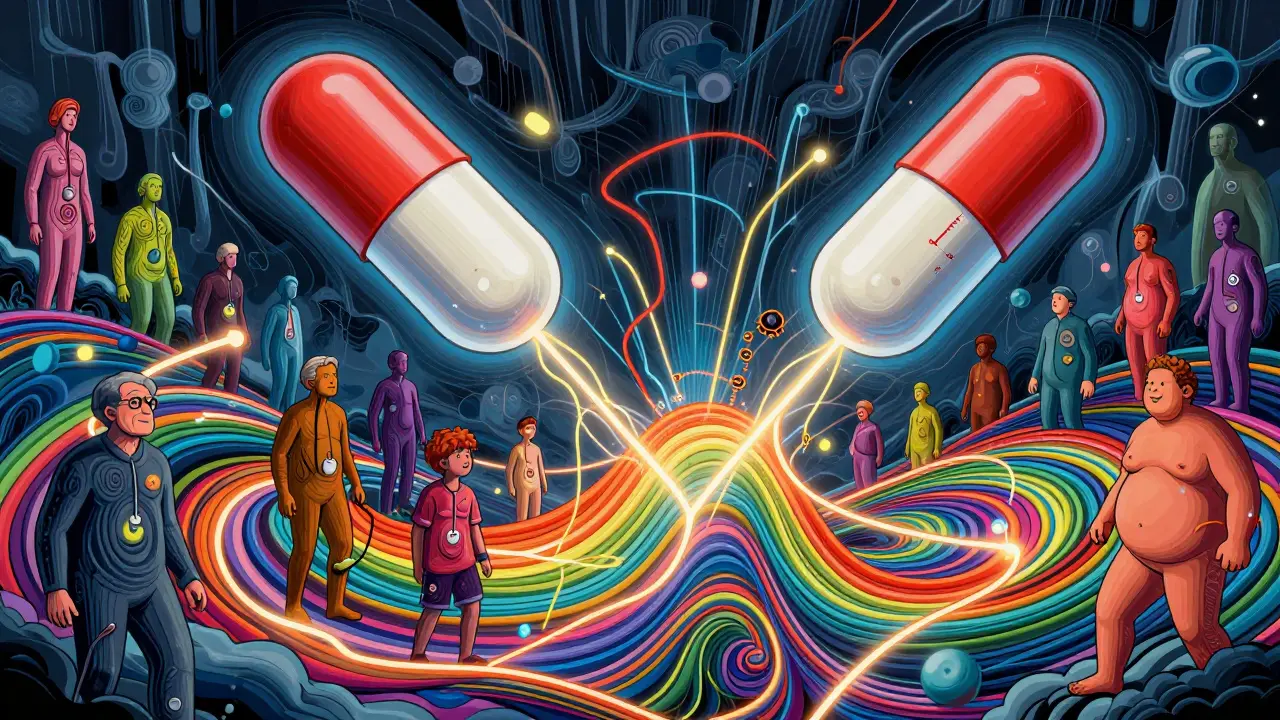
When two drugs are supposed to do the same thing, how do you prove they work the same way in real patients? Traditional bioequivalence studies used to rely on healthy volunteers, strict blood sampling schedules, and crossover designs. But those methods don’t reflect how drugs behave in real life - in elderly patients with kidney issues, children, or people taking five other medications. That’s where population pharmacokinetics comes in. It’s not about averages. It’s about understanding how every individual’s body handles a drug, and whether two versions - say, a brand-name pill and its generic copy - deliver the same exposure across the whole population.
Why Traditional Bioequivalence Falls Short
For decades, regulators accepted bioequivalence based on two numbers: AUC and Cmax. These measure how much of the drug gets into the bloodstream and how fast. If the 90% confidence interval for the ratio between two formulations fell between 80% and 125%, they were called equivalent. Simple. Clean. But it had a big flaw: it assumed everyone responded the same way. In reality, that’s not true. A 70-year-old with reduced kidney function might clear a drug 40% slower than a 30-year-old. Someone weighing 120 kg might need a higher dose than someone at 55 kg. Traditional studies, often done on 24-48 healthy adults, rarely captured these differences. And when you’re dealing with drugs that have a narrow therapeutic window - like warfarin, lithium, or some anti-seizure meds - even a 10% difference in exposure can mean the difference between a seizure and toxicity. That’s why regulators started looking for better tools. Population pharmacokinetics didn’t just offer an alternative - it offered a more honest picture of how drugs behave in the real world.What Is Population Pharmacokinetics (PopPK)?
Population pharmacokinetics is a statistical method that pulls together sparse, messy data from hundreds of patients - not just healthy volunteers - to build a model of how a drug moves through the body. Instead of taking 10 blood samples per person at fixed times, PopPK uses 2-4 samples per patient, collected during routine clinic visits. The data might come from Phase 1 trials, routine therapeutic drug monitoring, or even observational studies. The magic happens through nonlinear mixed-effects modeling. This approach separates two types of variability: between-subject variability (BSV) - how much people differ from each other - and residual unexplained variability (RUV) - the noise from measurement error or unmeasured factors. A good PopPK model can show you that 60% of the variation in drug clearance is due to kidney function, 20% to weight, and the rest to random chance. It’s not just about averages. It’s about predicting what happens to a 68-year-old woman with stage 3 kidney disease who weighs 58 kg and takes omeprazole. Can we be confident that her exposure to the drug will stay within safe limits? Can we say with confidence that a generic version will behave the same way? That’s what PopPK lets you answer.How PopPK Proves Equivalence
To prove equivalence using PopPK, you don’t just compare geometric mean ratios. You build two models: one for the reference drug and one for the test drug. Then you simulate thousands of virtual patients - each with different ages, weights, kidney functions - and see how the exposure profiles overlap. If the predicted concentration curves for both drugs fall within the same range across all simulated subgroups, you’ve shown population-level equivalence. Regulatory agencies like the FDA now accept this as valid evidence, especially when traditional studies are impractical. For example, testing a new formulation in neonates or patients with severe liver failure isn’t ethical or feasible with intensive sampling. PopPK makes it possible to evaluate equivalence without exposing vulnerable groups to unnecessary procedures. The FDA’s 2022 guidance explicitly says PopPK data can “alleviate the need for postmarketing requirements.” That’s huge. It means companies can get approval faster, with fewer trials, if they can show robust PopPK evidence. In fact, between 2017 and 2021, about 70% of new drug applications included PopPK analyses to support dosing across populations.
PopPK vs. Traditional Bioequivalence: When to Use Which
| Feature | Traditional Bioequivalence | Population Pharmacokinetics | |--------|-----------------------------|------------------------------| | Participants | 24-48 healthy volunteers | 40+ real patients (any condition) | | Sampling | 8-12 blood draws per person | 2-4 sparse samples per person | | Population | Homogeneous (young, healthy) | Diverse (age, organ function, weight, comorbidities) | | Equivalence Metric | 80-125% CI for AUC/Cmax | Simulated exposure overlap across subgroups | | Best For | Simple oral generics | Narrow therapeutic index drugs, special populations, biosimilars | | Regulatory Acceptance | Standard since 1980s | Increasingly accepted (FDA 2022, EMA 2014) | | Cost & Time | Lower upfront cost, longer trial duration | Higher upfront modeling cost, shorter clinical phase | PopPK doesn’t replace traditional studies - it complements them. For a simple immediate-release tablet, a standard crossover study still makes sense. But for a complex delivery system, a biosimilar, or a drug used mainly in elderly patients with multiple conditions, PopPK is the smarter tool.Tools, Training, and the Real-World Hurdles
Running a PopPK analysis isn’t something you do with Excel. It requires specialized software: NONMEM (used in 85% of FDA submissions), Monolix, or Phoenix NLME. These tools are powerful but steeped in complexity. Pharmacometricians - the specialists who build these models - typically need 18-24 months of hands-on training to become proficient enough for regulatory submissions. Even then, the biggest challenge isn’t the math - it’s the data. Many clinical trials weren’t designed with PopPK in mind. Sampling times are inconsistent. Covariates like lab values or concomitant meds aren’t recorded. A 2023 survey by the International Society of Pharmacometrics found that 65% of industry professionals cited “model validation and qualification” as their top obstacle. Without clear, standardized ways to validate a model, regulators sometimes ask for more data - delaying approvals. Another issue? Regional differences. The FDA is generally more open to PopPK-only equivalence claims than some EMA committees. A generics company in the U.S. might get approval based on PopPK alone. The same submission in Europe might still need a small traditional study. That inconsistency adds cost and complexity for global drug developers.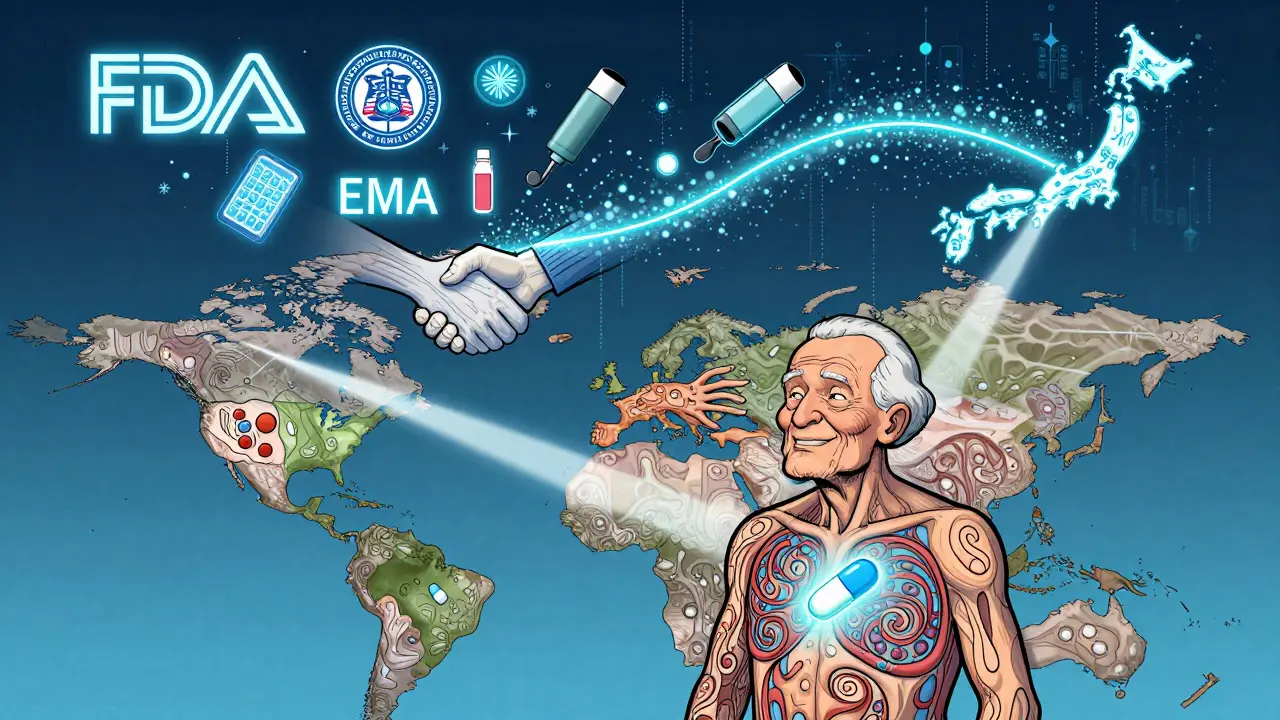
Where PopPK Is Making the Biggest Impact
The biggest wins are in areas where traditional methods fail:- Biosimilars: For large-molecule drugs like monoclonal antibodies, traditional bioequivalence studies are nearly impossible. PopPK is now the primary tool to prove similarity between a biosimilar and its reference product.
- Narrow therapeutic index drugs: Drugs like digoxin, cyclosporine, or theophylline need tight control. PopPK helps ensure that generic versions don’t cause toxicity or treatment failure in vulnerable patients.
- Special populations: Neonates, elderly, obese, or those with renal/hepatic impairment. PopPK lets you model exposure without unethical dosing.
- Complex formulations: Extended-release tablets, transdermal patches, or inhalers where absorption varies widely. PopPK can detect subtle differences in release patterns across subgroups.
The Future: Machine Learning and Global Standards
PopPK isn’t standing still. In early 2025, Nature published a study showing machine learning models could detect non-linear interactions between covariates - like how age and liver enzyme activity together affect drug clearance - that traditional models missed. These AI-enhanced models are starting to improve prediction accuracy, especially for drugs with complex, multi-factorial PK profiles. There’s also a push for standardization. The IQ Consortium’s Pharmacometrics Leadership Group is working on a consensus framework for model validation, with a draft expected by late 2025. This could finally bring clarity to what counts as a “valid” PopPK model - something regulators and industry have been asking for over a decade. Meanwhile, regulatory bodies are aligning. Japan’s PMDA adopted FDA-style PopPK guidance in 2020. The EMA is updating its guidelines to be more aligned with U.S. standards. The goal? Global harmonization. A single PopPK submission that works across the U.S., EU, and Japan would be a game-changer for global drug development.Final Thoughts: PopPK Isn’t Just a Tool - It’s a Mindset Shift
Population pharmacokinetics represents more than a technical upgrade. It’s a shift from asking “Do these drugs work the same on average?” to “Do they work the same for everyone?” It moves us away from one-size-fits-all dosing toward precision medicine. It gives regulators confidence that a generic drug won’t harm a frail elderly patient. It helps companies bring safer, more effective treatments to market faster. And it ensures that patients - not just healthy volunteers - are the real test subjects. The data is clear: PopPK is the direction of travel. The question isn’t whether it will become standard. It’s whether your organization is ready to use it well.Can population pharmacokinetics replace traditional bioequivalence studies entirely?
Not always. Traditional crossover studies still work best for simple, immediate-release oral generics in healthy adults. PopPK shines when you’re dealing with special populations, narrow therapeutic index drugs, or complex formulations where traditional studies are impractical or unethical. Regulators often accept PopPK as a standalone method in these cases, but for straightforward products, the old approach remains the gold standard.
How many patients do you need for a reliable PopPK analysis?
The FDA recommends at least 40 participants for robust parameter estimation. But the real number depends on the drug, the expected variability, and the covariates you’re studying. For example, if you’re looking at the effect of kidney function on clearance, you’ll need enough patients with a range of kidney function levels - ideally 10-15 with severe impairment. More data isn’t always better; it’s about having the right kind of data.
Is PopPK only used for generics?
No. While it’s widely used to prove bioequivalence of generics, PopPK is equally important for brand-name drugs. It helps determine optimal dosing for children, elderly patients, or those with organ impairment. It’s also critical for biosimilars, where traditional bioequivalence studies aren’t feasible. In fact, most new molecular entities now include PopPK analyses to support dosing recommendations across populations.
Why is NONMEM the industry standard for PopPK?
NONMEM has been around since 1980 and is the most validated tool for regulatory submissions. It’s highly flexible, supports complex models, and has decades of peer-reviewed literature backing its use. While newer tools like Monolix or Phoenix NLME are user-friendly and powerful, regulators still expect NONMEM outputs in formal submissions. About 85% of FDA PopPK analyses use it - not because it’s the easiest, but because it’s the most trusted.
Can PopPK be used to prove equivalence for biologics and biosimilars?
Yes - and it’s often the only practical way. Traditional bioequivalence studies rely on measuring small molecule concentrations in blood. Biologics are large proteins that can’t be measured the same way, and their PK is highly dependent on immune responses and target-mediated clearance. PopPK models can account for these complex dynamics and simulate exposure across diverse patient groups, making them essential for biosimilar approval. Most biosimilar applications today rely heavily on PopPK data.
Natasha Sandra
December 26, 2025 AT 07:44Erwin Asilom
December 28, 2025 AT 02:20sakshi nagpal
December 29, 2025 AT 20:07Sandeep Jain
December 31, 2025 AT 07:11roger dalomba
December 31, 2025 AT 11:21Brittany Fuhs
January 1, 2026 AT 02:24Sophia Daniels
January 2, 2026 AT 19:50Nikki Brown
January 4, 2026 AT 04:07Peter sullen
January 5, 2026 AT 04:39Steven Destiny
January 6, 2026 AT 18:55Fabio Raphael
January 6, 2026 AT 19:17Amy Lesleighter (Wales)
January 6, 2026 AT 20:29