The Beers Criteria: Potentially Inappropriate Medications for Seniors
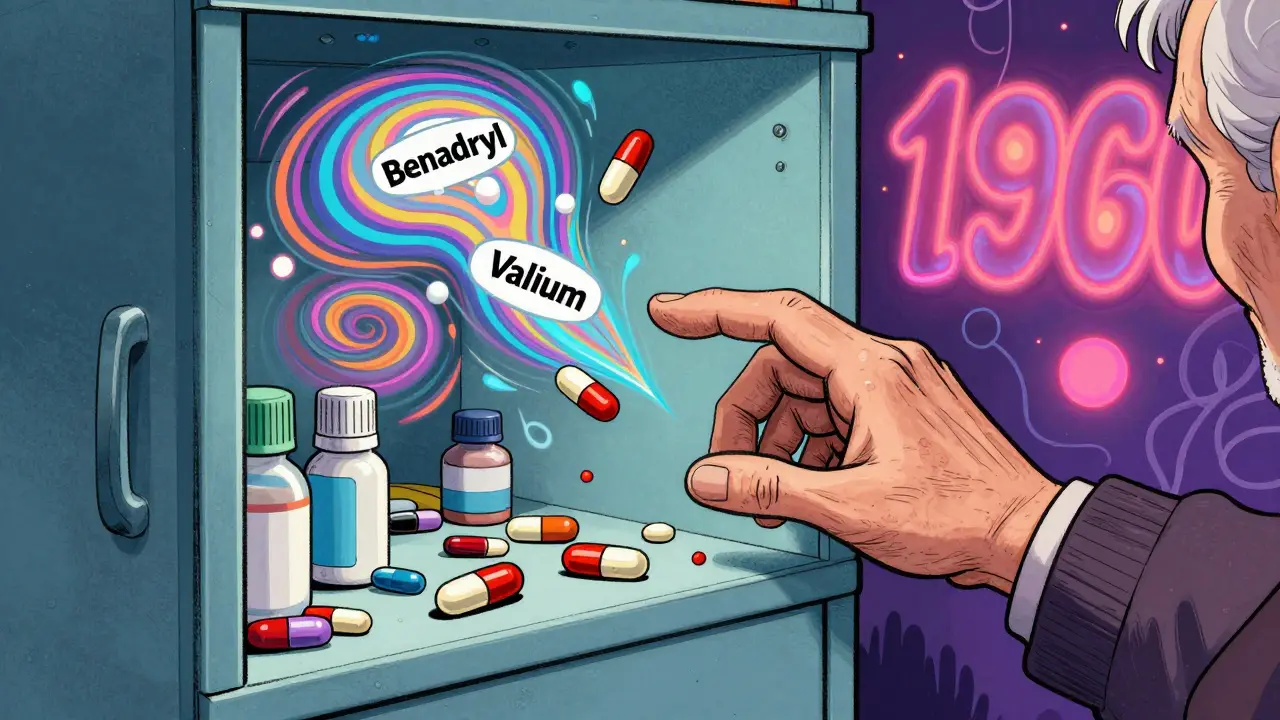
Every year, tens of thousands of older adults in the U.S. end up in the hospital because of medications that were supposed to help them-but ended up hurting them instead. It’s not always about taking too much. Sometimes, it’s about taking the wrong drug entirely. That’s where the Beers Criteria comes in. Developed by the American Geriatrics Society and updated every three years, it’s the most trusted guide doctors and pharmacists use to spot medications that are risky for people over 65. The latest version, released in May 2023, isn’t just a list of no-nos. It’s a practical tool that helps clinicians make smarter choices for aging bodies that react differently to drugs than younger ones.
What Exactly Is the Beers Criteria?
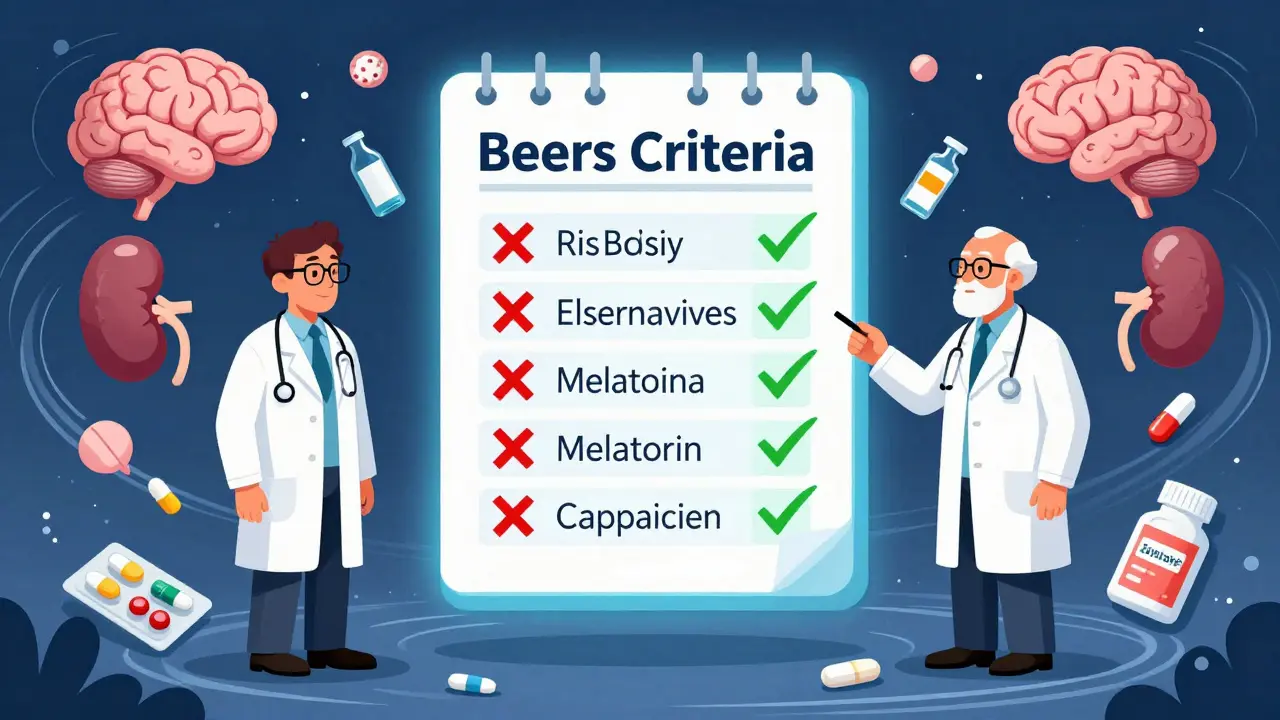
The Beers Criteria started in 1991 as a simple list of drugs to avoid in nursing homes. Today, it’s a detailed, evidence-based framework used in hospitals, clinics, and pharmacies across the country. The 2023 update reviewed over 7,300 studies and identified 134 medications or medication classes that should be avoided or used with extreme caution in seniors. This isn’t theoretical. It’s based on real-world outcomes: falls, confusion, kidney damage, internal bleeding, and even death.The list isn’t random. It’s broken into five clear categories:
- Drugs that are generally inappropriate for older adults, no matter their health condition
- Drugs that are risky for seniors with specific illnesses like heart failure or dementia
- Drugs that need extra caution-even if they’re not outright banned
- Drug combinations that create dangerous interactions
- Drugs that need dose changes if kidneys aren’t working well
For example, diphenhydramine-the active ingredient in Benadryl-is flagged because it blocks acetylcholine, a brain chemical. In older adults, that leads to brain fog, constipation, dry mouth, and even delirium. Yet it’s still widely prescribed for sleep or allergies. The same goes for long-acting benzodiazepines like diazepam (Valium), which increase fall risk by 50% in seniors. These aren’t rare cases. About 23% of older adults living at home are taking at least one Beers-listed medication.
Why Do These Drugs Still Get Prescribed?
You’d think once a drug is labeled dangerous for seniors, doctors would stop prescribing it. But the reality is messier. Many of these medications are cheap, familiar, and easy to write. A doctor under time pressure might reach for a familiar script instead of digging into alternatives. Sometimes, the patient asked for it. Other times, the problem started years ago, and no one ever revisited it.Take NSAIDs like ibuprofen or naproxen. They’re common for arthritis pain. But in someone with heart failure, kidney disease, or high blood pressure, they can cause fluid buildup, worsen heart function, or trigger acute kidney injury. The Beers Criteria says: avoid them. But many seniors still take them daily, unaware of the risk. And because they’re over-the-counter, patients don’t always tell their doctor they’re using them.
Another issue? Polypharmacy. Seniors often see multiple specialists. One prescribes a sleep aid. Another adds a painkiller. A third adds an anticholinergic for bladder control. Suddenly, they’re on five drugs that all slow down brain function. The Beers Criteria doesn’t just flag individual drugs-it warns about combinations. For example, mixing an anticholinergic with an opioid can cause severe constipation or even respiratory depression. These aren’t hypothetical risks. They show up in ERs every week.
How the Beers Criteria Compares to Other Tools
There are other guidelines out there, like STOPP/START, popular in Europe. STOPP/START looks at both inappropriate prescriptions and missed opportunities-like not prescribing a statin for someone with heart disease. The Beers Criteria, by contrast, focuses more narrowly on harmful drugs. That makes it simpler to use in electronic health records (EHRs). In the U.S., 87% of healthcare systems have Beers Criteria alerts built into their EHRs. Only 42% in Europe use STOPP/START.But simplicity has trade-offs. Beers can flag a drug as inappropriate even when it’s the right choice for a specific patient. For instance, antipsychotics like risperidone are listed as potentially inappropriate for dementia-related aggression. But in rare cases-when a patient is violent, hallucinating, or at risk of harming themselves-these drugs may be necessary. The Beers Criteria doesn’t say “never.” It says “use with caution.” That’s why it’s meant to be used with clinical judgment, not as a rigid rulebook.
Studies show that when clinics use the Beers Criteria properly, adverse drug events drop by 28%. That’s huge. One hospital in Minnesota cut hospital readmissions for seniors by 31% after integrating Beers alerts into their pharmacy review process. But the flip side? Alert fatigue. One primary care doctor in Texas told Medscape he gets an average of 12 Beers alerts per patient visit. Many are low-risk. He starts ignoring them. That’s why the 2023 update added a new feature: the Alternatives List.
The Alternatives List: What to Use Instead
The 2023 update didn’t just add more drugs to avoid. It added what to use instead. This is a game-changer. For example:- Instead of diphenhydramine for sleep: try melatonin (3 mg at bedtime) or cognitive behavioral therapy for insomnia (CBT-I)
- Instead of NSAIDs for joint pain: use topical capsaicin, physical therapy, or acetaminophen (within safe limits)
- Instead of long-acting benzodiazepines for anxiety: try SSRIs like sertraline or non-drug approaches like mindfulness training
- Instead of anticholinergic bladder meds like oxybutynin: consider pelvic floor exercises or intermittent catheterization
These aren’t just suggestions. They’re backed by clinical trials. The Alternatives List includes 147 options-both drug and non-drug-so doctors aren’t left hanging. Pharmacists are using this list during medication reviews to suggest safer switches. One pharmacy in Ohio reported a 40% increase in successful medication transitions after using the Alternatives List.
Who Uses the Beers Criteria-and Who Doesn’t?
The biggest users? Pharmacists and geriatricians. Eighty-nine percent of pharmacists say the Beers Criteria improves their ability to catch dangerous prescriptions. In Medicare Part D programs, it’s mandatory for patients taking eight or more medications. That means if you’re on a Medicare drug plan and you’re taking a lot of pills, your meds are being reviewed against Beers.But primary care doctors? Only 41% consistently use it, according to CDC data. Why? Lack of training. Many weren’t taught the Beers Criteria in medical school. Others say their EHR alerts are too noisy. Some worry about pushing back against patients who want their old meds. And cost plays a role too. Dr. Jerry Avorn from Harvard points out that Beers doesn’t address affordability. For a senior on a fixed income, a safer drug might cost $200 a month-while the Beers-listed one is $5. Sometimes, the cheaper option is chosen, even if it’s riskier.
That’s why the American Society of Consultant Pharmacists recommends combining Beers with the Medication Appropriateness Index, which looks at dose, duration, and clinical need. It’s not enough to say “don’t use this.” You need to ask: “Is this the right drug, at the right dose, for the right reason?”

How to Use the Beers Criteria as a Patient or Family Member
You don’t need to be a doctor to use this tool. If you or a loved one is over 65 and taking multiple medications, ask these questions:- Is any of this on the Beers Criteria list?
- Can any of these be stopped or replaced with something safer?
- Are we using the lowest effective dose?
- Have we checked for interactions between all these drugs?
- Are there non-drug options we’ve tried first?
The American Geriatrics Society offers a free mobile app and pocket guide with the full list. It’s updated quarterly. Download it. Bring it to your next appointment. Don’t wait for your doctor to bring it up. Many seniors don’t even know their meds are being reviewed. A 2023 survey found that 61% of older adults had never heard of the Beers Criteria.
Also, don’t assume OTC means safe. Antihistamines, sleep aids, and even some cough syrups can be dangerous. Keep a full list of everything you take-including vitamins, supplements, and herbal products-and review it with your pharmacist every six months.
The Future of Safe Prescribing for Seniors
The Beers Criteria is evolving. The 2026 update will expand kidney dosing guidance to cover every single drug cleared by the kidneys-something only 68% of current entries do. The AGS is also working with Google Health AI to build predictive models that flag seniors at highest risk for adverse drug events before they happen.Meanwhile, the pharmaceutical industry is responding. Over 23 new medications have been developed specifically to replace Beers-listed drugs. The market for senior-friendly meds is expected to hit $84 billion by 2027. And in 2024, Medicare made Beers Criteria reviews mandatory for dual-eligible patients-12.7 million people.
Still, challenges remain. In low-income countries, 63% of Beers-listed drugs have no affordable alternative. And in palliative care, symptom relief sometimes requires using drugs the criteria warns against. That’s why the Beers Criteria isn’t a one-size-fits-all rule. It’s a starting point. A conversation starter. A tool to help you ask the right questions.
Older adults deserve medications that heal, not harm. The Beers Criteria doesn’t promise perfection. But it gives us a clear path to safer care. And in a world where drug-related hospitalizations are a leading cause of injury in seniors, that’s not just helpful-it’s essential.
Is the Beers Criteria only for people in nursing homes?
No. The Beers Criteria applies to all adults aged 65 and older, whether they live at home, in assisted living, or in a nursing facility. It was originally developed for nursing homes, but research showed that seniors living independently face the same risks from inappropriate medications. Today, it’s used in outpatient clinics, pharmacies, and hospitals across the U.S. to guide prescribing for all older adults.
Can I still take a Beers-listed drug if my doctor says it’s necessary?
Yes. The Beers Criteria is not a ban-it’s a warning. Some medications on the list may still be appropriate in specific situations. For example, antipsychotics might be used short-term in a senior with severe dementia-related psychosis who hasn’t responded to other treatments. The key is that the decision is intentional, documented, and regularly reviewed. Always ask your doctor why they’re prescribing it and if there’s a safer alternative.
Are over-the-counter (OTC) drugs included in the Beers Criteria?
Yes. The 2023 update explicitly includes common OTC medications like diphenhydramine (Benadryl), chlorpheniramine, and doxylamine. These are often used for sleep or allergies but carry high anticholinergic risks for seniors. Many older adults don’t realize OTC drugs can be dangerous. Always check with your pharmacist before taking any OTC product, especially if you’re on other medications.
How often is the Beers Criteria updated?
The American Geriatrics Society updates the Beers Criteria every three years. The most recent version was published in May 2023. Updates are based on new clinical evidence, changes in drug availability, and feedback from healthcare providers. The 2023 version added 32 new medications and removed 18 based on new data. A free mobile app and pocket guide are available with quarterly updates to reflect minor changes.
Does Medicare require the Beers Criteria to be used?
Yes. As of 2024, Medicare Part D requires all prescription drug plans to use the Beers Criteria in medication therapy management programs for dual-eligible beneficiaries-people enrolled in both Medicare and Medicaid. This affects about 12.7 million Americans. Pharmacists working with these patients must review prescriptions against the Beers list and offer alternatives when appropriate.
Ayodeji Williams
January 8, 2026 AT 10:33Katrina Morris
January 9, 2026 AT 10:30Sai Ganesh
January 10, 2026 AT 05:51Paul Mason
January 10, 2026 AT 23:57Aparna karwande
January 12, 2026 AT 03:30Rachel Steward
January 13, 2026 AT 12:26Alex Danner
January 15, 2026 AT 03:47Jessie Ann Lambrecht
January 15, 2026 AT 22:40Vince Nairn
January 16, 2026 AT 06:11Kyle King
January 17, 2026 AT 16:53Kamlesh Chauhan
January 18, 2026 AT 14:35Jonathan Larson
January 19, 2026 AT 23:53Anthony Capunong
January 20, 2026 AT 10:01LALITA KUDIYA
January 21, 2026 AT 15:17