The Difference Between Medication Side Effects and Adverse Drug Reactions
Side Effect Checker
This tool helps you determine if your symptoms might be a side effect, adverse drug reaction, or unrelated event. Based on your inputs, it provides guidance on whether your symptoms are likely related to your medication.
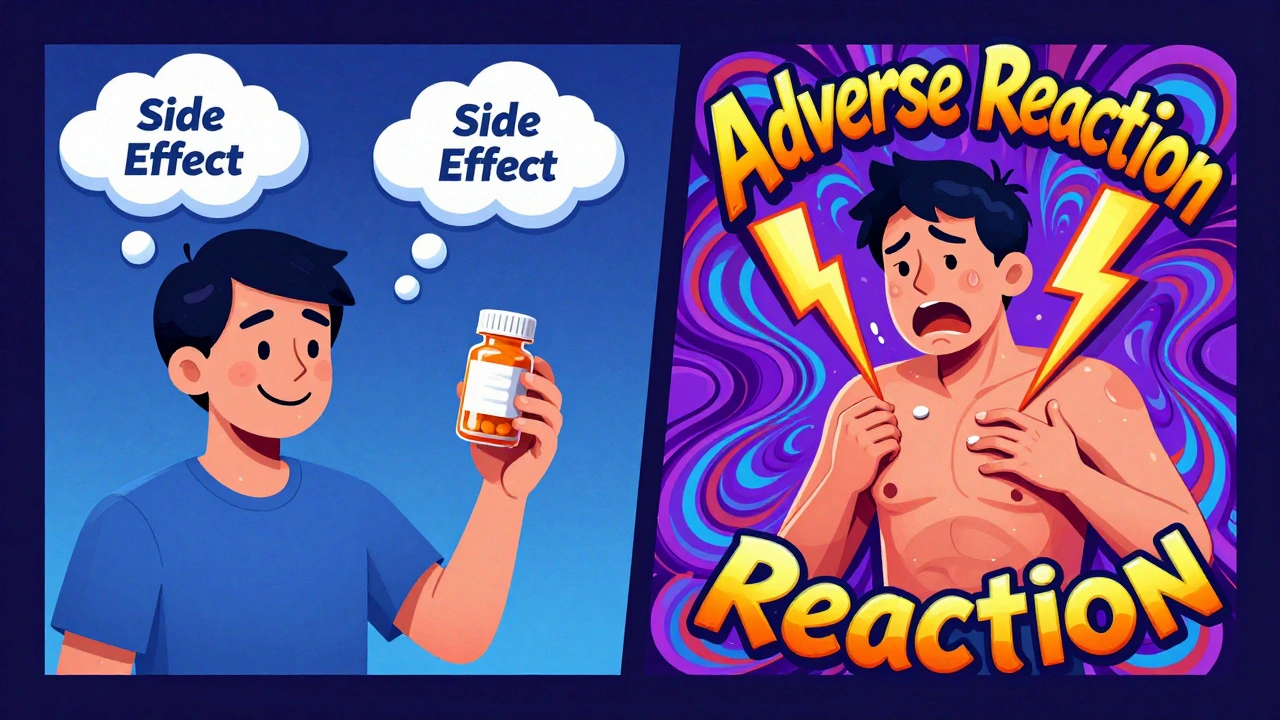
When you start a new medication, your doctor might mention possible side effects. But what if you get a headache, feel dizzy, or have an upset stomach? Is that a side effect-or something more serious? Many people, even some healthcare providers, use these terms interchangeably. But they’re not the same. Mixing them up can lead to unnecessary fear, wrong decisions, and even dangerous outcomes.
What Exactly Is a Side Effect?
A side effect is a known, predictable reaction to a drug that happens because of how the drug works in your body. It’s not a mistake. It’s not an accident. It’s built into the drug’s biology. For example, if you take an antihistamine for allergies, you might get drowsy. That’s a side effect. Why? Because antihistamines cross the blood-brain barrier and affect brain chemicals that control alertness. This isn’t rare. It’s expected. In fact, it’s so common that drug labels list it upfront. Side effects are usually dose-dependent. That means the higher the dose, the more likely and severe the effect. Take NSAIDs like ibuprofen. They reduce pain and inflammation by blocking certain enzymes-but those same enzymes protect your stomach lining. So, stomach upset or ulcers are common side effects. They’re not surprises. They’re documented, studied, and understood. The key to identifying a side effect? It shows up more often in people taking the drug than in people taking a placebo. In clinical trials, if 30% of people on a new blood pressure drug report dry cough, but only 5% of people on sugar pills do, that’s a confirmed side effect. It’s not random. It’s linked.What Counts as an Adverse Drug Reaction?
An adverse drug reaction (ADR) is any harmful, unintended response to a medication taken at normal doses. All side effects are ADRs-but not all ADRs are side effects. Think of it this way: side effects are a subset of ADRs. ADRs include both predictable side effects and unpredictable, rare reactions that aren’t tied to the drug’s main action. Type A reactions (the predictable kind) make up 80-85% of all ADRs. These are the side effects we just talked about: nausea from antibiotics, low blood sugar from insulin, or muscle pain from statins. They’re dose-related and usually not life-threatening. Type B reactions are different. They’re rare, unpredictable, and not tied to dosage. These are the scary ones. Think of a severe allergic reaction to penicillin-even if you’ve taken it before without issue. Or a life-threatening skin rash from carbamazepine in people with a specific gene (HLA-B*15:02). These aren’t side effects. They’re true adverse drug reactions. They happen because of your unique biology, not because the drug works the way it’s supposed to.What’s an Adverse Event? (And Why It’s Not the Same)
An adverse event is any negative health occurrence that happens after you take a drug-whether it’s caused by the drug or not. Let’s say you’re taking a new cholesterol drug and then get into a car accident two days later. The accident is an adverse event. But it’s not caused by the drug. Or maybe you start a new antidepressant and then come down with the flu a week later. The flu is an adverse event. But again, not linked to the medication. Adverse events are the raw data. They’re the first thing doctors and pharmacists notice. But they don’t mean the drug caused the problem. That’s why researchers use control groups in trials. If both the drug group and placebo group get headaches at similar rates, then headache isn’t a side effect-it’s just something that happens to people. A 2020 JAMA study on the blood thinner apixaban showed this clearly. Headaches happened in 12.3% of people on the drug and 11.8% on placebo. No real difference. But major bleeding? That happened in 2.1% of the drug group versus 0.5% in the placebo group. That’s a confirmed side effect-and a serious one.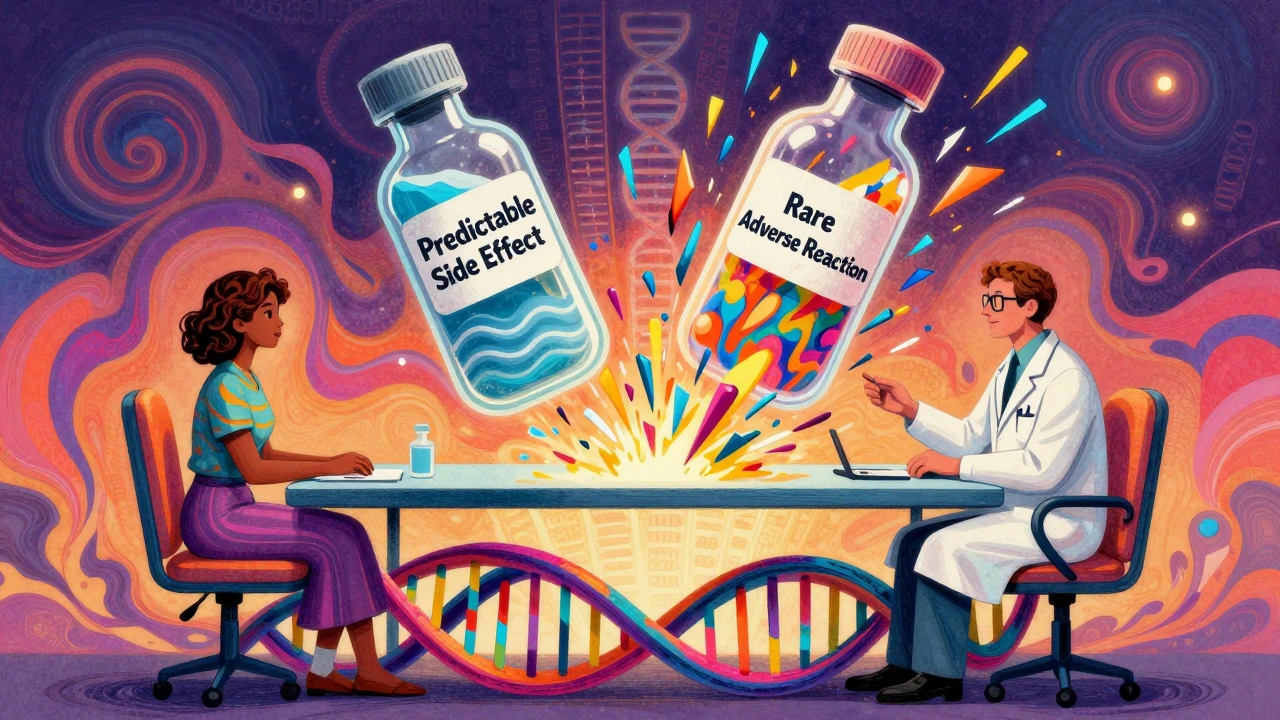
Why This Distinction Matters in Real Life
This isn’t just academic. Getting these terms wrong can cost lives. A 2021 study found that 43% of patients stopped taking life-saving medications because they thought every bad feeling was a side effect. One woman quit her blood thinner after getting a mild headache. She later had a stroke. The headache wasn’t related to the drug. But she didn’t know the difference. Doctors make the same mistake. A 2021 survey showed 68% of healthcare workers use “side effect” and “adverse reaction” interchangeably in medical notes. That causes problems. Insurance companies deny claims when documentation is vague. Pharmacists can’t track real safety signals. Regulators can’t spot dangerous drugs early. The FDA and global health agencies now require drug makers to separate these terms in labeling. Adverse events are all reports-good, bad, or random. Adverse reactions are only those with proven links. That’s why the FDA received over 1.2 million adverse event reports in 2023-but only 32% were confirmed as actual reactions.How Clinicians Tell the Difference
Good doctors use a simple three-step check:- Timing: Did the problem start soon after taking the drug? If symptoms appeared a week later, it’s less likely to be related.
- Dechallenge and rechallenge: If stopping the drug makes the symptom go away (dechallenge), and restarting it brings it back (rechallenge), that’s strong evidence of a true reaction.
- Known profiles: Does this symptom match what’s already documented for this drug? Tools like Micromedex or Lexicomp help answer this quickly.

Technology Is Making This Easier
New tools are helping cut through the noise. AI-powered pharmacovigilance systems now scan millions of patient records to spot patterns. One system used by ArisGlobal improved side effect detection accuracy by 41% in 2023. Genetic testing is also changing the game. A 2023 study in Nature Medicine found that people with a specific gene variant (CYP2C19) had nearly nine times the risk of serious bleeding from clopidogrel-a drug used after heart attacks. That’s not a random side effect. It’s a genetic predisposition. Knowing this lets doctors choose safer alternatives before the problem even starts.What You Should Do
If you’re on medication:- Don’t assume every new symptom is caused by the drug.
- Track when symptoms started and how they change with dose.
- Ask your doctor: “Is this a known side effect-or could it be something else?”
- Never stop a prescribed medication without talking to your provider.
- Learn the difference between a side effect and a coincidence.
- Help your loved one report symptoms accurately-not just “I feel bad,” but “I got a headache two days after starting the pill.”
The Bigger Picture
The line between side effect and adverse reaction isn’t just a technical detail. It’s a safety line. When we confuse the two, we risk overreacting to harmless symptoms or underreacting to real dangers. Regulators, hospitals, and drug companies are slowly getting better at this. But the biggest change will come from patients and providers who understand the difference. When you know that a side effect is predictable and often manageable-and that not every bad feeling is the drug’s fault-you make smarter, safer choices. The goal isn’t to scare you off medication. It’s to help you use it wisely.Are side effects the same as adverse drug reactions?
No. All side effects are adverse drug reactions, but not all adverse drug reactions are side effects. Side effects are predictable, dose-related, and directly tied to the drug’s mechanism of action. Adverse drug reactions include side effects plus rare, unpredictable reactions like allergic responses or genetic sensitivities that aren’t linked to dosage.
Can a side effect be dangerous?
Yes. Some side effects can be serious-even life-threatening. For example, statins can cause muscle damage (rhabdomyolysis), and blood thinners can cause major bleeding. What makes them side effects is that they’re known, documented, and often dose-dependent. The key is recognizing them early and managing them, not avoiding the drug altogether.
If I get a headache after taking a pill, is that a side effect?
Not necessarily. Headaches are common and happen for many reasons. If people taking the same drug and those taking a placebo report headaches at similar rates, then it’s likely not a side effect. Only when the drug group has significantly more headaches than the placebo group is it considered a confirmed side effect.
Why do drug labels list so many side effects?
Drug labels list all possible side effects-whether common or rare-because regulators require full transparency. But that doesn’t mean you’ll get them all. Most people only experience one or two, if any. The list is there so you know what to watch for, not to scare you away from a needed medication.
Can adverse events be prevented?
Some can. Adverse events caused by medication errors (wrong dose, wrong drug) are preventable. But many adverse events are just coincidences-like catching a cold while on a new pill. The goal isn’t to prevent all adverse events, but to identify which ones are actually caused by the drug (adverse reactions) so you can respond appropriately.
How do I report a side effect or adverse reaction?
In the U.S., report suspected adverse reactions to the FDA’s MedWatch program using Form 3500. If you’re unsure whether it’s a side effect or just an adverse event, report it anyway. The FDA’s system is designed to filter out coincidences and find real patterns. Your report helps improve drug safety for everyone.
James Kerr
December 3, 2025 AT 05:42Man, this is such a needed post. I used to panic every time I got a headache after my blood pressure med, but now I know it’s probably just my brain being weird and not the drug. Thanks for clarifying!
Cindy Lopez
December 4, 2025 AT 15:37While the distinction between side effects and adverse reactions is technically accurate, the article’s reliance on clinical jargon undermines its accessibility. The term 'dechallenge and rechallenge' is not colloquial, nor is it intuitive to laypersons. Precision in terminology should not come at the expense of comprehension.
shalini vaishnav
December 4, 2025 AT 17:11In India, we’ve known this for decades. Our Ayurvedic practitioners never confuse symptoms with drug reactions-they observe the whole body, not just the pill. Meanwhile, Western medicine still clings to its reductionist models and calls it science. This article is just a slow catch-up.
vinoth kumar
December 6, 2025 AT 03:37Really appreciate this breakdown. I work in a pharmacy and see people stop meds all the time because they think a stomach ache means the drug is 'poisoning' them. This kind of clarity saves lives. We need more posts like this!
Gene Linetsky
December 6, 2025 AT 15:39They’re lying. The FDA knows 90% of these 'side effects' are manufactured by Big Pharma to scare people into buying more drugs. That headache? Probably the placebo effect. But they want you to think it’s the drug so you keep taking it. The real danger is the system, not the medicine.
Ignacio Pacheco
December 6, 2025 AT 18:20So let me get this straight: if I take a pill and then my cat sneezes, that’s an 'adverse event.' But if I take the same pill and my cat dies? Still an adverse event unless I can prove the pill did it. Sounds like a legal loophole dressed up as medicine.
Gavin Boyne
December 7, 2025 AT 05:06There’s a philosophical truth here: we treat drugs like magic bullets, but biology is messy. A side effect isn’t a flaw-it’s a signature. The body doesn’t obey our tidy categories. We label things to feel in control, but the real wisdom is knowing when to step back and let the system speak. That’s not science. That’s humility.
Rashi Taliyan
December 8, 2025 AT 01:39I took metformin for PCOS and got diarrhea for three weeks. I thought it was normal-until my aunt said, 'That’s not a side effect, that’s your body screaming.' I switched meds. Never looked back. Thank you for validating what women’s bodies tell us when no one listens.
Kara Bysterbusch
December 9, 2025 AT 09:46Bravo. This is the kind of nuanced, evidence-based clarity that ought to be standard in public health discourse. The conflation of 'adverse event' with 'adverse reaction' is not merely semantic-it is a systemic failure of communication that endangers patient autonomy and clinical efficacy. I commend the author for elevating the dialogue with precision, grace, and unwavering fidelity to scientific integrity.